University of Tokyo science mathematics 2018: problems and solutions
These solutions are this site's independent explanations, not official University of Tokyo answers. The original author judged the first four problems comparatively accessible, with more geometric work in the last two. Difficulty ratings and score suggestions reflect that historical assessment. See the past-paper review.
Problem 1: a trigonometric function's variation and limits
For , study the increase and decrease of
and find its limits as and .
Solution
Differentiate and factor:
Put . Then and on , so . Thus is negative before , zero there, and positive afterward. The minimum is .
The sine limit gives
For the other endpoint, put :
Hence the second limit is . The divergent numerator term is , which must not be replaced by . The useful calculus habit is to differentiate a sign-controlling factor when its sign is not immediately clear; see standard limits.
Problem 2: binomial coefficients divided by factorials
Define
- For , write in lowest terms, with positive integer denominator , and find .
- Find all for which is an integer.
Part 1
Factorial cancellation gives
Euclid's algorithm gives . Since is even and is odd, the reduced form is
Part 2
We have and . For ,
Every factor in the product numerator is odd, while the denominator includes . No factor of two in that denominator can cancel with the odd numerator. Thus the result cannot be an integer. Therefore
A nonintegral last ratio alone would not prove a nonintegral product; the uncancelled factor of two is the decisive argument.
Problem 3: the area swept by two moving points
Let C be the part of with . Let , , and . As P moves on C and Q moves on segment OA, define R by
Find the area of R's region, and its limits as and .
Fix the height
Write , , and , . Then
Fix . The possible are , so the possible x-values are the union of the intervals
They overlap exactly when . Thus their union has length
restricted in both cases to . Every point of each interval occurs because ranges over a full interval; hence this is the actual cross-section, not just an outer bound.
Integrate the union length
The switching height lies within the vertical range exactly when . Therefore
For , the intervals overlap at every height, so
Consequently,
The plus sign in the second expression is essential; the source's minus sign would make the formulas disagree at . Both correct expressions give there.
The limits are
Geometrically, when is small, most horizontal sections are two separate intervals of length , spread over height ; their overlap correction tends to zero, giving area two. When is large, the sections overlap throughout and have base length , height , and a vanishing width correction, giving area one. These are checks on the calculation rather than substitutes for its interval analysis. The swept-region guide develops the same coordinate-fixing method.
Problem 4: three cubic roots with the middle root above one
Let and . Find and sketch all such that has three distinct real roots , with .
Solution
Since , the local maximum is and the local minimum is . Three distinct roots exist exactly when
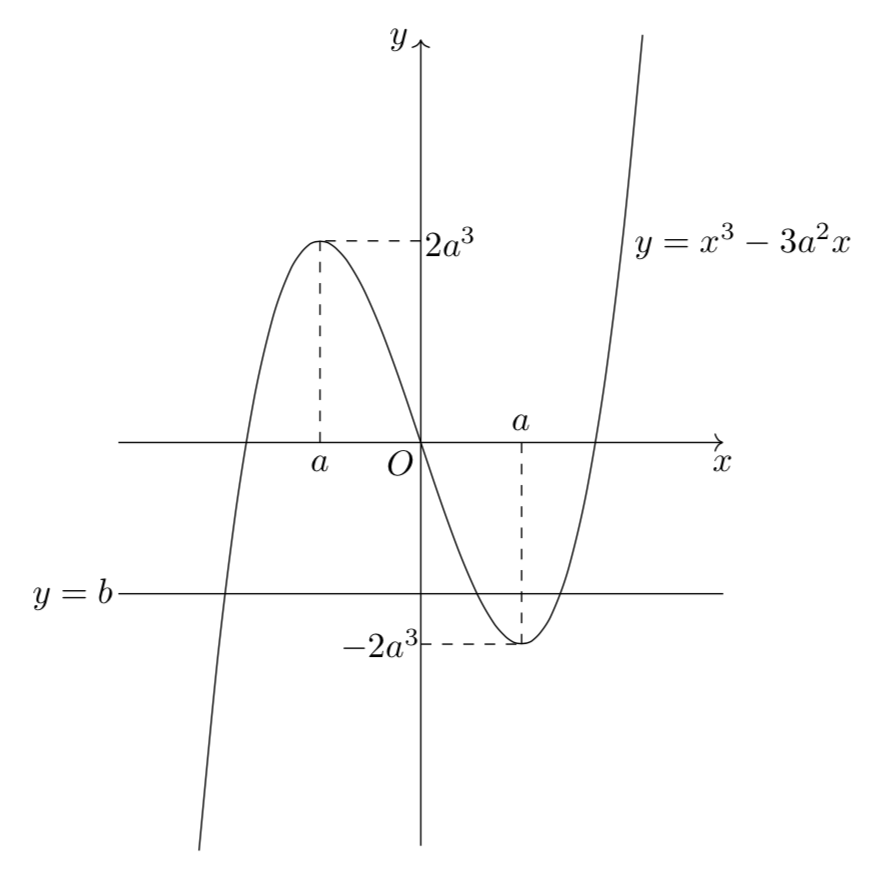
The middle root lies on the strictly decreasing branch . It is greater than one exactly when and , or .
For , the latter upper bound is already below . Also , because their difference is . Hence
All boundaries are excluded.

Separating the horizontal level is the key simplification. See root placement and parameter separation.
Problem 5: reflect a point in a circle tangent
Let C be the unit circle centered at zero in the complex plane. Take , with , and reflect in the tangent to C at P to obtain . Put .
- Express and as polynomials in , and calculate .
- Find the locus of when and .
Part 1: translate reflection into two conditions
The vector from A to Q is normal to the tangent, hence parallel to OP. Thus for a nonzero real . Also P is equidistant from A and Q:
Squaring and using gives
Therefore , and
This is the actual reflection: the tangent's normal direction gives the perpendicular relation, and equal distances place its midpoint on the tangent. Since , the reflection is nontrivial.
Now , so . As ,
Finally,
Part 2: obtain the parabola and its exact interval
Write . The last identity becomes
To determine which part is attained, write with . Using ,
As increases from to , its cotangent decreases continuously from to . Therefore every value of in occurs, giving
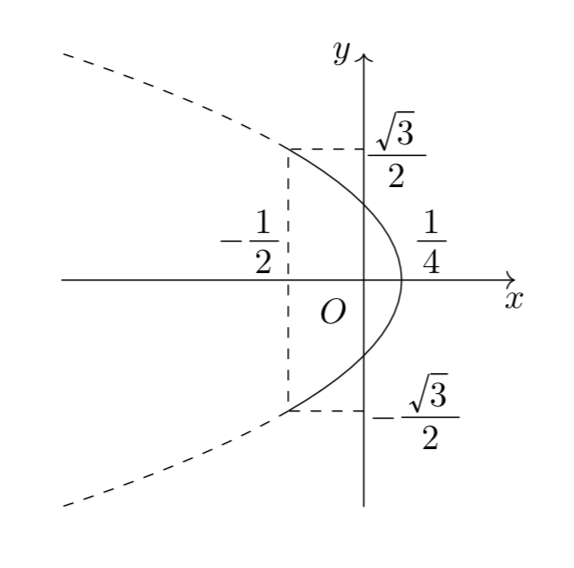
The equality of distances also identifies a parabola with focus zero and directrix , but the parameter restriction is still needed to select this finite arc.
Problem 6: a union of three rounded tubes
Let
For a moving point on OA, AB, or BC, take the closed ball of radius centered at that point. The three swept solids are , respectively.
- Find the heights for which the plane meets both and , and describe their sections in that plane.
- Find the condition on for .
- Under that condition, let and . Express the volume of using S and T.
- Calculate S, T, and the union volume.
Part 1: two capsule sections
The planes meeting have , while those meeting have . Their common range is
Put
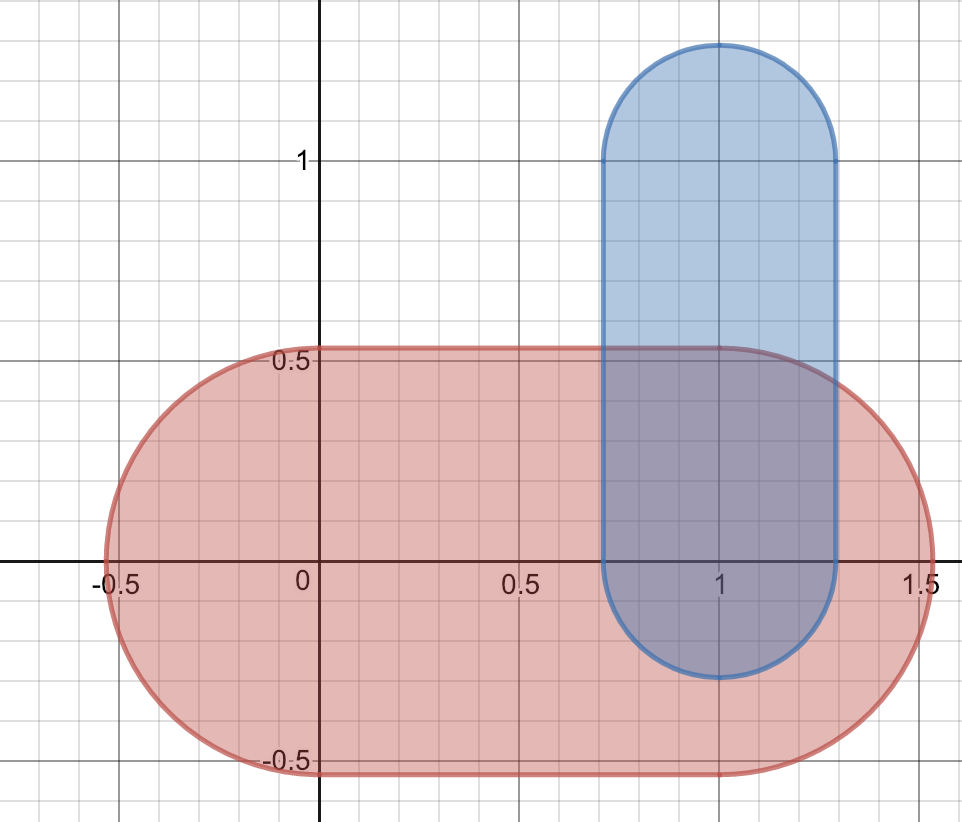
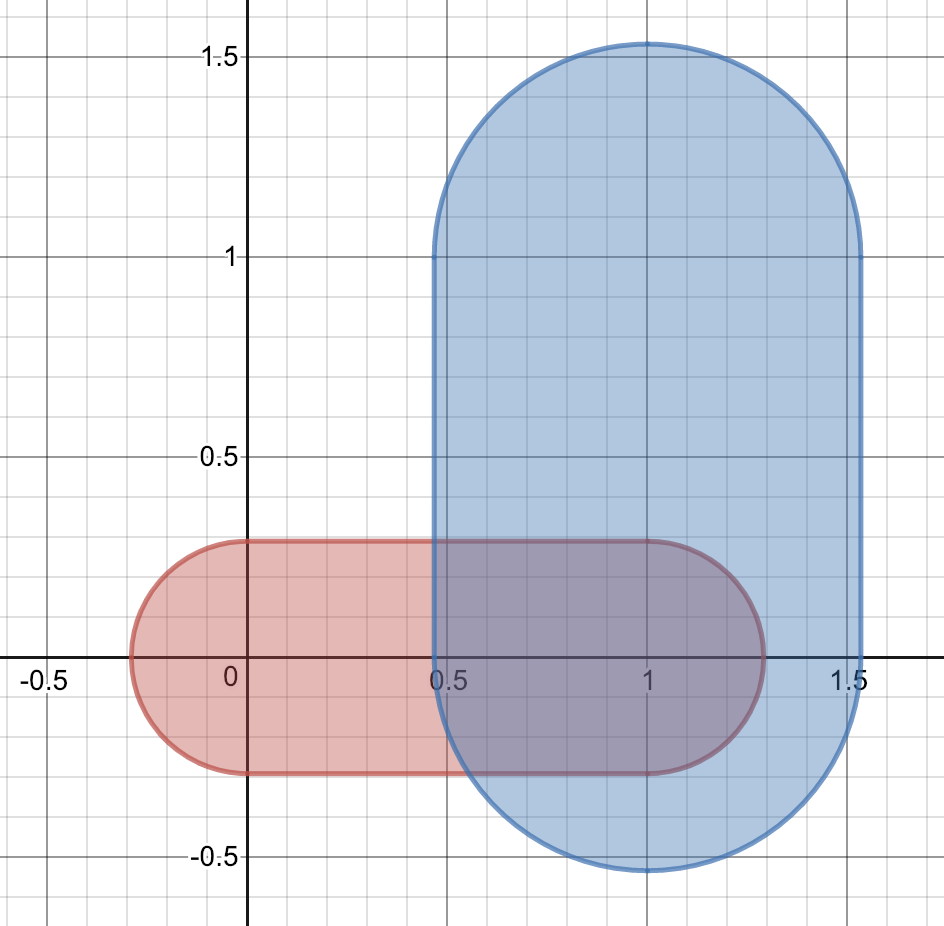
In the xz-plane at that height, the section of is the closed capsule of radius about the horizontal segment from to . The section of is the closed capsule of radius about the vertical segment from to .
For , ; for the inequality reverses. The illustrations show the corresponding two shapes.
Part 2: include the intersection in the middle tube
Throughout the relevant height range, , so the section of is the disk .
The farthest points of the two-capsule intersection from include , at squared distance . This is also the maximum. Indeed, in the upper-left quadrant relative to , the capsule constraints give and ; in the remaining quadrants one of the radius- or radius- end disks bounds the distance by a smaller value. The corner lies in both rectangular portions because .
Thus inclusion of the whole section is equivalent to
The allowed interval contains , where the right side has minimum . Therefore
Part 3: inclusion–exclusion
The three individual volumes equal S, and the two adjacent intersections have volume T by congruence. The nonadjacent intersection equals the triple intersection under the inclusion condition. Those two terms cancel in inclusion–exclusion:
The source has S and T reversed in one displayed answer; the correct expression agrees with its final calculation.
Part 4: calculate the two building blocks
A radius-r ball swept along a unit segment forms a cylinder of radius r and length one, plus two hemispherical caps. Hence
For the adjacent intersection , cut at , . Put . The intersection consists of a square of side in the upper-left quadrant about A and three quarter-disks of radius in the other quadrants. The segment lengths are one and , so these pieces lie within the relevant tube sections.
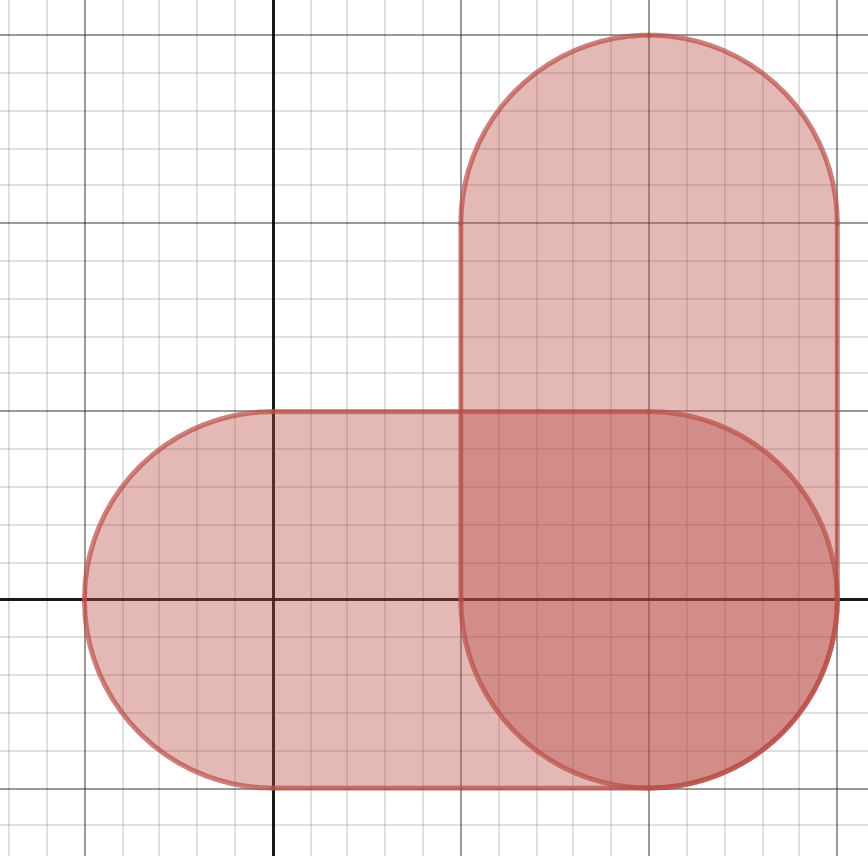
Consequently,
The final volume is
Using unit-radius cap volumes would be incorrect: all radius powers must remain in S and T.
Reviewing this paper
The original author's historical practice targets were approximately 90–100 points for the strongest medical-track candidates and 70–80 for other science-track candidates. These are personal strategy suggestions, not official cutoffs. The main review themes are controlling derivative signs, finding uncancelled prime factors, integrating actual unions of intervals, locating a middle root on a monotone branch, proving a locus is fully attained, and applying inclusion–exclusion to solids.
Related articles
- Equating rational and irrational parts: proof and worked problems
- How to simplify nested square roots, with three worked examples
- Conditional probability: the formula, information protocols, and worked examples
- Integration by parts: formulas, proof, and four useful patterns
- Triple-angle identities: remember, derive, and apply them
About the author
Koki Saito
Physician and graduate of the University of Tokyo Faculty of Medicine. Drawing on his entrance-exam experience, he explains how to choose mathematical methods and construct complete solutions.
Full profile →Have a question or spotted an error? Contact us.