Find a region swept by a moving line: slices and inverse membership
Two ways to describe a moving region
When a curve moves with a parameter, the region it sweeps out is the union of all its positions. You can find that union from either direction:
- Slices: fix an -coordinate and find every possible -coordinate there.
- Inverse membership: fix a candidate point and ask whether at least one allowed parameter makes the curve pass through it.
In Japanese entrance-exam mathematics these are often called the direct-image and inverse-image methods. The names describe the direction of the reasoning. Here we will use “slicing” and “membership” to make the operations explicit.
Both are ways of answering the same question:
A moving-line problem
Problem. As the real parameter varies over , find the region swept out by the line
The word “region” is important. We need every point lying on at least one of these lines, not merely their intersections or an envelope curve.

Method 1: find the vertical slices
Fix x and vary the parameter
For a fixed real , regard the height as a function of :
This is an upward-opening parabola in the variable . Its endpoint values are
and its vertex occurs at .
The parameter interval is closed, so the maximum and minimum are attained. Also, is continuous: as varies between two values, every intermediate height is reached. Thus the vertical slice is the entire interval between the minimum and maximum, with no gaps.
Find the lower boundary
There are three cases, depending on the vertex location:
- If , then . The minimum on the allowed interval is at , giving .
- If , the vertex lies in . The minimum is .
- If , then . The minimum is at , giving .
Therefore
Find the upper boundary
An upward-opening quadratic reaches its maximum on a closed interval at an endpoint. Compare the two endpoint values:
They are equal at . Hence
At , both expressions give the same value, so their overlapping conditions cause no ambiguity.
State the complete region
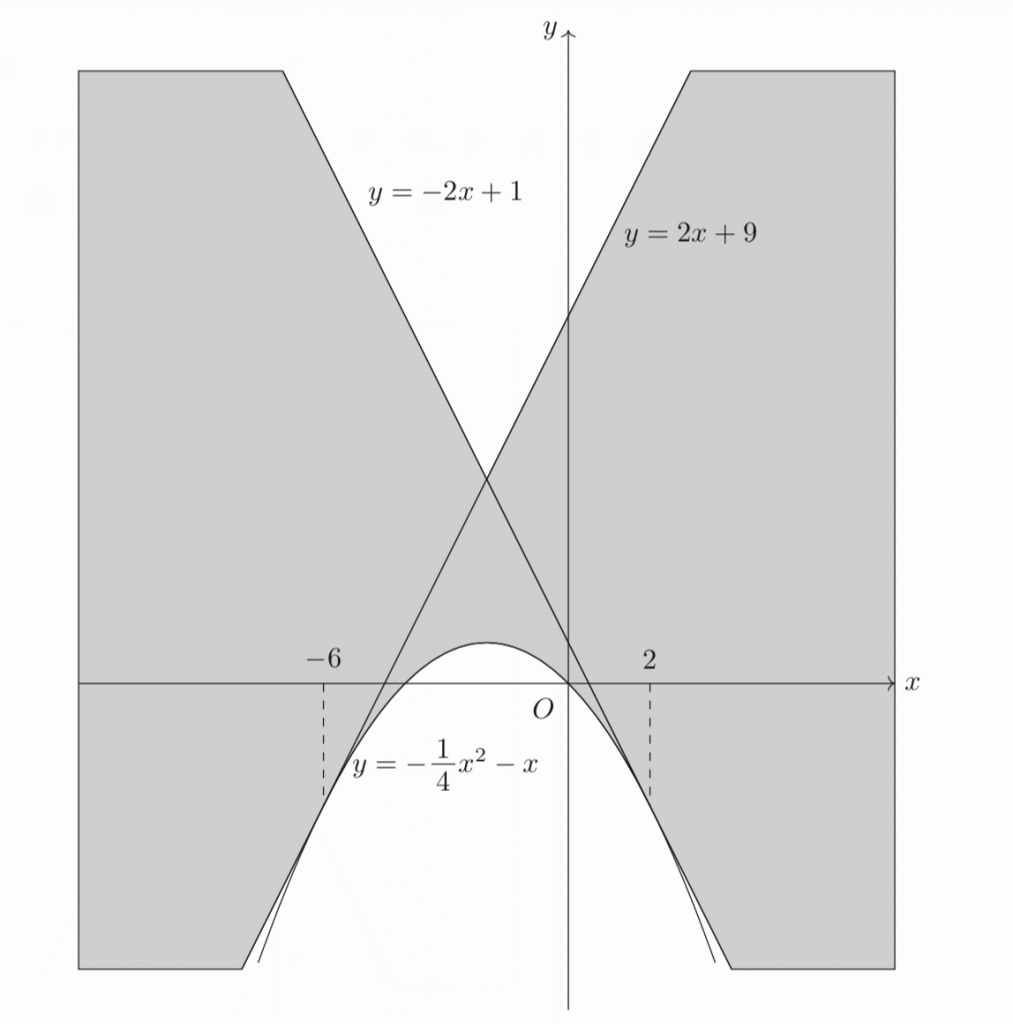
The required region is
Equivalently, split it into four ranges:
- : .
- : .
- : .
- : .
Every boundary is included. The endpoint lines correspond to allowed values and , and the parabolic boundary is reached at when that value is allowed.
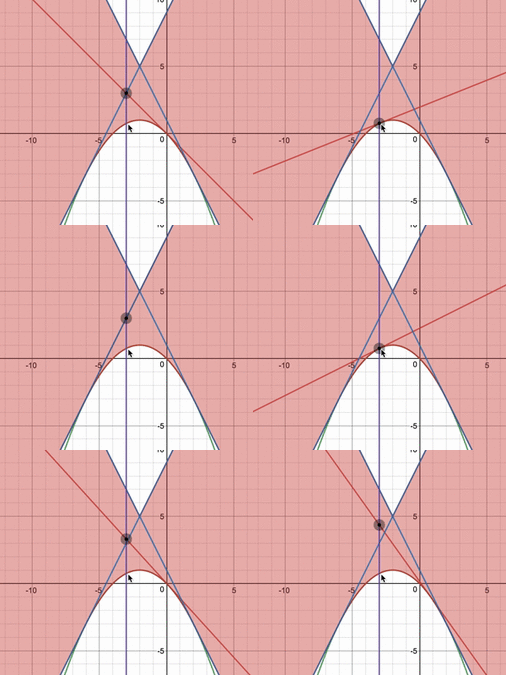
Visualize two slices
At , the minimum occurs at :
So the slice is .
At , the height is simply . Its range for is .
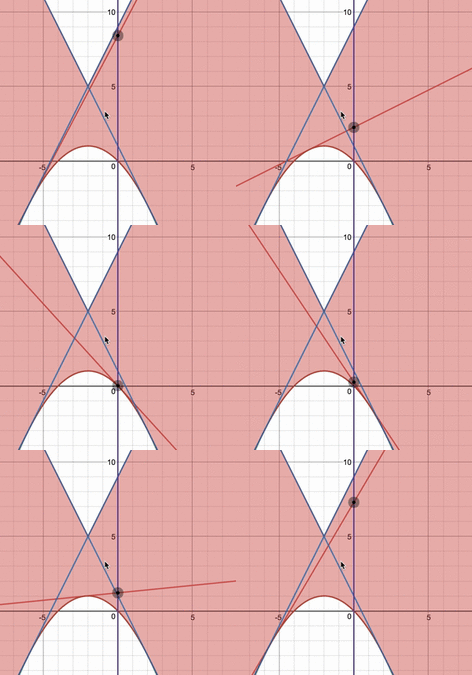
A moving line is unbounded, so these slices exist for every real . The closed parameter interval does not make the swept region bounded in the plane.
Method 2: test whether a point can be reached
Regard the equation as an equation for a
Fix a candidate point . It belongs to the swept region exactly when
has at least one root in .
The discriminant alone is insufficient: it only tells us whether real parameter values exist, not whether they are allowed.
Derive the membership conditions
Set
The endpoint values, vertex, and discriminant are
Because this quadratic opens upward, a root lies in if either of the following holds:
- The endpoint values have opposite signs, or one is zero:
- Both endpoint values are nonnegative, the vertex lies within the interval, and the minimum value is nonpositive:
The second case includes tangency. If both endpoint values are negative, convexity puts the entire graph below zero between them, so there is no root in the interval.
Substitution gives the complete membership condition:
or all four conditions
The first condition fills the strip between the two endpoint lines. The second fills the additional portion above the parabolic envelope where the vertex parameter is allowed. Together they describe exactly the same region as the slicing answer.
Check a point inside the region
For , the parameter equation becomes
The value lies in the allowed interval, so the point is reached. We need one allowed parameter, not every algebraic solution to be allowed.

For comparison, gives
Both values lie outside . The point is not in the region, even though the discriminant is positive.
Which method should you choose?
Use slices when fixing a coordinate makes the remaining range calculation simple. Here it produces a quadratic on a closed interval, so its vertex and endpoints provide everything we need. The answer also comes directly in a form that is easy to draw.
Use inverse membership when solving for the parameter, or checking existence in its domain, is simpler. Here it reduces to locating the roots of a quadratic on an interval.
These are guidelines rather than restrictions. Inverse membership does not stop being valid for a cubic, a non-polynomial expression, or two asymmetric parameters. Its usefulness depends on whether you can solve the resulting existence problem. Likewise, slicing is a general viewpoint, but a complicated or discontinuous parameter map may produce multiple disjoint intervals rather than one interval between a minimum and maximum.
For example, if the allowed parameter were only or , the two endpoint heights would usually be the only heights reached at a fixed . Filling everything between them would be wrong. Continuity over the full interval is what justifies doing so in our problem.
A two-parameter extension: midpoint of two moving points
Let
Find the region traced by their midpoint . The midpoint equations are
Write and . Then
The two parameter restrictions are equivalent to
Therefore
To check sufficiency, choose any point satisfying these inequalities and set . Then , so and both lie in . Those choices produce the required midpoint. This reverse construction proves that the inequalities describe the whole region.
What a complete region proof needs
A candidate boundary is only part of the answer. Show that no point outside your region is reachable, and that every point inside it is reachable. Include parameter restrictions, boundary inclusion, and any continuity argument used to fill a slice.
For the related skill of counting roots as a parameter changes, see a graphical method for parameter-dependent equations. For a transformation-based locus problem, see circle inversion in the complex plane.
Related articles
- Equating rational and irrational parts: proof and worked problems
- How to simplify nested square roots, with three worked examples
- Conditional probability: the formula, information protocols, and worked examples
- Integration by parts: formulas, proof, and four useful patterns
- Triple-angle identities: remember, derive, and apply them
About the author
Koki Saito
Physician and graduate of the University of Tokyo Faculty of Medicine. Drawing on his entrance-exam experience, he explains how to choose mathematical methods and construct complete solutions.
Full profile →Have a question or spotted an error? Contact us.