Circle inversion in the complex plane: properties and worked problems
What is circle inversion?
Inversion in the unit circle maps a nonzero complex number to
Here is the complex conjugate of . The origin is excluded because division by zero is undefined.
The geometric meaning
Write , with . Then
Thus and have the same argument, and their distances from the origin have product one. If they represent points and , then lies on the ray and

Points on the unit circle stay fixed; points inside it move outside, and vice versa. Applying the transformation twice returns the original point.
Why it helps with locus problems
A locus problem asks what figure is traced by a transformed point. Knowing the general behavior of inversion lets you predict whether to expect a line or a circle before calculating.
The related map is inversion followed by reflection in the real axis. It has the same circle-and-line classification, but the resulting positions can differ, so do not confuse the two transformations.
Two important properties
A circle through the origin, with the origin removed, maps to a line not through the origin.
A circle not through the origin maps to another circle not through the origin.
The reverse statements also hold because inversion is its own inverse. A line through the origin maps to itself, excluding the origin.
A circle through the origin becomes a line
Let a circle have center and pass through the origin. Its equation is
Substituting and using gives
The last equation says that is equally distant from and . Its locus is the perpendicular bisector of the segment joining those points: a line not passing through the origin.
Conversely, every point on that line gives a valid nonzero on the original circle. This reverse check establishes the whole locus.

A circle not through the origin becomes another circle
Let the original circle be , with and . Substitution gives
Both sides are nonnegative, so squaring preserves equivalence:
Complete the square:
The image is therefore a circle with center and radius
In the following diagrams, the red circle maps to the blue circle. The black circle is the unit circle.
When the original circle does not enclose the origin:

When the original circle encloses the origin:

Problem 1: a circle that maps to itself
Problem. In the complex plane with origin , let lie on the ray and satisfy .
- If and represent and , express in terms of . You may use .
- As moves on the circle with center and radius , determine the locus of .
Part 1: translate the geometry into algebra
Because lies on the ray , write with . The distance condition gives
Thus
If , no point satisfies the distance condition, which explains the exclusion.
Part 2: substitute the inverse transformation
The original circle is
It does not pass through the origin, so its image is another circle. Substitute :
Multiplying by and expanding yields
or
This circle does not contain , and every point on it gives a valid original point. It is the complete locus.

The image is the same circle. In the general formula, , so both center and radius remain unchanged.
Problem 2: move the inversion circle
Problem. Points and are inverse with respect to a circle of center and radius if they lie on the same ray from and satisfy .
For a positive real number , let be the circle of center and radius . Write the inverse of with respect to as .
- Find in terms of , , and .
- Write with real , and express in terms of .
- Determine the curve traced by as varies over all positive real numbers.
Part 1: translate the center to the origin
Subtracting from both points gives the same geometry as ordinary inversion, with radius :
Therefore

Part 2: invert the point i
Substitute , so :
Thus
Part 3: eliminate the parameter and check the range
Since , we have and . Substitution gives
This identifies a circle, but we must still determine which part is traced. We know , so the points lie on its right-hand semicircle.
Conversely, take a point on this circle with . The circle equation implies and . Set . Then
which recovers both parameter formulas. Hence every point on the open right-hand semicircle is reached:
The endpoints and are approached as and , respectively, but neither is attained.

The original animations show how the inversion circle moves and how the image of traces the semicircle:


Problem 3: the reciprocal transformation
The following problem is from the University of Tokyo's 2017 science-track mathematics examination, Problem 3. Remember that includes a reflection compared with unit-circle inversion.
Problem. For , set .
- Let be a nonzero complex number, and let be the perpendicular bisector of the segment joining and . As moves along , the locus of is a circle with one point removed. Find its center and radius.
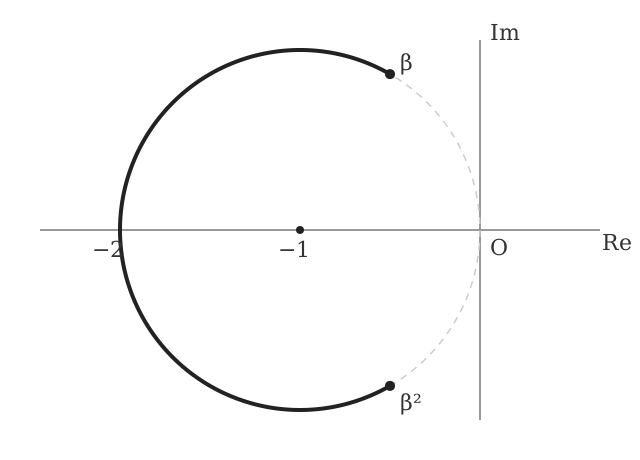
- Let be the cube root of with positive imaginary part. Determine and sketch the locus of as moves along the segment joining and .
Part 1: write the line as an equality of distances
The condition is , or
Substituting and multiplying by yields
Completing the square gives
Hence the center is and the radius is . The point is excluded, since is never zero for finite . Every other point gives a valid on .
Part 2: determine the correct arc
We have , and the segment can be parameterized by
Writing gives
It follows that
The map is continuous and one-to-one on the segment. As runs from through to , runs from through to . Thus the locus is the arc
including both endpoints. This is the longer arc on the left side of the circle with center and radius .
A useful habit for locus problems
First predict the type of figure using the inversion properties. Then substitute the inverse transformation, simplify the equation, and check excluded points and parameter ranges. An equation for a whole circle is not enough when the original point moves only along a segment or a restricted part of a curve.
Practice another kind of structural reasoning with integer problems or probability recurrence relations.
Related articles
- Equating rational and irrational parts: proof and worked problems
- How to simplify nested square roots, with three worked examples
- Conditional probability: the formula, information protocols, and worked examples
- Integration by parts: formulas, proof, and four useful patterns
- Triple-angle identities: remember, derive, and apply them
About the author
Koki Saito
Physician and graduate of the University of Tokyo Faculty of Medicine. Drawing on his entrance-exam experience, he explains how to choose mathematical methods and construct complete solutions.
Full profile →Have a question or spotted an error? Contact us.