Three useful limit formulas, their meaning, and how to derive related limits
Three useful starting points
Three standard limits organize many elementary calculations:
Angles in the first formula are in radians, and logarithms below are natural logarithms. These are a useful small collection to understand well, rather than a claim that no other facts about limits will ever be needed.
The author's original study advice was to focus on these three formulas and derive related ones instead of memorizing a long disconnected list.
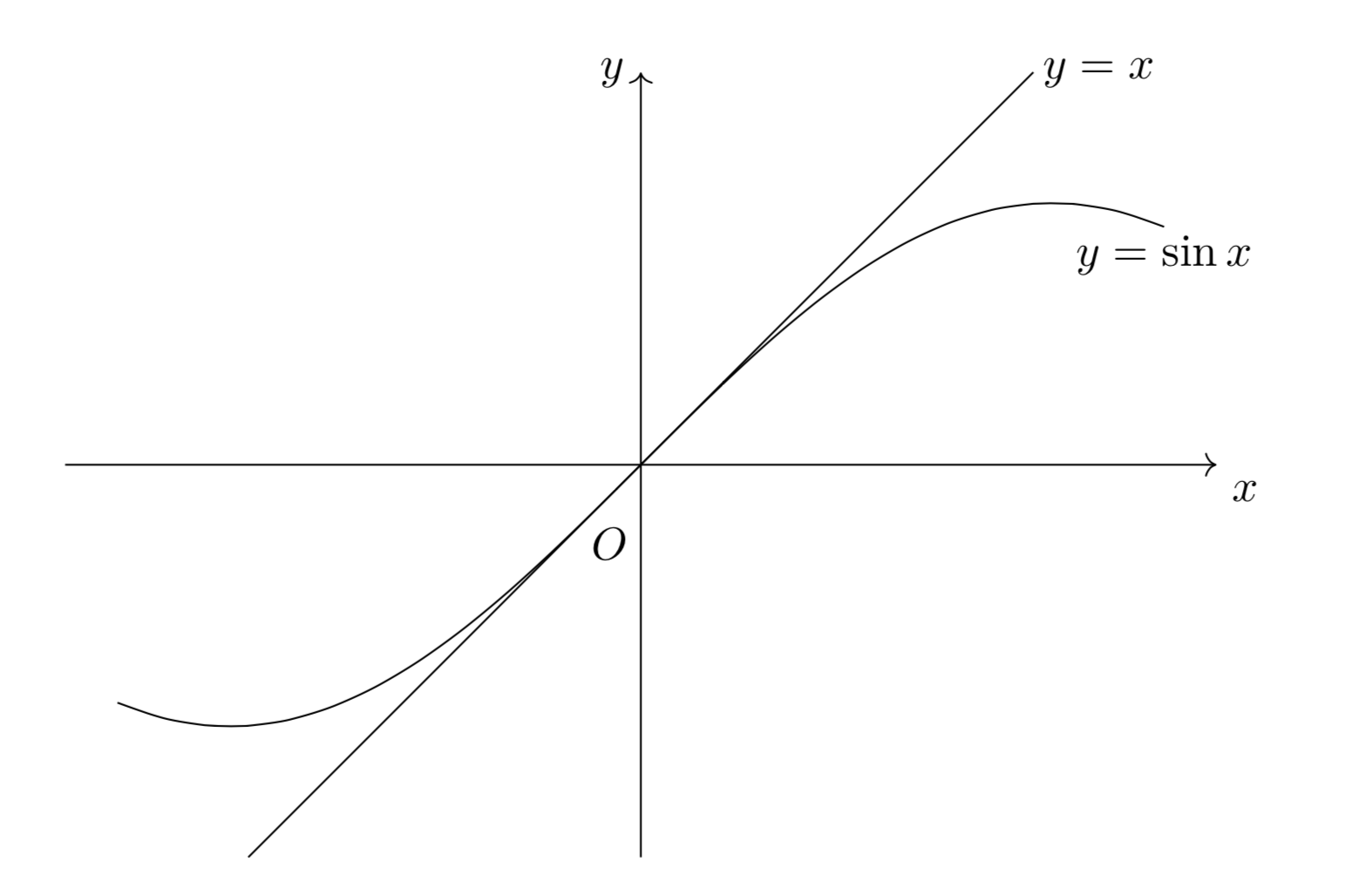
Remember the first two through their graphs
Near zero, behaves like . The first limit says their ratio tends to one, even though both values tend to zero.
Similarly, behaves like near zero:
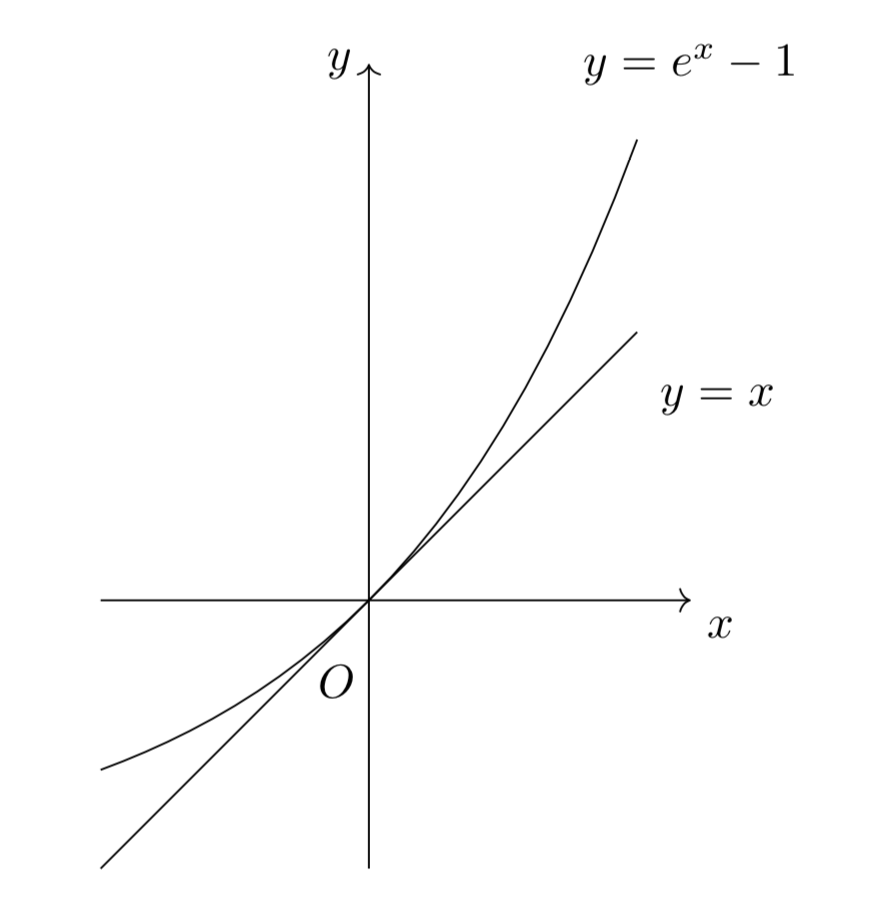
These pictures help interpret the formulas as local first-order behavior. A sketch is not a proof, and a proof using tangent slopes must not presuppose a derivative formula that itself depends on the limit being proved.
The third formula describes through a limiting power. Depending on the development of calculus, it may be adopted as a definition or proved equivalent to another definition of .
Derivation 1: the cosine limit
For sufficiently close to zero,
Using the sine limit and continuity of cosine gives
The useful algebraic move is multiplication by the conjugate , which creates and exposes the known limit.
Derivation 2: the logarithmic limit
We want
Set , so and . On the real domain ,
The exponential limit therefore yields
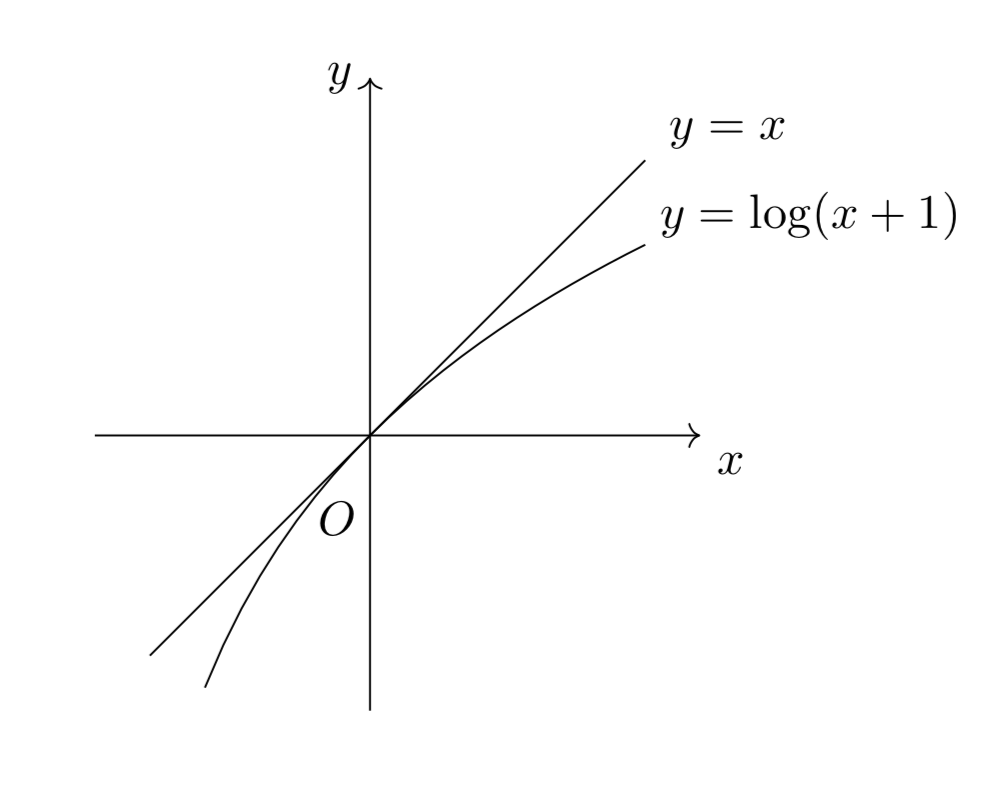
The logarithmic graph is the inverse of the exponential graph, reflected across . In the original diagram, denotes the natural logarithm.
Derivation 3: a power with a minus sign
For , write . Then
The base tends to and the exponent tends to . By continuity of positive real powers,
The restriction ensures that the base is positive while taking arbitrary real powers.
What counts as a proof of the starting formulas?
The sine limit has a geometric squeeze proof. The article proving the limit of sin x/x also explains how to justify the sector-area formula without relying on trigonometric derivatives.
The exponential limit expresses that the derivative of at zero is one. If that derivative has already been established independently, the limit follows immediately from the definition of derivative. If the derivative was proved using the same limit, citing it in the reverse direction would be circular. The logical starting point depends on the chosen definition of the exponential function.
Likewise, the limiting-power definition of and the exponential derivative are related, but passing between them requires a justified construction of real powers and continuity. They should not be treated as unrelated formulas that automatically prove one another without those steps.
Match the variable before applying a formula
For example,
so its limit at zero is . The same principle gives
for a fixed real constant ; the case is immediate.
Before using a standard limit, check the direction of approach, the real domain, the units of angles, and whether the numerator and denominator use the same small variable. Those checks make a small set of formulas much more useful than memorization alone.
Related articles
- Equating rational and irrational parts: proof and worked problems
- How to simplify nested square roots, with three worked examples
- Conditional probability: the formula, information protocols, and worked examples
- Integration by parts: formulas, proof, and four useful patterns
- Triple-angle identities: remember, derive, and apply them
About the author
Koki Saito
Physician and graduate of the University of Tokyo Faculty of Medicine. Drawing on his entrance-exam experience, he explains how to choose mathematical methods and construct complete solutions.
Full profile →Have a question or spotted an error? Contact us.