The limits of sin x/x at zero and infinity, with a noncircular proof
Two different limits
With measured in radians,
The first concerns the local behavior of sine near zero. The second concerns a bounded numerator divided by a quantity growing without bound. They require different squeezes.
The geometric proof near zero
For , compare a triangle inside a unit-circle sector with the sector and a triangle outside it. In the figure, is the circle's center, , and is tangent to the circle at .

Their areas give
Because and , these inequalities imply
As , both bounds tend to one. The squeeze theorem gives the right-hand limit .
For negative , use the fact that . The quotient is even, so the left-hand limit is the same. This proves the two-sided limit.
Why radians matter
The unit-sector area is half the angle only when the angle is measured in radians. If a variable instead measures degrees, then , so
The denominator's units cannot be ignored.
The limit at infinity
For ,
The upper bound tends to zero as , hence
The same absolute-value argument also proves the limit zero as , using as the upper bound. An inequality written with as a nonnegative upper bound applies only when .
Is the sector-area proof circular?
It depends on which geometric facts have already been established independently. One possible circular chain is:
- Use the sine limit to prove the derivatives of sine and cosine.
- Use those derivatives in a trigonometric substitution to compute a circular sector's area.
- Use that sector-area formula to prove the same sine limit.
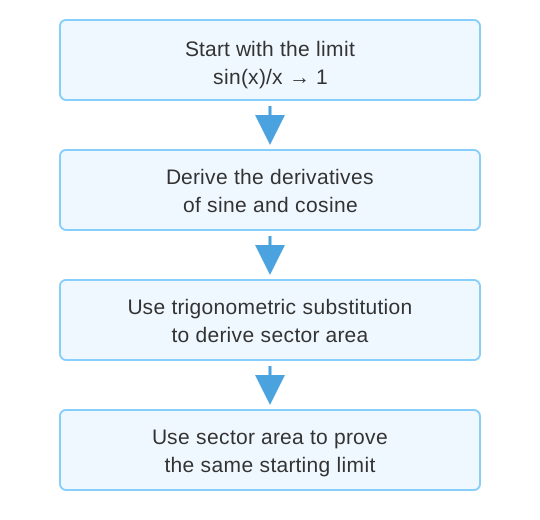
If sector area and radians have been developed geometrically without those derivative formulas, the usual proof has no such circularity. The argument is not automatically invalid just because a sector appears in it.
Here is an alternative development using only algebraic differentiation, integration by parts, and an independently established arc-length formula.
Establish sector area without trigonometric substitution
Choose on the right-hand unit semicircle . Let
The sector bounded by the positive horizontal axis and the radius through has area

Instead of substituting a sine or cosine, integrate by parts with the differentiated factor :
Since , the remaining integral is
Thus
Subtract the triangle area:
Identify the integral as unit-circle arc length
For the same algebraic curve,
Its arc length from height zero to height is
Therefore . Radian measure on a unit circle is its arc length, so if the central angle is , the sector has area .
No derivative of a sine or cosine was used. We can now use the sector-area comparison in the squeeze proof without assuming the sine limit along the way. This construction assumes an arc-length theorem for smooth algebraic curves that has itself been established independently of trigonometric differentiation.
The integration-by-parts step is an example of a useful general tactic: when substitution would depend on a theorem not yet available, a different algebraic identity may avoid that dependency.
Related: three useful limit formulas and integration by parts.
Related articles
- Equating rational and irrational parts: proof and worked problems
- How to simplify nested square roots, with three worked examples
- Conditional probability: the formula, information protocols, and worked examples
- Integration by parts: formulas, proof, and four useful patterns
- Triple-angle identities: remember, derive, and apply them
About the author
Koki Saito
Physician and graduate of the University of Tokyo Faculty of Medicine. Drawing on his entrance-exam experience, he explains how to choose mathematical methods and construct complete solutions.
Full profile →Have a question or spotted an error? Contact us.