Root placement in an interval: discriminants, vertices, and endpoints
Turn a root question into an intersection question
A root-placement problem asks how many real roots of an equation lie in a specified interval. For a quadratic, three pieces of information are especially useful:
- The discriminant: are there two distinct roots, a double root, or no real roots?
- The vertex: where is the axis relative to the interval?
- The endpoint values: on which side of the horizontal axis is the graph at the boundaries?
We will assume the quadratic opens upward. If its leading coefficient is negative, multiply the equation by minus one first. This leaves its roots unchanged and makes the sign criteria below applicable.
The quadratic formula is valid too, but directly solving several radical inequalities is often longer than using the graph's structure.
Two distinct roots in an open interval
For with , let and . Both roots lie in exactly when
The vertex is below the axis because . Positive endpoint values and a vertex inside force one crossing on each side of it before reaching the endpoints.
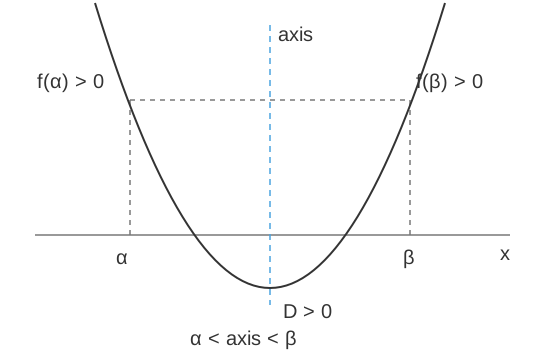
For a closed interval, allowing the roots at the endpoints changes the endpoint inequalities to nonstrict ones. Keeping still distinguishes two roots from a double root.
Problem 1: two roots in (-1, 2)
Problem. Find all real for which
has two distinct roots in .
For ,
The four conditions become
Their intersection is
At the discriminant is zero, so the two roots merge. At one root is an excluded endpoint. Both strict boundaries are therefore necessary.

Exactly one root in an open interval
There are three possibilities to examine:
- The endpoint values have opposite signs, giving one crossing inside.
- A double root lies strictly inside the interval.
- An endpoint is itself a root, and the other root lies strictly inside.
The third case is easily missed because an endpoint of an open interval is excluded, while the other root may still count.


Problem 2: one distinct root, including a double root
Problem. Find all real for which
has exactly one distinct root in . A double root counts as one.
Here , , , and .
First handle endpoint roots:
- At , the roots are and , so exactly one is inside.
- At , the roots are and , again leaving exactly one inside.
Away from those parameter values, opposite endpoint signs require
which gives or .
The double-root case requires . Its two values both place inside .
Combining the cases,
The same problem can be approached by separating the parameter and rotating a line.
At least one root in a closed interval
For an upward quadratic, a useful exhaustive criterion on is
or, simultaneously,
The first case includes an endpoint root and opposite-sign endpoints. The second includes a vertex at or below the axis while both endpoints are at or above it. The cases can overlap, but together they omit no valid configuration.
Equivalently, the continuous function must have a minimum at most zero and a maximum at least zero on the interval. The maximum of an upward quadratic is at an endpoint; the minimum is at the vertex if it lies inside, or at an endpoint otherwise.
Problem 3: a closed interval
Problem. Find all real for which
has at least one root in .
The discriminant first requires . For every in this range, the vertex lies in , and therefore in the required interval. Its minimum value is nonpositive. Thus a root exists in the interval precisely when at least one endpoint value is nonnegative:
The first inequality gives or . The second gives
Intersecting their union with yields
The endpoints are included because roots at the interval boundaries are allowed.

Problem 4: a cubic and a separated constant
Problem. Find all real for which
has a root in .
Write . The fixed function has derivative throughout , so it is strictly decreasing there. Its endpoint limits are
Continuity and strict decrease show that its image is exactly . Therefore

For higher-degree equations, parameter separation can simplify the question to the range or intersection count of a fixed function. It is a useful choice rather than a rule forbidding other approaches; derivatives, factorization, or explicit roots can also be appropriate.
The endpoint habit
Write down whether each interval endpoint is included before starting. Then test critical parameter values directly in the original equation. A discriminant equality, a tangency, and a root crossing an endpoint are different events, and each can change a root count.
Related articles
- Equating rational and irrational parts: proof and worked problems
- How to simplify nested square roots, with three worked examples
- Conditional probability: the formula, information protocols, and worked examples
- Integration by parts: formulas, proof, and four useful patterns
- Triple-angle identities: remember, derive, and apply them
About the author
Koki Saito
Physician and graduate of the University of Tokyo Faculty of Medicine. Drawing on his entrance-exam experience, he explains how to choose mathematical methods and construct complete solutions.
Full profile →Have a question or spotted an error? Contact us.