Two vector equations of a plane, and how to obtain Cartesian form
A point and a normal vector
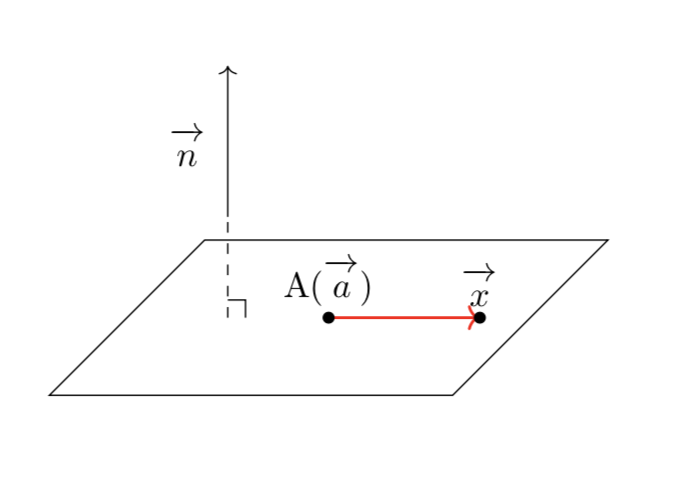
Let a plane pass through a point with position vector , and let be a normal vector. A point with position vector lies on the plane exactly when
Every displacement within the plane is perpendicular to its normal. Conversely, the points satisfying this equation form the plane through perpendicular to . Requiring a nonzero normal prevents the equation from degenerating into for all of space.
A point and two independent directions
Alternatively, let be linearly independent vectors parallel to the plane. Then its points are exactly
The two direction vectors span all displacements along the plane, and adding places it through the chosen point. Independence matters: parallel directions would span only a line, and zero directions can degenerate further.
Example 1: expand a normal equation
Problem. Find the equation of the plane through with normal vector .
Let be a general point on it. The normal equation is
Expand the dot product:
Therefore
Substituting checks the constant: . The coefficient vector of the Cartesian equation is the given normal.
Example 2: convert two spanning directions
Problem. Find the equation of the plane through parallel to and .
The parametric form is
You can eliminate from the three coordinate equations. Another route is to find a vector perpendicular to both directions.
Find and verify a normal
The cross product gives
Whether obtained by a cross product or by solving two equations, verify the result directly:
This nonzero vector is therefore normal to the plane. Using the known point gives
hence
The same result by eliminating parameters
From , we have . Substitute into :
Then , which rearranges to the same equation. Thus the two descriptions are equivalent, not competing definitions.
How to present a solution clearly
If a vector method lies outside the syllabus assumed by an examination, the two dot-product checks provide a short elementary justification of the proposed normal. There is no need to conceal how it was found. Always state a point on the plane and a nonzero normal, or a point and two independent directions.
The projection and reflection formulas in orthogonal projection vectors use the same normal-vector description.
Related articles
- Equating rational and irrational parts: proof and worked problems
- How to simplify nested square roots, with three worked examples
- Conditional probability: the formula, information protocols, and worked examples
- Integration by parts: formulas, proof, and four useful patterns
- Triple-angle identities: remember, derive, and apply them
About the author
Koki Saito
Physician and graduate of the University of Tokyo Faculty of Medicine. Drawing on his entrance-exam experience, he explains how to choose mathematical methods and construct complete solutions.
Full profile →Have a question or spotted an error? Contact us.