The cross product: formula, orientation, plane normals, and areas
What is a cross product?
For vectors in oriented three-dimensional Euclidean space, their cross product is a vector perpendicular to both. For nonzero, nonparallel inputs, its length is
where is their angle. Its direction is determined by the right-hand rule: curl the fingers of your right hand from toward through the smaller angle; the thumb gives the direction of the product.
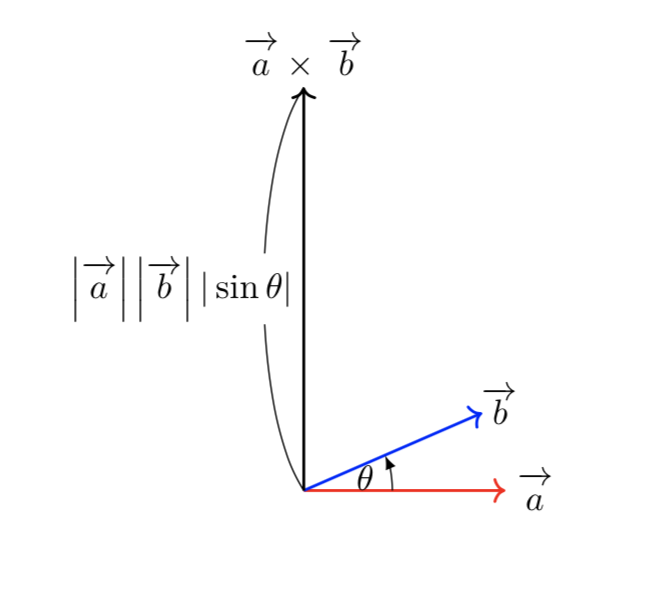
A dot product is a scalar. A cross product is a vector. Swapping the inputs reverses its sign:
If the inputs are parallel, or either is zero, the cross product is zero; a direction for the zero vector is not specified by the right-hand rule.
The component formula
For
we have
Remember the cyclic order . For the first component use the second and third coordinates; for the second use the third and first; for the third use the first and second. Reversing one pair accidentally is a common sign error.
Example: compute all three components
Take and .
The first component is .
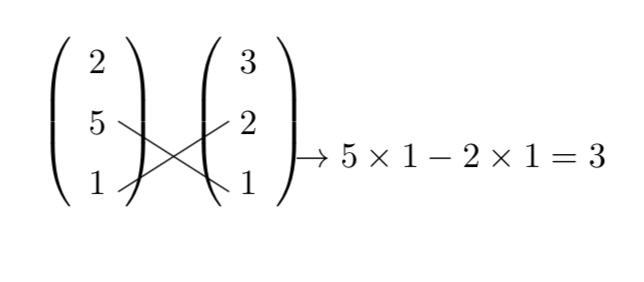
The second is . In the cyclic order this uses the third coordinate before the first, rather than simply taking the first coordinate before the third.
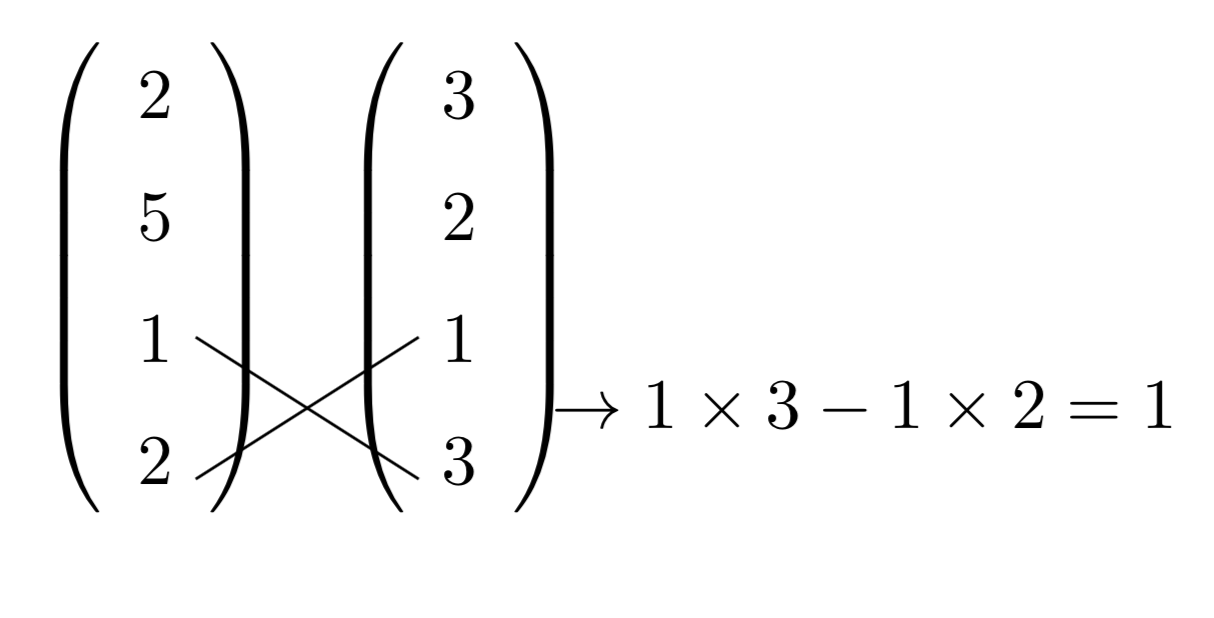
The third is . Thus
As a check, its dot products with the inputs are and . A mistaken sign often fails one of these checks immediately.
Application 1: a normal to a plane
Two independent direction vectors spanning a plane have a nonzero cross product, which supplies a normal. Once a point on the plane is known, its equation is
For the vectors in the example, a plane through has equation . The complete conversion is shown in vector equations of planes.
If the two directions are parallel, their cross product vanishes and does not determine a plane normal. Check independence rather than substituting a zero normal into the formula.
Application 2: areas in three dimensions
The parallelogram spanned by has base and perpendicular height . Its area is consequently
The triangle spanned by the same two vectors has half that area:
For the example, , so the parallelogram area is and the triangle area is .
An equivalent dot-product formula
Since ,
Therefore
For and , the squared lengths are and , and the dot product is . Hence , agreeing with the cross-product calculation.
Choose whichever area formula is shorter for the given data. If an examination assumes only dot products, the final formula can be justified directly using the cosine of the included angle. Remember that the cross-product length is the parallelogram area; a triangle still needs the factor .
Related articles
- Equating rational and irrational parts: proof and worked problems
- How to simplify nested square roots, with three worked examples
- Conditional probability: the formula, information protocols, and worked examples
- Integration by parts: formulas, proof, and four useful patterns
- Triple-angle identities: remember, derive, and apply them
About the author
Koki Saito
Physician and graduate of the University of Tokyo Faculty of Medicine. Drawing on his entrance-exam experience, he explains how to choose mathematical methods and construct complete solutions.
Full profile →Have a question or spotted an error? Contact us.