Orthogonal projection vectors: line and plane formulas with applications
What is an orthogonal projection?
An orthogonal projection is the component of a vector along a specified line or plane, obtained by dropping a perpendicular. Thinking of a shadow can help, provided the light rays are perpendicular to the receiving line or plane.
For a vector and a nonzero direction vector , the projection onto the line spanned by is
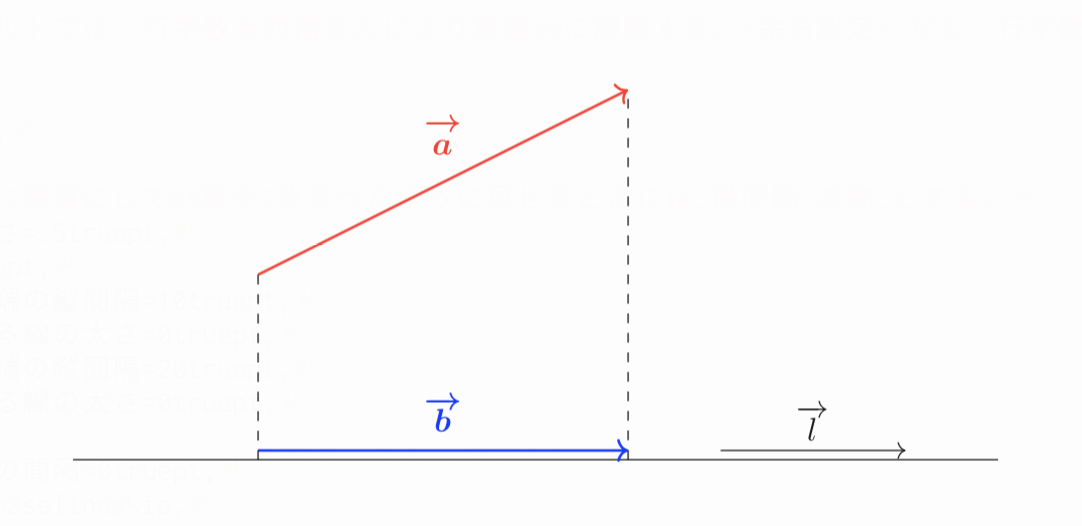
The same formula works in two or three dimensions. It is the dimension of the receiving subspace, rather than the dimension of the drawing, that determines which projection formula to use.
Deriving the line-projection formula
Write the projected vector as . Orthogonality requires the residual to be perpendicular to , so
Since ,
Substitution gives the formula above. This derivation also proves that it is the unique projection with the stated properties.
The geometric interpretation
If is the angle between nonzero and , its signed component in the direction of is
Multiply that scalar by the unit direction to recover the projection vector. If the dot product is negative, the projection points opposite to ; its length is still nonnegative.
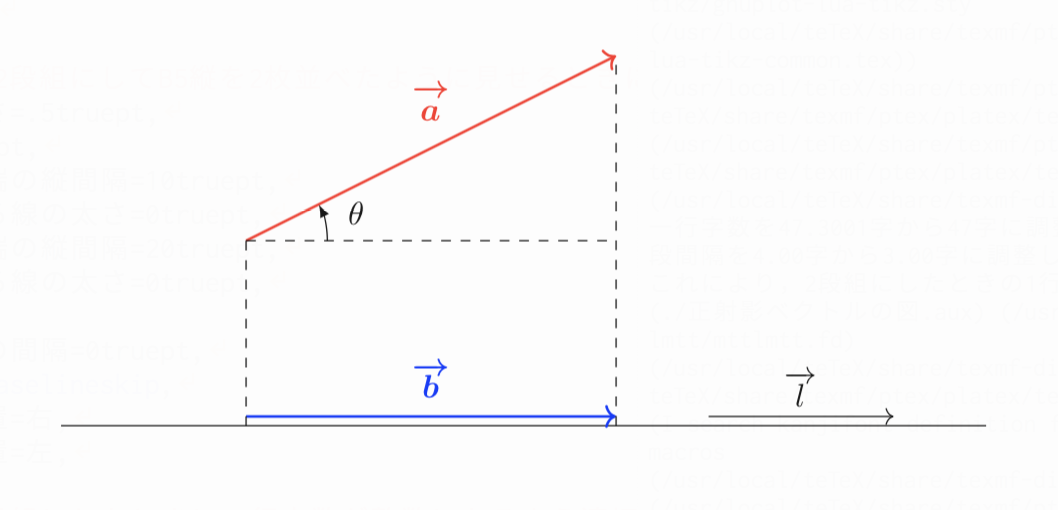
When is a unit vector, the formula simplifies to . The denominator in the general formula is , not a vector square.
Projection onto a plane through the origin
Let be normal to a plane through the origin. Remove the component parallel to the normal:
The resulting vector is in the plane because its dot product with is zero. The removed component is perpendicular to that plane, which establishes the projection property.
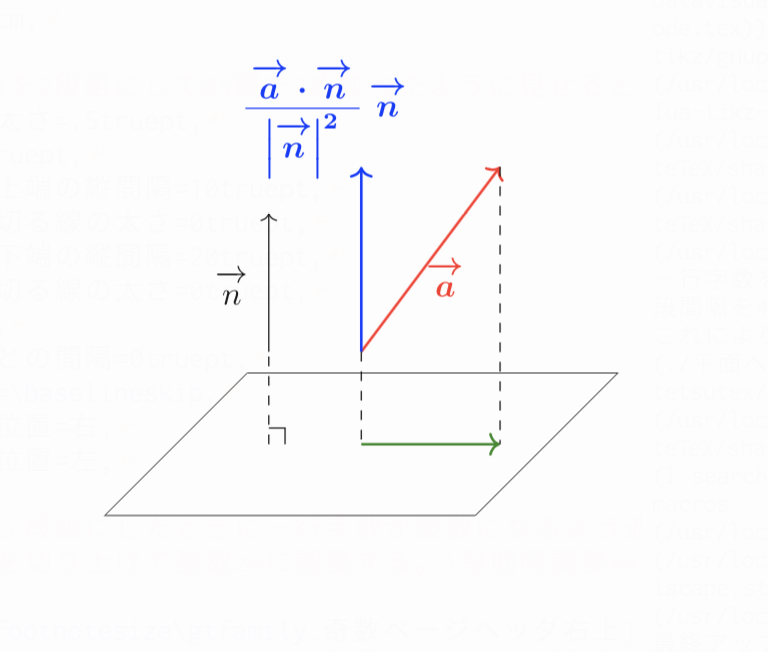
For a plane not passing through the origin, translate by a known point on the plane before applying this formula. A point and a free vector are different objects; the translation must not be omitted.
Example 1: a perpendicular foot on a line
Problem. In a triangle , suppose and . Let be the foot of the perpendicular from to the line . Express as .
The vector is the projection of onto the direction . Thus
The length of is not needed. The given dot product already determines its component along .
Example 2: reflection across a plane
Problem. Let lie on a plane in three-dimensional space, and let be normal to . A point has reflection across . With and , express in terms of .
This is the plane-reflection problem discussed in the original article, attributed there to Kwansei Gakuin University's School of Business Administration.
Let be the midpoint of , which is also the perpendicular foot of on . The displacement from to the plane is the component of along the normal:
Since ,
Check both defining properties
The displacement is parallel to the normal. Also, the midpoint has position vector
and , so it lies on the plane. These two checks confirm that the construction is the desired reflection. If already lies on the plane, the correction term vanishes and .
A practical habit
Before calculating, identify the vector being projected, the receiving direction or plane, and whether a translation is needed. Afterward, check parallelism of the projected component and orthogonality of the residual. These conditions are often quicker to recall than a memorized formula.
Related: vector equations of planes and cross products.
Related articles
- Equating rational and irrational parts: proof and worked problems
- How to simplify nested square roots, with three worked examples
- Conditional probability: the formula, information protocols, and worked examples
- Integration by parts: formulas, proof, and four useful patterns
- Triple-angle identities: remember, derive, and apply them
About the author
Koki Saito
Physician and graduate of the University of Tokyo Faculty of Medicine. Drawing on his entrance-exam experience, he explains how to choose mathematical methods and construct complete solutions.
Full profile →Have a question or spotted an error? Contact us.