Areas enclosed by parametric curves: cardioids, astroids, and a check
Start with the shape and the direction
For , , a practical procedure is to understand the curve, write an area integral using its branches, and substitute . The parametric-sketching guide explains how to determine the shape.
Symmetry often reduces the calculation. Signed integrals require attention to which branch is above another and whether increases or decreases along the parameter interval. When one branch doubles back, split it at the turning point before interpreting the integral geometrically.
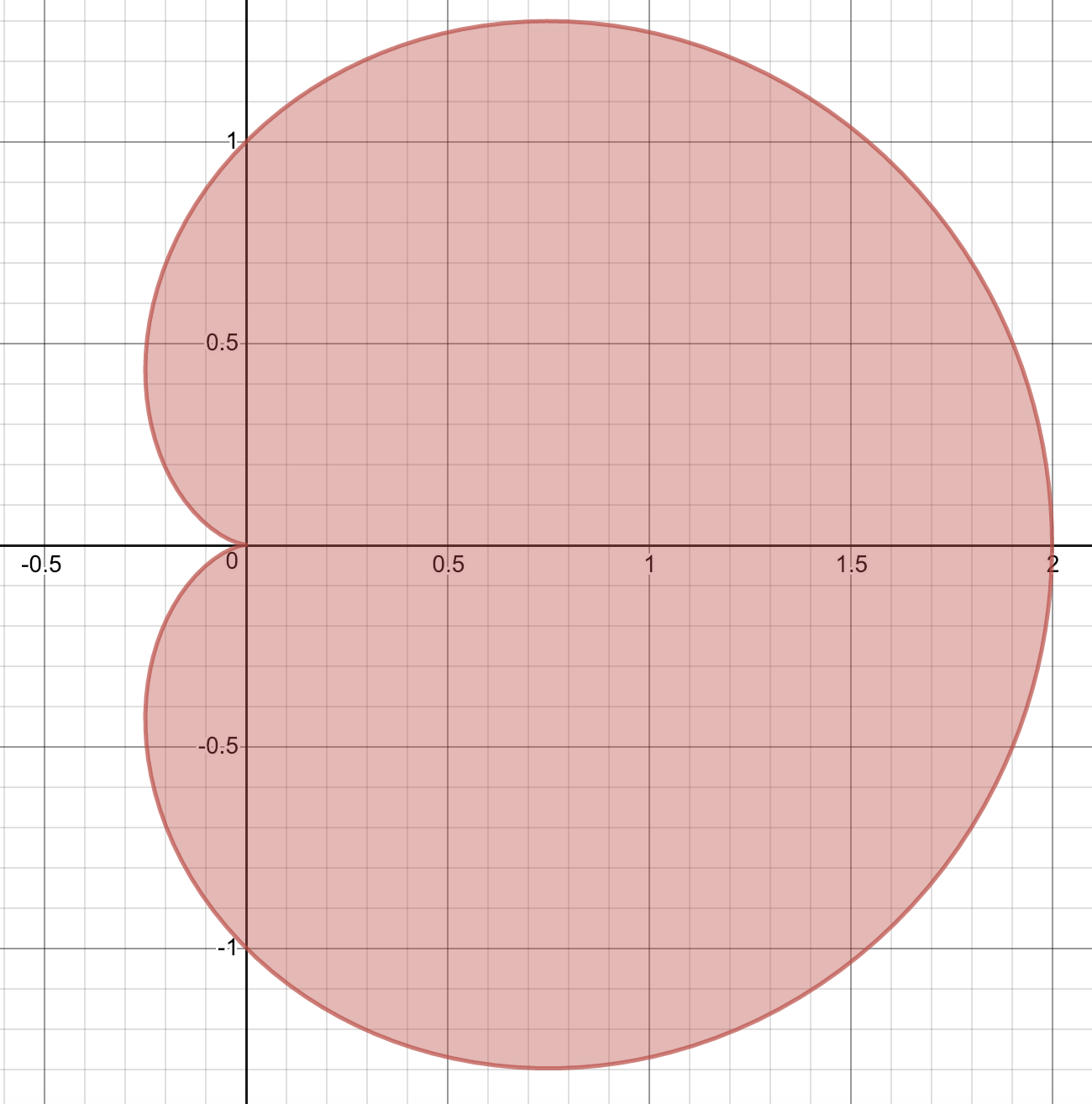
Consecutive pieces may combine neatly after substitution, as in the first example. This is a useful consequence of their orientations, not a universal rule that arbitrary area pieces must become a single integral.
Example 1: a cardioid
Find the enclosed area of
Replacing by leaves unchanged and negates , so the curve is symmetric about the -axis. On the upper half, ,
The path starts at , reaches its greatest height at , turns in the -direction at , and ends at the origin:
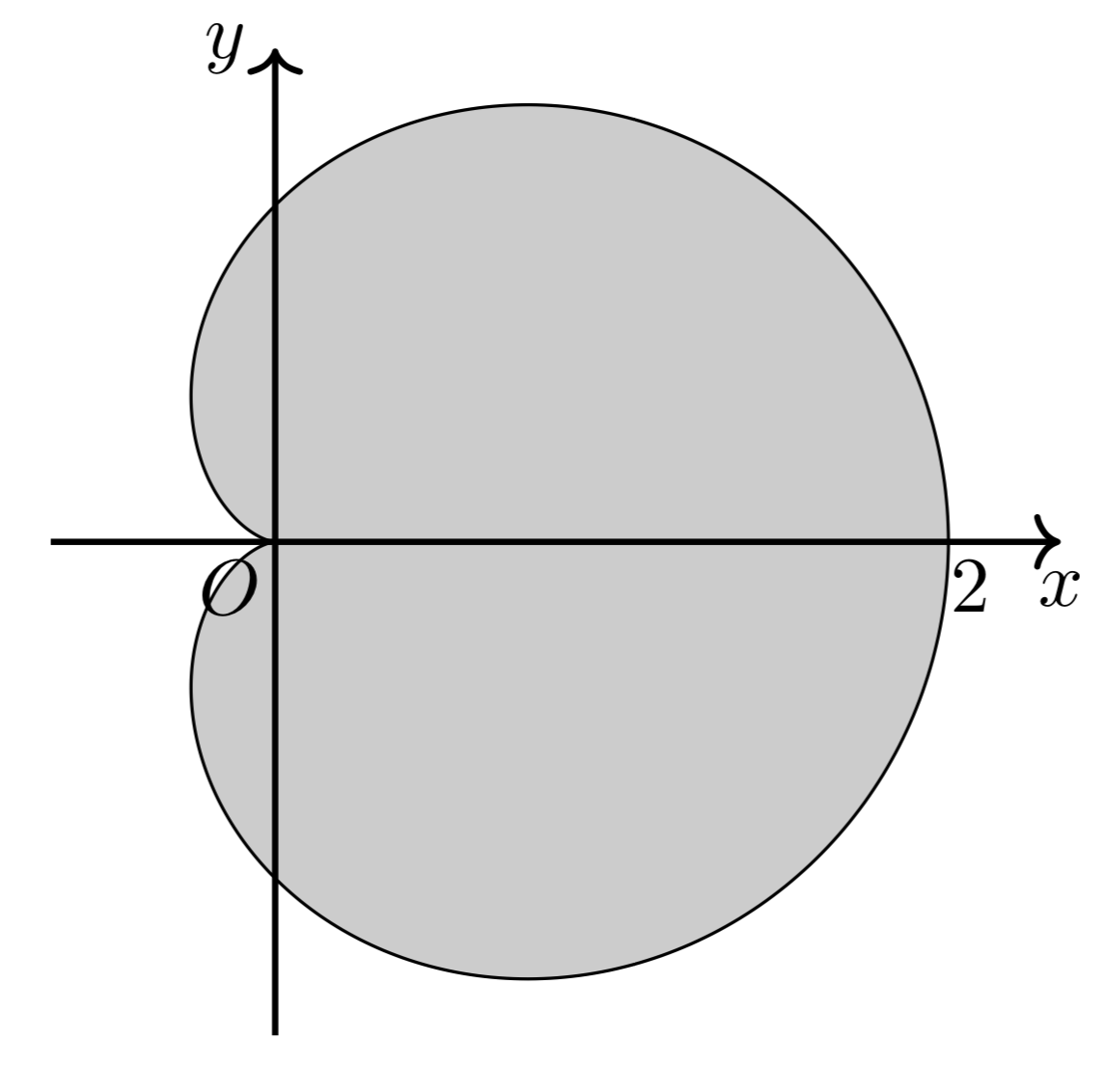
Call the height on and that on . For negative the upper half lies between those branches; for positive it lies between and zero. Its area is therefore
The first branch runs toward decreasing , so its parameter bounds reverse. Substitution gives
Consequently,
Reflecting across the axis doubles the area:
Example 2: an astroid
Find the enclosed area of
Reflection in either coordinate axis preserves the curve, so it suffices to find its first-quadrant area and multiply by four. On ,
The point moves from to , with decreasing and increasing.
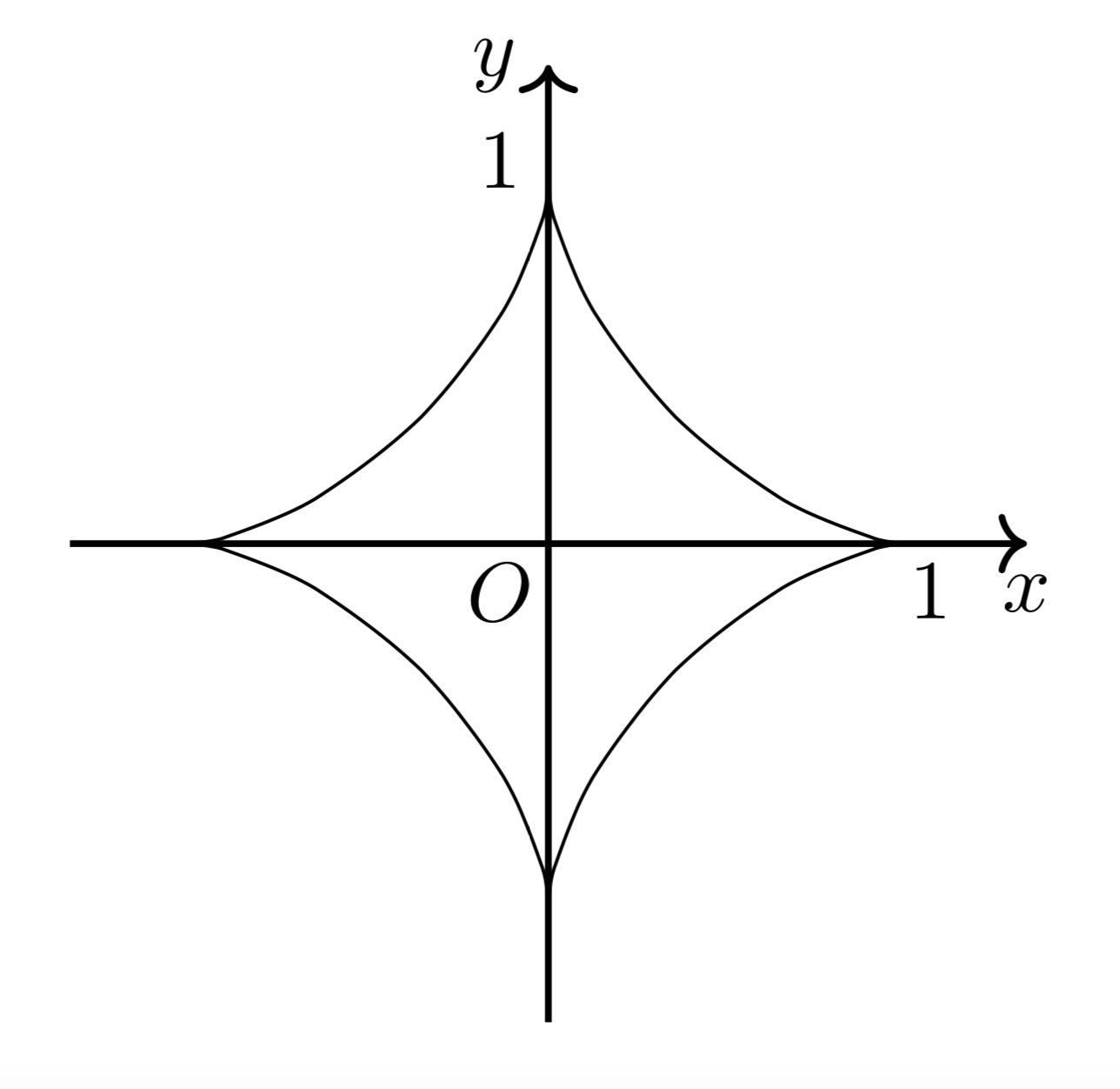
The first-quadrant area is
where . For , integration by parts gives
Hence . Starting with , we obtain and . Therefore and
The integration-by-parts recurrence is worth understanding as well as remembering. See also integration by parts.
A second calculation using Green's area formula
For a simple closed, piecewise smooth boundary traversed once counterclockwise, the enclosed area is
Clockwise traversal changes the sign. Isolated cusps do not prevent applying the formula piecewise and taking limits. For a self-intersecting path, this expression gives signed area with multiplicity; taking its absolute value need not give the ordinary area of the union of its loops. Multiple traversals also count area multiple times.
Check the cardioid
Writing , , and , direct differentiation gives . Thus
Check the astroid
Here the integrand simplifies to
Therefore
This independent setup is often more useful for checking than repeating the same long calculation.
Why the formula works
For the examples above, the polar angle increases continuously, and the region is swept once by radial segments. A small angular change sweeps area . Since and ,
Integrating proves the formula for this radial setting. The cusp of the cardioid has radius zero and is handled by a limit.
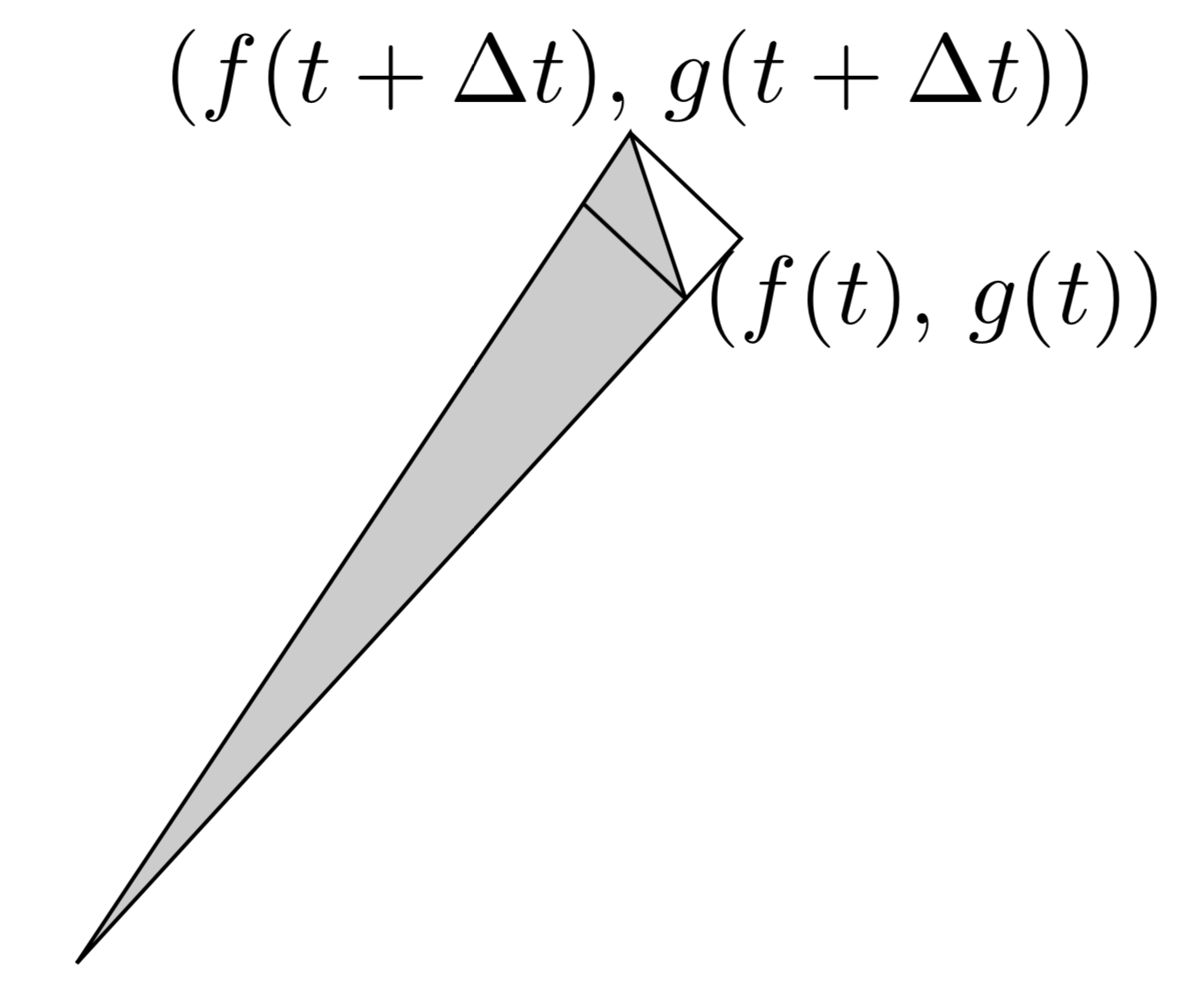
The determinant of two nearby position vectors gives the same local calculation:
For the general simple-boundary statement, Green's theorem supplies a direct proof. Choose and . Then
Substitution of and yields the claimed sign . The radial argument explains the two examples without requiring the full theorem; it should not be mistaken for a proof for every possible boundary.
If an examination expects only elementary methods, use the branch integrals as your main solution, or supply whatever justification is required for an additional theorem. The determinant interpretation is related to the cross product.
Related articles
- Equating rational and irrational parts: proof and worked problems
- How to simplify nested square roots, with three worked examples
- Conditional probability: the formula, information protocols, and worked examples
- Integration by parts: formulas, proof, and four useful patterns
- Triple-angle identities: remember, derive, and apply them
About the author
Koki Saito
Physician and graduate of the University of Tokyo Faculty of Medicine. Drawing on his entrance-exam experience, he explains how to choose mathematical methods and construct complete solutions.
Full profile →Have a question or spotted an error? Contact us.