Three ways to sketch a parametric curve
What a parameter describes
A parametric curve gives both coordinates in terms of another variable:
The parameter describes where the point is on the curve. Such a curve need not be the graph of a single-valued function , and its parameter interval is part of its definition.
There are three useful approaches to sketching it:
- Eliminate , retaining the restrictions inherited from its interval.
- Differentiate the coordinates with respect to and track their changes.
- Recognize a familiar curve after a rotation or another transformation.
1. Eliminate the parameter
Problem
Sketch the path of when
From the first equation . Substituting into both the second equation and the parameter restriction gives
Thus the answer is the indicated closed segment of a parabola, with endpoints and included.
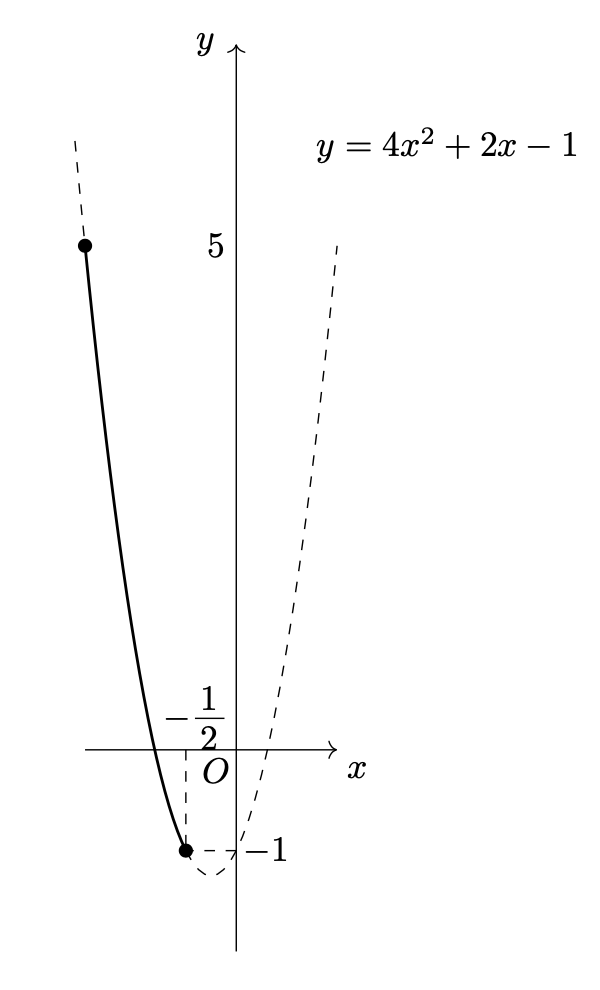
The full parabola would be an incorrect answer. Elimination without the parameter range loses information. Conversely, every in the displayed interval corresponds to an allowed , so the restriction is sufficient as well as necessary.
2. Follow derivatives with respect to the parameter
Elimination may produce an equation that is harder to read than the original parametrization. In that case, study and directly.
Problem
For all real , sketch
The coordinate derivatives are
The important parameter values are and :
- Before , both coordinates decrease.
- Between and , decreases while increases.
- After , both coordinates increase.
At these turning points,
Also , and both coordinates tend to as . Where ,
There is a horizontal tangent at the first turning point and a vertical tangent at the second; at each point the other coordinate derivative is nonzero. These observations give the following sketch.
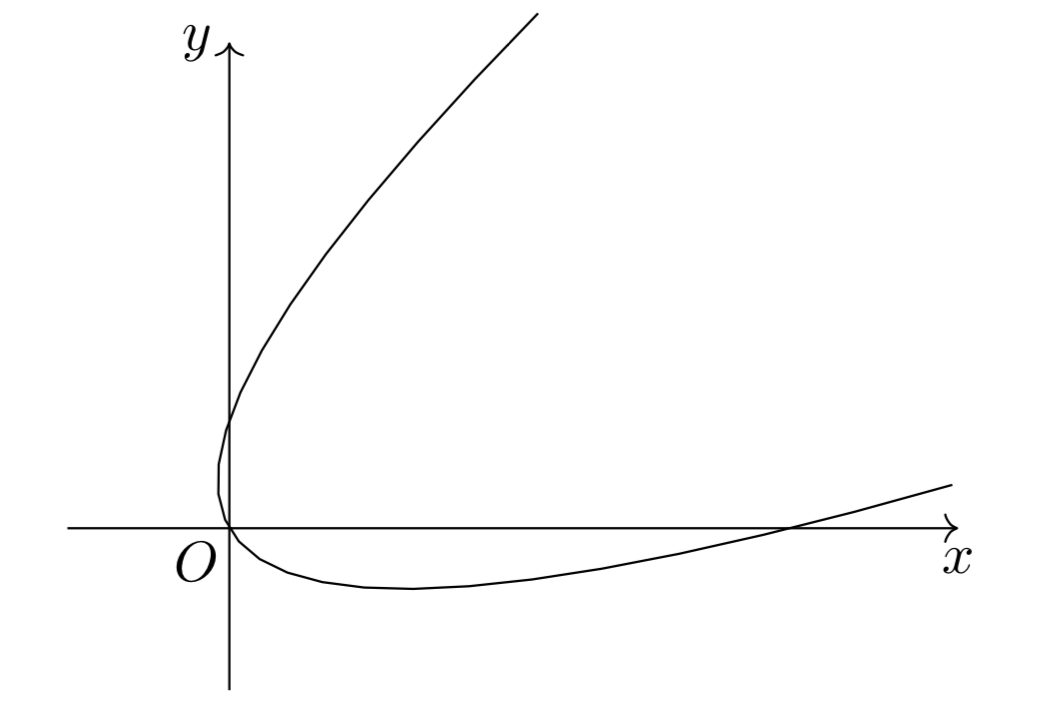
This method is broadly useful, but a reliable sketch can also require checking self-intersections, endpoints, asymptotes, or points where both derivatives vanish. Coordinate monotonicity alone does not settle every possible curve.
3. Recognize a rotation
For the same example, group the coefficients as vectors:
The two coefficient vectors are the standard coordinate directions rotated counterclockwise through . Equivalently,
The point describes the parabola for all real . Multiplication by rotates it by about the origin. Thus the curve above is exactly that rotated parabola, rather than merely a shape that resembles one.
In matrix notation the same statement is
You can also recover the unrotated coordinates:
This verifies the geometry without relying on a visual guess. Recognizing a transformation is especially efficient when the coefficient vectors reveal it; otherwise, direct differentiation is often the more straightforward starting point.
For subsequent applications, see areas enclosed by parametric curves and volumes of their solids of revolution.
Related articles
- Equating rational and irrational parts: proof and worked problems
- How to simplify nested square roots, with three worked examples
- Conditional probability: the formula, information protocols, and worked examples
- Integration by parts: formulas, proof, and four useful patterns
- Triple-angle identities: remember, derive, and apply them
About the author
Koki Saito
Physician and graduate of the University of Tokyo Faculty of Medicine. Drawing on his entrance-exam experience, he explains how to choose mathematical methods and construct complete solutions.
Full profile →Have a question or spotted an error? Contact us.