2020 Center Test Mathematics II/B: worked English explanations
This is a guide to the 2020 former Center Test, whose question selection and curriculum differ from the current Common Test. Questions 1 and 2 were compulsory in this paper; Questions 3–5 were the optional sections discussed by the original article. Results below use mathematical names instead of Japanese answer-box letters. See also Mathematics I/A from the same year.
Question 1: trigonometry, powers, and logarithms
1.1 A trigonometric inequality
Solve, for ,
The addition formula gives
Rearranging the inequality therefore yields
Since , the solution is
1.2 Sine and cosine are the roots of a quadratic
Suppose are the two roots of . Their sum is , so
The root product is , giving k=12. Factorization gives
If sine is the larger root, then
Both are positive, so the angle in is in the first quadrant. Comparing cosine with and gives the sharper interval . Thus the corresponding source choice is .
1.3 Fractional powers and reciprocal identities
Let satisfy . Put . Squaring gives
Since and the sum is positive,
Finally,
Positivity selects the correct square root in the second step.
1.4 Logarithms turn a region into linear inequalities
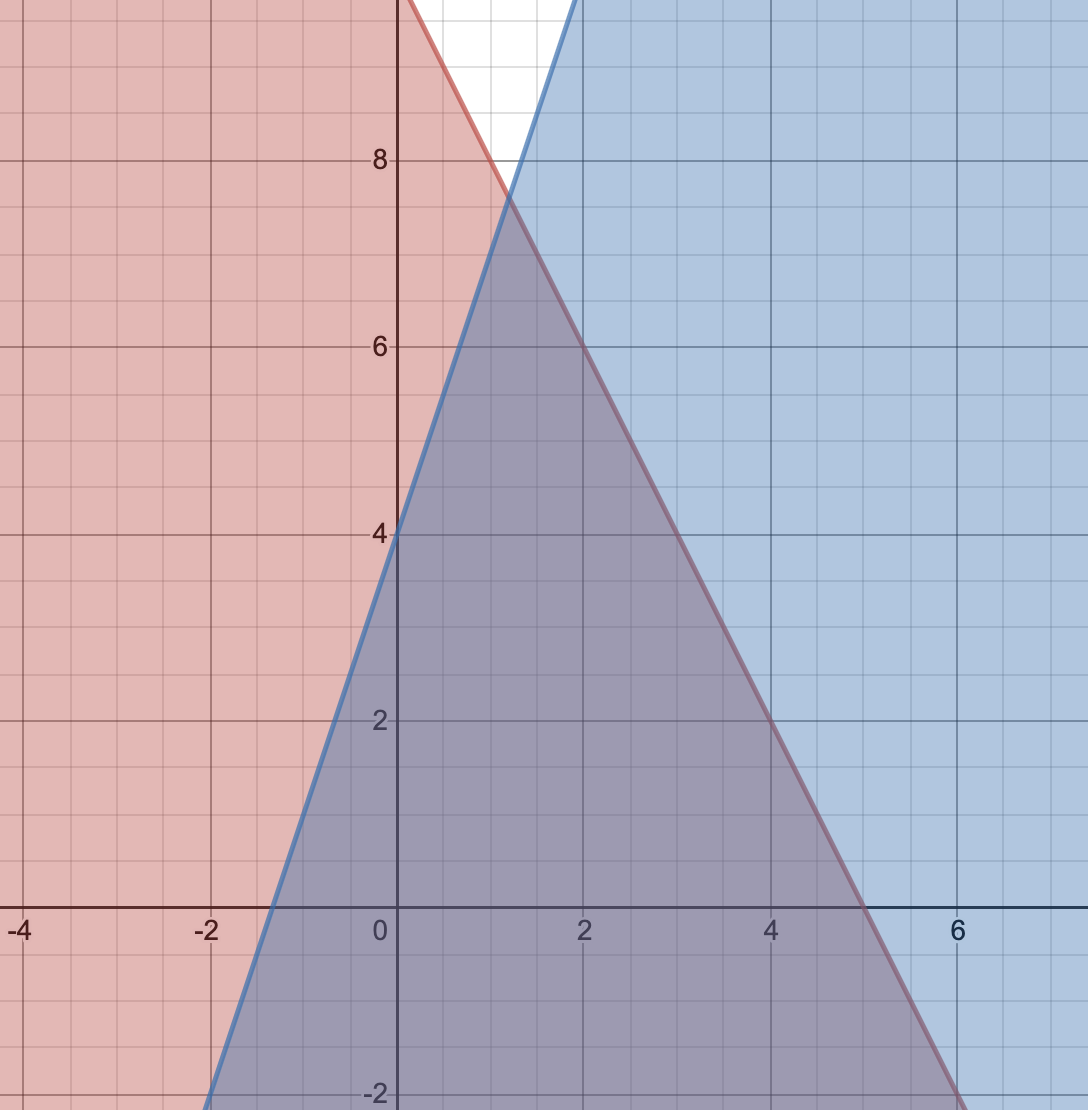
For x,y positive, suppose
Set , . The conditions become
Indeed . The upper bounds on Y are and , whose intersection is , . Therefore the greatest integer value of Y is 7. This is an integer condition on , not a claim that the largest y is seven.
When Y=7, the inequalities give , hence
The greatest integer x is therefore 5.
Question 2: common tangents and areas between parabolas
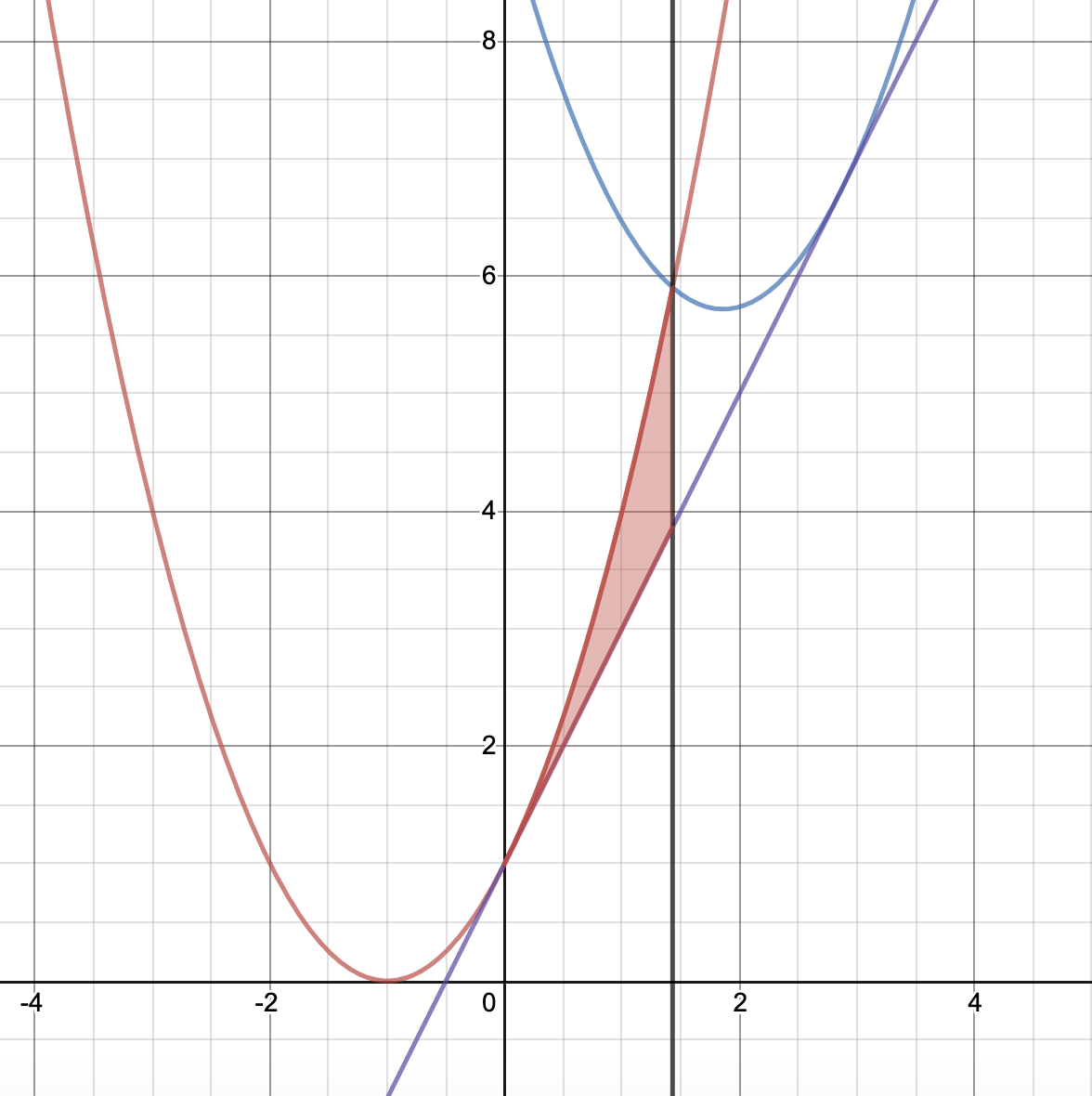
Let ,
Call their graphs C,D and their common tangent .
2.1 Find the tangent and contact points
At x=t on C, the tangent is . At x=s on D, it is
Equality of slopes and intercepts gives and . Since a>0, substitution forces t=0 and s=2a. Consequently,
2.2 Find an intersection and a basic area
Equating f and g gives , so the graphs meet at x=a. The region bounded by C, , and x=a has area
2.3 Restrict the enclosed region to 0 at most x at most 1
Now assume . Let T be the area of the part of the region enclosed by C,D, with .
Relative to the tangent, the parabola heights are and . The upper boundary of the enclosed region switches at x=a. Since , the right tangency point is at or beyond the end of the interval.
If , the whole interval lies to the left of the crossing, giving . For ,
Thus
Both formulas agree at one. The original question describes constancy for a>1; the endpoint also has that value.
2.4 Optimize a combination of areas
For , put . Then
The second factor is positive throughout the interval. Therefore U increases until a=2/3 and decreases afterward, giving
Question 3: normalize a complicated recurrence
Let and, for ,
The minus sign on the polynomial term is part of the given recurrence.
3.1 Compute the next term
At n=1,
3.2 Choose a normalization and telescope
Define
Then , and dividing the recurrence by gives
The last sign is minus. Some intermediate lines in the source incorrectly use plus, though its final general term corresponds to the minus sign.
Use
Summing increments for gives a telescoping sum and a geometric sum:
Therefore
Substitution verifies b1=0 as well. See telescoping sums and the recurrence guide.
3.3 Recover the original terms
Multiplying by the normalizing factor,
Both terms are integers for ; the second is an integer because it halves the product of two consecutive integers.
3.4 Remainders modulo three
For the first term is divisible by three. At n=1 it is also divisible by three because , despite the exponential factor being one.
Modulo three, the second term is one when n is divisible by three and zero otherwise. Division by two here is legitimate using the inverse of two modulo three, or by checking the three residue classes directly. Hence
There are multiples of three among the first 2020 indices. Their sum of remainders is , so
Question 4: spatial vectors and a tetrahedron
Let
Let be plane OAB. Point C lies in this plane with and .
4.1 Basic lengths and an inner product
Writing and ,
Thus and .
4.2 Find C
Write . The two constraints give
Solving,
Its squared length is , so .
4.3 Classify and measure OABC
We have
Thus OA and CB are parallel with unequal lengths in ratio 3:2. OABC is a trapezoid, not a parallelogram. Since OC is perpendicular to them, its area is
4.4 Find D and an angle
Suppose D has z-coordinate one, , and . Write and .
The first constraint gives p+q=2. Since and , the second gives . Hence
Together these yield
Its distance from O is two. Therefore
4.5 The tetrahedron volume
Plane OCD is perpendicular to plane OAB: OA is perpendicular to both OC and OD, two independent directions in the first plane. The planes intersect along OC. Thus the height of D above plane ABC is
The base area is
Consequently,
Question 5: probability distributions and statistical inference
5.1 A finite distribution of borrowed-book counts
Among 720 students, the counts borrowing zero, one, two, and three books during the stated week are 612, 54, 36, and 18; nobody borrowed four or more. Choose a student uniformly and let X be the book count.
The mean and second moment are
Therefore
5.2 A binomial count and a normal approximation
In the specified sampling model, let Y count library users among 600 sampled students, each with use probability p. Treat Y as binomial with parameters 600,p.
For p=0.4,
The standardized variable is . Using the normal approximation requested by the question, without a continuity adjustment,
The supplied normal table gives , leaving a lower-tail probability about 0.0188. Rounded to two decimal places, the answer is 0.02. This is an approximation, not an exact binomial identity.
For p=0.2, the mean is 120, half its previous value. The standard deviation is
which is times the previous standard deviation, rather than half.
5.3 Centering a variable and a 95% confidence interval
Let the normally distributed daily study-time variable W have mean m minutes and standard deviation 30 minutes. Define , and use independent observations of the same distribution as specified in the question. Subtracting a constant changes the mean but not the standard deviation:
For 100 sampled students with mean W equal to 110 minutes, the sample mean of U is 50. Its standard error is . The normal-based 95% confidence interval for is
Rounding the endpoints to one decimal place gives
The values used from the source's Japanese normal-distribution table are recorded directly here: the central area from zero to 2.08 is about 0.4812, and the two-sided 95% critical value is about 1.96.
Related articles
- Equating rational and irrational parts: proof and worked problems
- How to simplify nested square roots, with three worked examples
- Conditional probability: the formula, information protocols, and worked examples
- Integration by parts: formulas, proof, and four useful patterns
- Triple-angle identities: remember, derive, and apply them
About the author
Koki Saito
Physician and graduate of the University of Tokyo Faculty of Medicine. Drawing on his entrance-exam experience, he explains how to choose mathematical methods and construct complete solutions.
Full profile →Have a question or spotted an error? Contact us.