2020 Center Test Mathematics I/A: worked English explanations
This article explains the 2020 former Center Test, not the format or selection rules of the current Common Test. Questions 1 and 2 were compulsory in this paper; Questions 3–5 were the optional sections discussed in the source. The Japanese answer-box letters are replaced below by named mathematical results. For the companion paper, see 2020 Mathematics II/B.
The original graphic-reading questions use historical life-expectancy charts. Their relevant readings are recorded in English tables below, and the 20-observation histogram is redrawn with English labels. Original numerical choice labels are retained only where useful to identify the source answer.
Question 1: algebra, sets, and quadratic graphs
1.1 A line depending on a parameter
Consider .
The slope factors as , so it is negative exactly when
Assume the slope is nonzero and let b be the x-intercept. Then
For , b is positive when the denominator is negative, giving . For , the zero value a=0 gives b=0 and must be excluded; positive b then requires a positive denominator, giving .
At , rationalizing yields
1.2 Divisibility sets and a counterexample
For positive integers n, let p mean “n is divisible by 4,” q mean “n is divisible by 6,” and r mean “n is divisible by 24.” Let P,Q,R be the corresponding sets.
The number 32 belongs to P but not Q or R. Among the supplied choices, it belongs to .
The least element of is . Since 12 is not divisible by 24, . It is a counterexample to
A single counterexample disproves this implication; it does not disprove its converse.
1.3 A translated parabola
Translate so that its x-intercepts are and . Its equation is
To meet the vertical segment from to , its height at x=3 must satisfy
The first inequality gives or ; the second gives . Thus
If the parabola passes through and , then , so . Completing the square gives
It is therefore translated by horizontally and vertically. Its y-intercept is
Question 2: triangle geometry and statistics
2.1 An angle bisector and a circumradius
In triangle ABC, . The bisector of meets AB at D. Suppose and . Find BD, , AC/AD, AD, and the circumradius of ABC.
The cosine rule in BCD gives
Next,
Because ADC is supplementary to CDB and the sine is positive,
The angle-bisector theorem gives
Set , so . The cosine rule at C in ACD yields
The candidates are one and two. They correspond to opposite signs for . The actual supplementary-angle condition requires this cosine to be , so only is valid.
Now AB=AD+BD=3. If , then and . Therefore . The sine rule gives
The extra angle condition is essential to reject the spurious length x=2.
2.2 Quartile statements for 99 observations
Use the median-of-halves convention of this question: for ordered values , the median is , the first quartile is , and the third is . Which of the following source statements always hold?
| Original choice | Statement | Verdict | | --- | --- | --- | | 0 | The mean lies between the first and third quartiles. | False | | 1 | The interquartile range is strictly greater than the standard deviation. | False | | 2 | Exactly 49 observations are strictly below the median. | False | | 3 | Removing one observation equal to the maximum leaves the first quartile unchanged. | True | | 4 | Removing values strictly below the first quartile or strictly above the third leaves exactly 51 observations. | False | | 5 | The range of the remaining observations after that removal equals the original interquartile range. | True |
For choice 0, take one zero and 98 values equal to 100. Both quartiles are 100, but the mean is . For choices 1, 2, and 4, a constant dataset is enough: its standard deviation and interquartile range are both zero, it has no value strictly below its median, and all 99 observations remain after the described trimming.
For choice 3, after removing a maximum there are 98 observations, whose lower half still consists of the original first 49; its median is still . For choice 5, the retained set contains both quartile values, and all retained values lie between them, so its maximum minus minimum is , including in the presence of ties.
Thus the correct source choices are 3 and 5.
2.3 Reading the 47-prefecture box plots
The source groups municipal male life-expectancy data by 47 prefectures, labeled P1 through P47. The decisive chart readings are:
| Claim about the supplied chart | Reading that settles it | Verdict | | --- | --- | --- | | Every prefecture's interquartile range is at most one year. | P10's box spans more than one year. | False | | The plots are sorted by increasing median. | P32's median exceeds P33's. | False | | Every P47 value exceeds every P1 value by at least 1.5 years. | The gap from P1's maximum to P47's minimum is at least 1.5. | True |
The source choice for false, false, true is 6. Compare the relevant box edge or whisker, not merely its central position.
2.4 Match a histogram and a box plot
The histogram for 20 municipalities has the following bins and frequencies, with left endpoints included and right endpoints excluded:
| Life expectancy in years | Frequency | | --- | --- | | | 2 | | | 4 | | | 9 | | | 3 | | | 2 |
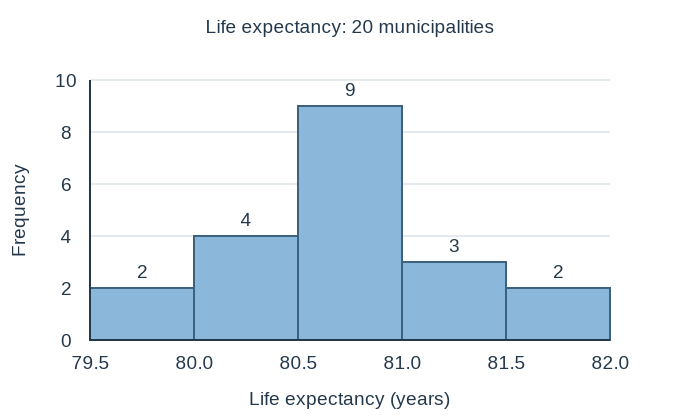
The cumulative counts are 2, 6, 15, 18, 20. Hence the minimum lies in the first bin; the first quartile, based on the fifth and sixth observations, lies in the second; the median, based on the tenth and eleventh, lies in the third; and the maximum lies in the fifth. Among the supplied box-plot choices, 4 has all these features. The bin data identify intervals for the statistics, not their exact numerical values.
2.5 Read a difference from a scatter plot
The source's scatter plot compares male and female life expectancy and supplies parallel guide lines for their difference. Its band corresponding to a difference in contains nine points. The matching difference-histogram choice is 3, the only supplied option whose corresponding bin has frequency nine. This is a count within a band between parallel lines, rather than a count in a vertical x-interval.
Question 3: probability
3.1 Identify two correct statements
The four source claims concern these experiments. For the coin calculations below, use the fair-coin model assumed in the solution.
- Five coin tosses: the probability of at least one head exceeds 0.95. This is true because .
- Estimate from a small sample: an eight-ball bag contains red and white balls. Observing three reds in five draws with replacement does not establish that the true red probability is exactly . A sample proportion is not an identity for an unknown probability.
- Two cards: five cards carry labels A once, B twice, and C twice; choose two without replacement. Matching labels occur with probability , so different labels occur with probability . This claim is true. The labels replace the Japanese syllables in the source without changing the experiment.
- Two robots: each reports a coin's actual face correctly with probability 0.9, independently conditional on that face. Given both report heads, the true-head probability is not at most 0.9. For a fair prior it is
Thus the correct original choices are 0 and 2. The conditional-probability guide explains why the prior and conditional independence matter in the robot example.
3.2 A coin game that stops on returning to zero
Start at score zero. Toss a fair coin at most five times, adding two for heads and subtracting one for tails. If the score returns to zero after a toss, stop immediately; otherwise stop after five tosses.
After two tosses, score minus two requires TT, with probability . Score one requires HT or TH, with probability .
A return to zero within five tosses can occur only at toss three, with one head and two tails. There are three orders, so the return probability is .
A final score of four requires three heads and two tails over five tosses. Of the orders, three return to zero at toss three and must be excluded. Therefore
Conditioned on this final score, four of the seven surviving orders have score one after two tosses: the first two tosses are HT or TH, the third must be H to avoid stopping, and the last two can be HT or TH. Hence
Counting all ten five-toss orders without the stopping rule would give the wrong sample space.
Question 4: repeating fractions and base seven
4.1 A decimal repetend
Let . Then , so
4.2 A base-seven repetend
Let , where a,b are distinct digits from zero to six. Multiplication by shifts two base-seven places, giving
To express y as an odd integer divided by four, its fractional part must be or . Thus or 36, with digit pairs or . The possible values are
For , the pair is , with .
For y-2 to be a unit fraction with integer , the positive integer must be a proper divisor of 48. The candidates are
The values 8, 16, 24 have equal base-seven digits and are excluded. The remaining six give distinct digit pairs, so there are six possible values of y.
Question 5: Ceva, Menelaus, and circle powers
In triangle ABC, let D divide BC with , and E divide AC with . Put and .
Ceva's theorem gives
Menelaus applied to ABD with transversal GFC gives
Applied to GBC with transversal AFD, it gives
The resulting area ratios are
Therefore
Now suppose B,D,F,G lie on a circle and FD=1. Then AF=8 and AD=9. Writing AG=GB=x, the circle-power theorem at A gives
so x=6 and AB=12.
If also , then and
This equals . The converse circle-power criterion shows B,G,E,C are concyclic. Their angle relations, with A,E,C collinear, give
The order of points on each secant matters when using the angle relation; the equal products supply the needed concyclicity.
Related articles
- Equating rational and irrational parts: proof and worked problems
- How to simplify nested square roots, with three worked examples
- Conditional probability: the formula, information protocols, and worked examples
- Integration by parts: formulas, proof, and four useful patterns
- Triple-angle identities: remember, derive, and apply them
About the author
Koki Saito
Physician and graduate of the University of Tokyo Faculty of Medicine. Drawing on his entrance-exam experience, he explains how to choose mathematical methods and construct complete solutions.
Full profile →Have a question or spotted an error? Contact us.