University of Tokyo science mathematics 2015: problems and solutions
These are this site's independently written solutions to the 2015 science-track mathematics paper, not official University of Tokyo answers. Difficulty comments and score-planning suggestions are the original author's retrospective judgments, not admissions thresholds. For an approach to reviewing past papers, see the textbook review.
Problem 1: the region swept by a family of parabolas
For every positive real , consider
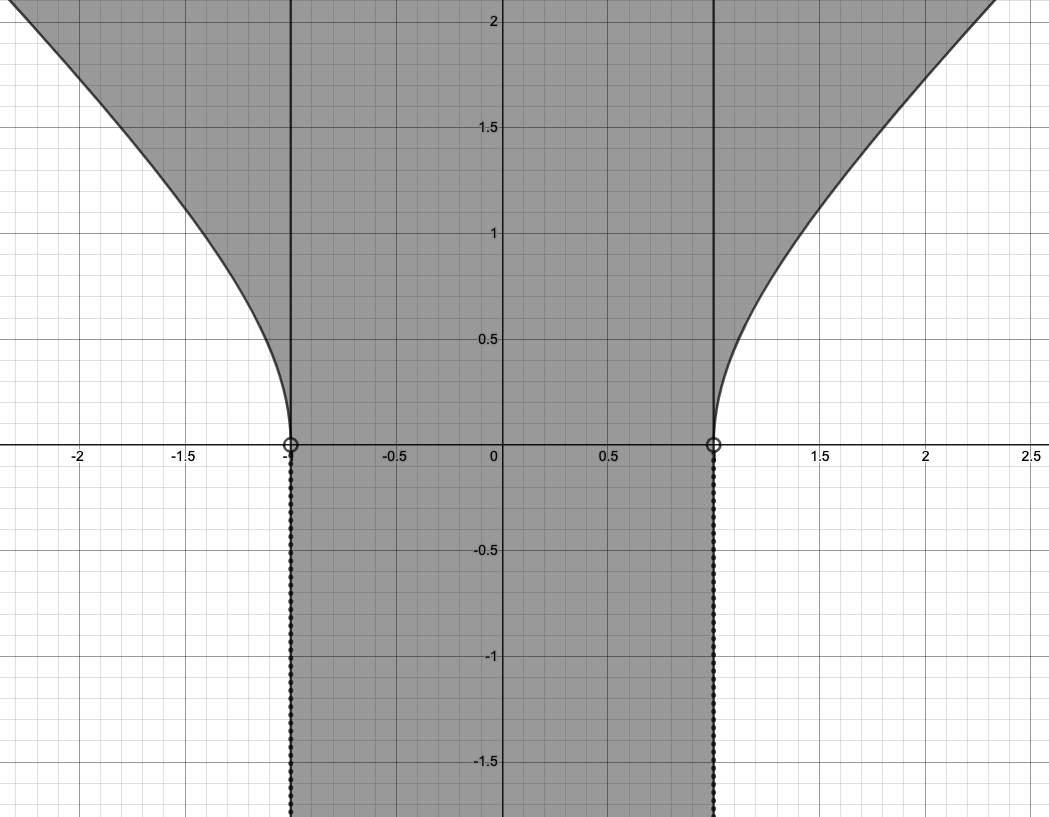
Describe the region swept out as ranges over all positive real numbers.
Strategy and difficulty
This is a standard region problem. You can either fix and find the range of , or ask whether a proposed point gives an admissible positive solution for . The first approach keeps the cases particularly transparent; see swept regions.
Solution
Fix and write
Its derivative is .
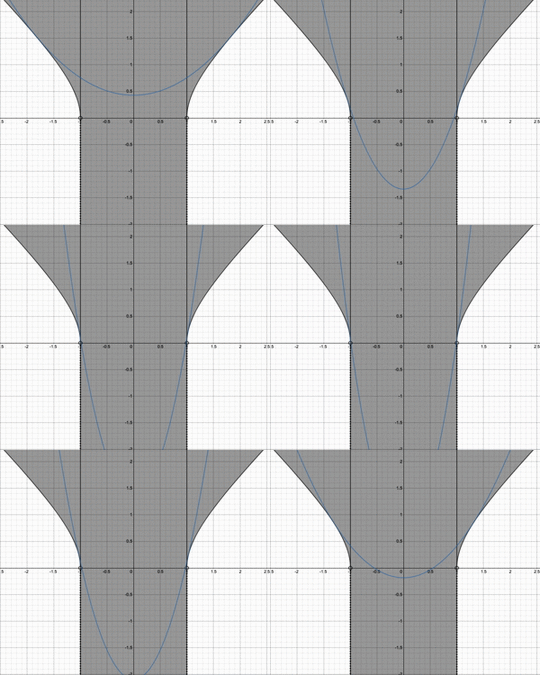
If , the function is strictly decreasing, tends to as , and tends to as . Continuity therefore gives every real .
If , it is , whose range is .
If , its derivative changes from negative to positive at
where the attained minimum is . Both endpoint limits are , so its range is .
Consequently, the swept region is
The curved boundary is included, while and the nonpositive parts of are excluded. The source's strict inequality in the third case is a typo: the minimum is attained.
Problem 2: random strings of unequal-length blocks
Roll a fair die repeatedly, appending a block at each roll: outcomes 1, 2, or 3 append AA, outcome 4 appends B, outcome 5 appends C, and outcome 6 appends D. For example, rolls produce AACDAAB.
- After rolls, find the probability that the th character from the left is A.
- For , find the probability that the st character is A and the th is B.
Strategy and difficulty
This is a standard probability-recurrence problem with an important modeling choice: condition on the first block, not just the last roll. After rolls there are at least characters, so later appends cannot alter the character positions in question.
Part 1
Let the requested probability be . For a target position , the first block has length one with probability , leaving target position in the remaining string, or length two with probability , leaving position . Thus
The initial values are and . For the latter, either the first block is AA, or it is a one-character block followed by AA.
The recurrence yields
Hence
Eliminating gives
Part 2
Let be the probability of AB at positions . The same first-block split gives for .
We have : a string cannot begin AB because A arrives only in a double block. Also , obtained by first appending AA and then B. Therefore
Solving,
The recurrence guide explains these two geometric combinations.
Problem 3: a power curve and a logarithm meet once
Let and let be a positive rational number. Suppose and , for , have exactly one common point .
- Express and the -coordinate of in terms of .
- Find the volume formed by rotating the region bounded by these two curves and the -axis about the -axis.
- Find when that volume is .
You may use as without proof.
Part 1: separate the parameter
Rather than trying to solve explicitly, write
The function increases up to and decreases afterward. It tends to at zero, is zero at one, has maximum , and tends to zero from above at infinity.
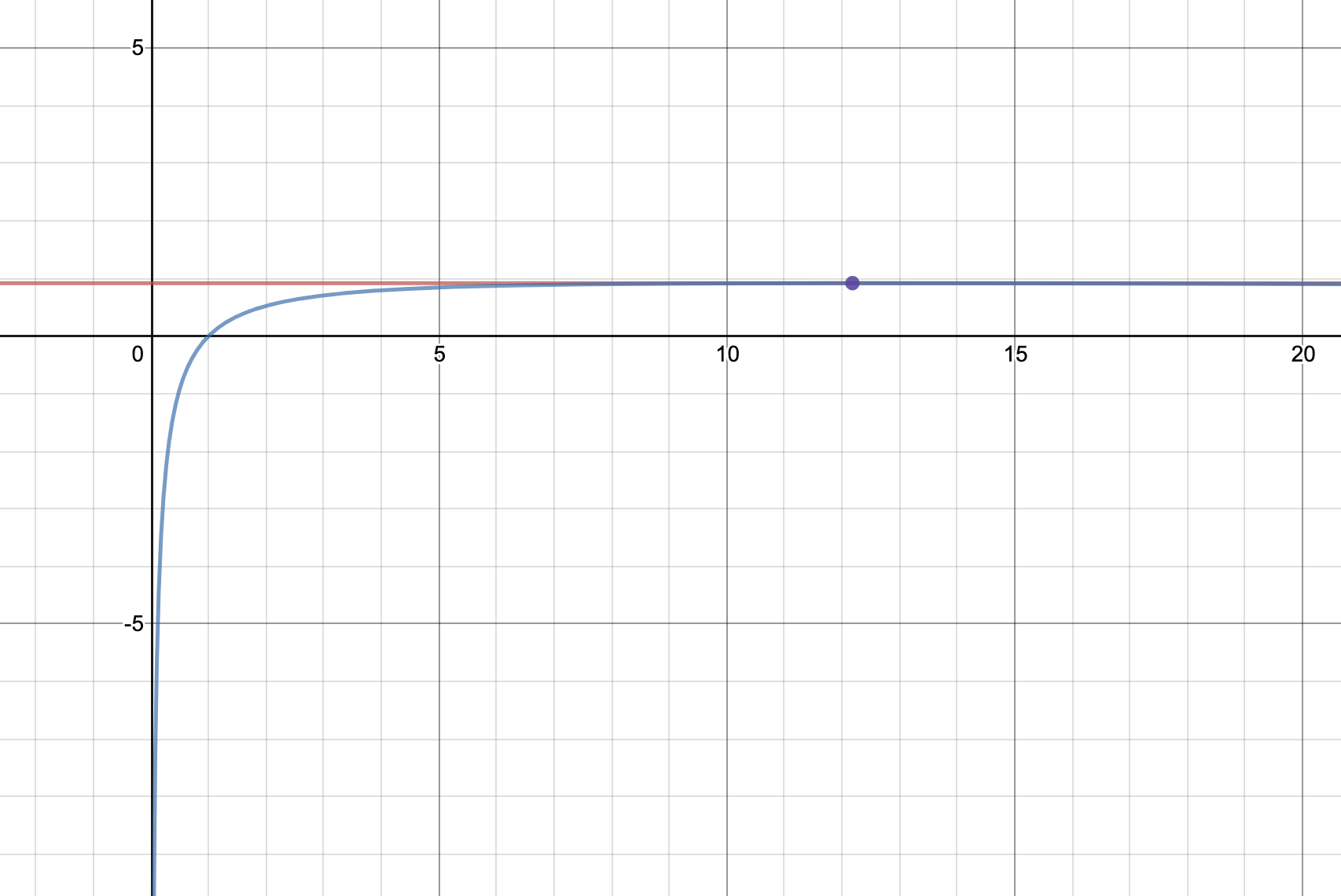
For positive , a unique intersection occurs precisely at the maximum. Therefore
The positive condition on matters: nonpositive horizontal levels have different intersection behavior.
Part 2: disks followed by washers
On the lower boundary is the axis, while on it is . The power curve provides the upper boundary throughout.
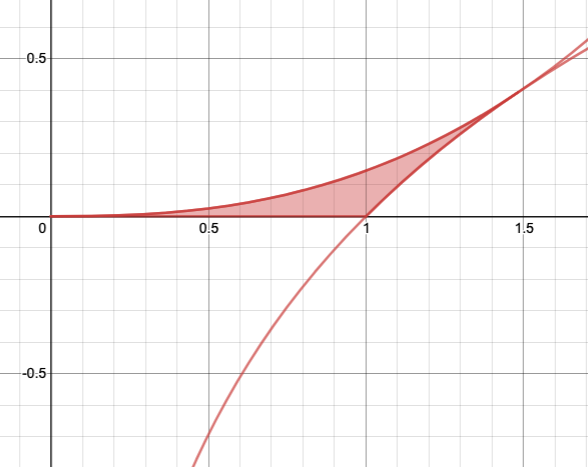
Put . The volume is
The first term is . Integration by parts twice gives
Thus
Therefore
Part 3
Since the exponential and denominator are positive, exactly when . Hence
The initial parameter separation is the main obstacle; after it, the volume calculation is a standard application of integration by parts.
Problem 4: a nonlinear recurrence hides Fibonacci numbers
Define
- Show that is independent of .
- Express using , for .
- If and , prove .
Part 1: find the invariant
Positivity follows inductively, so all divisions are valid. Substituting the recurrence and cancelling gives
The common value is its value at , namely .
Part 2: turn it into a linear recurrence
The invariant says . Replace by and divide by :
Shifting the index,
This avoids a potentially zero factor that would arise from subtracting squared identities.
Part 3: compare recurrences and initial values
The odd-index Fibonacci subsequence satisfies
This is the same second-order recurrence as for . The first two values match: and . Two-step induction therefore proves
The induction guide explains why two initial cases are needed.
Problem 5: the first even binomial coefficient
Find the smallest positive integer for which is even.
Solution
Track powers of two instead of computing huge binomial coefficients. Let denote the exponent of two dividing a positive integer . Consecutive coefficients satisfy
For , write with odd and . Since ,
and the bracket is odd. Therefore , so each step preserves the coefficient's two-adic valuation. Starting from , every coefficient through is odd.
At ,
The valuation increases by one for the first time, giving
The original solution checks the sixteen even values through 32 individually; the argument above groups those checks by their exact power of two. Either approach needs to establish that every earlier coefficient is odd. Looking only at whether a ratio is an integer would be insufficient, since the intermediate ratios can be nonintegral even when their two-adic valuation is zero.
Problem 6: concentrating integrals
For a positive integer , define
- Let be continuous. If for , prove
- Find .
Part 1: normalize the averaging kernel
Substitute . Since outside ,
On this interval , and
Multiplying by the nonnegative weight and integrating proves the bounds. Nonnegativity and total weight one are both essential.
Part 2: use the derivative relationship
We have , including at the endpoints, and . Integration by parts gives
where . The boundary term vanishes because for every integer .
Since , Part 1 gives
Both bounds tend to . The squeeze theorem therefore gives
Reviewing this paper
The author's assessment was that Problem 5's unusual parity calculation could consume disproportionate time, while the remaining problems mostly reward familiar region, recurrence, and calculus methods. The original suggested practice targets of roughly 80–90 points for the strongest medical-track candidates and 60–70 for other science-track candidates; these are historical strategy opinions, not official requirements or predictions of admission.
A useful review records the modeling choice in each problem: fixing a coordinate, conditioning on the first block, separating a parameter, finding an invariant, tracking a prime valuation, or recognizing an averaging kernel. These decisions are more transferable than memorizing the final numerical answers.
Related articles
- Equating rational and irrational parts: proof and worked problems
- How to simplify nested square roots, with three worked examples
- Conditional probability: the formula, information protocols, and worked examples
- Integration by parts: formulas, proof, and four useful patterns
- Triple-angle identities: remember, derive, and apply them
About the author
Koki Saito
Physician and graduate of the University of Tokyo Faculty of Medicine. Drawing on his entrance-exam experience, he explains how to choose mathematical methods and construct complete solutions.
Full profile →Have a question or spotted an error? Contact us.