University of Tokyo science mathematics 2016: problems and solutions
The solutions below are this site's own explanations of the 2016 science-track paper, not official University of Tokyo answers. Difficulty and timing comments are the original author's judgments. The past-paper review suggests ways to compare alternative approaches.
Problem 1: strict bounds for e
Let . Prove that for every positive real ,
Solution
The exponent on the right is , not . The author regarded this as an accessible differentiation-and-limit problem, but both derivative signs require justification.
Set and . Their positive bases and values justify logarithmic differentiation:
Differentiate the sign-controlling expressions:
Both tend to zero at infinity. Therefore and , so strictly increases and strictly decreases. Moreover,
A strictly increasing function with limit lies strictly below it; a strictly decreasing one lies strictly above it. This proves both inequalities. See logarithmic differentiation for the general method.
Problem 2: a tournament that stops after consecutive wins
Teams A, B, and C play games without draws, with each participant equally likely to win each game, independently of previous results. A plays B first. The winner then plays the waiting team C. Thereafter, unless the tournament has ended, the latest winner plays the team that sat out that game. A team winning two consecutive games becomes champion and the tournament stops.
- For , find the probability A becomes champion exactly in game .
- For , given that A wins the tournament within games, find the probability A's final opponent is B.
Part 1: recognize a forced cycle
If the first winner is A, then to avoid an earlier championship the subsequent winners must cycle A, C, B, A, C, B, and so on until someone wins again. If the first winner is B, the continuation cycle is B, C, A, B, C, A, and so on.
A can finish by repeating a win at game in the first pattern when , and in the second when . There is one specified sequence of winners in each permitted case, each with probability . Hence
The restriction excludes the nonexistent one-game championship.
Part 2: compute two finite geometric sums
A wins within games with probability
The second sum is empty at , and the final formula still gives .
A's final opponent is B only in the second pattern, whose probability is
The required conditional probability is :
At it is zero, as expected. The conditional-probability guide also develops this example.
Problem 3: minimize a projected triangle's area
Let and set
Let be the intersection of the line with the -plane. If the area of is , find its minimum and the value of attaining it.
Solution
Rather than calculate all three separately, first replace by the point on at height one. A point on that line is
Its height is one when , so
The triangle lies in the plane , with area
Projection from to the parallel plane multiplies lengths by and areas by its square. Therefore
Differentiate:
On the allowed interval, the denominator and factors are positive. Thus decreases before two and increases afterward, giving
The geometric reduction saves coordinates; the final optimization is routine once the correct area-scaling factor is in place.
Problem 4: when do 1, z, and z squared form an acute triangle?
Find and sketch the set of complex numbers for which , , and form an acute triangle.
Solution
Coincidences occur at , so these cannot be admitted. For three distinct points, an angle at a vertex is acute when the real part of the ratio of its two incident vectors is positive. This is the complex form of a positive dot product.
At B and A the ratios simplify to
Thus their real-part conditions are and . At C,
whose real part is positive exactly when
Combining,
These conditions already exclude the coincident points. They also exclude real , since real numbers strictly between minus one and zero lie inside the indicated circle. Thus the three points are noncollinear, and the three positive dot products are sufficient for a genuine acute triangle.
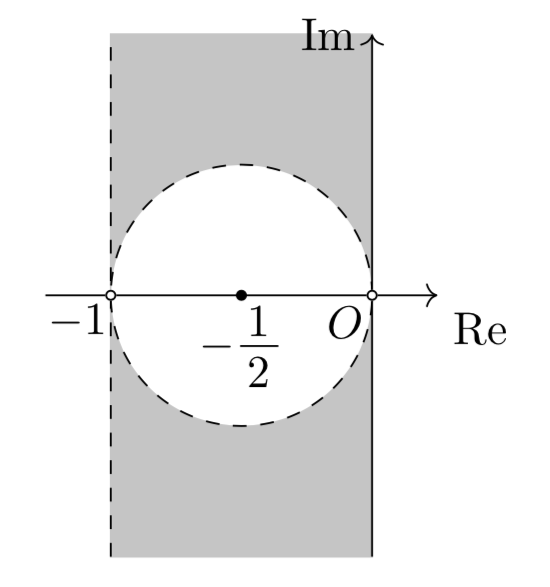
The author rated this as standard once the translation of “acute” into an algebraic condition was recognized.
Problem 5: prescribed decimal digits in square roots
Let and choose decimal digits with . Write
- Find all positive integers satisfying .
- Show that if the integer , some positive integer satisfies .
- Show that no positive integer has .
Part 1: square a narrow positive interval
Put and . Then . Since all quantities are positive, the requested condition is equivalent to
The bounds are
Because and , exactly two integers occur:
This notation automatically handles carrying among decimal digits. The increment in the original interval is , not the appearing in some source expansions.
Part 2: an interval wider than one
Squaring again gives
Their difference is
since . Choose . Then , so it satisfies the desired inequalities. It is positive because .
Part 3: a noninteger square root cannot have this finite fraction
Suppose the equality held. Then would be rational and nonintegral, because . Write it as in lowest terms, with positive integers . Squaring gives . Coprimality of forces , so is an integer, a contradiction.
This last part is logically independent of most of the preceding interval construction. It proves the stronger familiar fact that a square root of an integer is either an integer or irrational.
Problem 6: the volume swept by a moving segment
A segment of length two moves in space so that A lies in and lies on the segment. Let be the region it sweeps. Find the volume of .
Find the sections before integrating
The conditions are rotationally symmetric about the -axis. In an axial plane, let be the angle of the directed segment from A toward B with the positive vertical direction. Then , because .
The endpoint B has radial coordinate and height
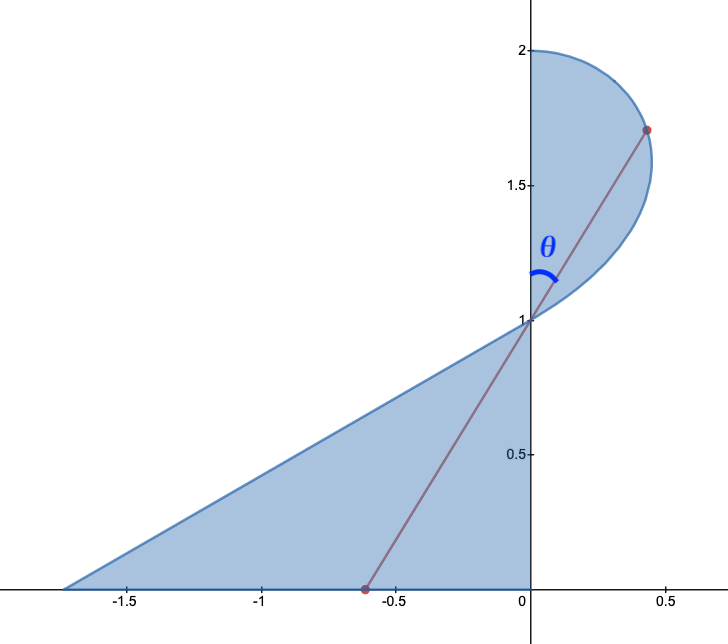
To justify the full cross-section, fix and a possible radius . The line through C and this point reaches at radius on the opposite side. The length from that plane to the point is
It can fit within a segment of length two exactly when
Every intermediate radius is therefore attained, so the section is a disk. At it reduces to C, and at to a point on the axis.
Integrate the disks
Thus
An equivalent calculation substitutes :
Use , or reserve one sine factor for substitution. The triple-angle guide gives both options, and parametric rotation volumes explain the importance of branch direction and disks versus washers.
The author viewed the problem as conceptually standard but calculation-heavy. Checking that the boundary actually bounds filled disks is as important as evaluating the integral.
Reviewing this paper
The original assessment was that the paper had no exceptionally hard single problem, but enough calculation to make a perfect score difficult. Its suggested historical practice targets were 90–100 for the strongest medical-track candidates and 70–80 for other science-track candidates; these are strategy opinions, not official admissions criteria.
Review the decisions that make the calculations manageable: differentiate the sign-controlling logarithm, identify a forced cycle, use similarity before coordinates, translate acute angles into dot products, square positive decimal bounds, and prove the shape of a swept cross-section.
Related articles
- Equating rational and irrational parts: proof and worked problems
- How to simplify nested square roots, with three worked examples
- Conditional probability: the formula, information protocols, and worked examples
- Integration by parts: formulas, proof, and four useful patterns
- Triple-angle identities: remember, derive, and apply them
About the author
Koki Saito
Physician and graduate of the University of Tokyo Faculty of Medicine. Drawing on his entrance-exam experience, he explains how to choose mathematical methods and construct complete solutions.
Full profile →Have a question or spotted an error? Contact us.