Logarithmic differentiation: variable powers, products, and worked problems
Why logarithms help
When both the base and exponent depend on , neither the constant-power rule nor the constant-base exponential rule applies on its own. On an interval where , let
Taking natural logarithms gives . Differentiate using the chain and product rules:
Therefore
Natural logarithms keep the derivative formula simple. Other logarithm bases are possible but introduce conversion factors. The notation throughout this article makes the natural base explicit.
Three useful situations
A constant base: recover the exponential derivative
For with constant , , so
The case gives zero as it should. This derivation presumes that the logarithm, its derivative, and the relevant inverse-function differentiation rules have already been established. It should not be used circularly to establish those same starting facts.
Both base and exponent vary
For on ,
hence
Treating the exponent as a constant and writing would miss the change in the exponent.
Many products and powers
Example. Differentiate the real fifth-root function
The original real function is defined for . To take a logarithm, also work away from the zeros and use an absolute value:
Differentiate:
Thus, for ,
The points require separate analysis rather than substitution into this formula. Locally the function behaves like a nonzero constant times a signed power of order or , respectively, so it has no finite derivative there. The point is outside the original domain entirely.
Taking accommodates negative values of ; it does not make a logarithm of zero permissible.
An equivalent shortcut: write the power as an exponential
For a positive base,
The chain rule immediately gives the same derivative. For instance,
This is a shorter presentation of the same reasoning, not a different rule that avoids the domain condition.
Problem 1: minimize x to the power x
Problem. Find the minimum of for .
Since , the sign of its derivative is the sign of . This is negative for , zero at , and positive for .
The function therefore decreases and then increases, giving the global minimum
Problem 2: two bounds for e
The following problem is attributed in the original article to the University of Tokyo's 2016 science-track paper.
Problem. Define by
Prove that for every real ,
The exponent on the right is , which is important for the sharper upper bound.
Take logarithms and define
Both tend to as . Direct differentiation gives
and
Both first derivatives tend to zero at infinity. Since is strictly decreasing toward zero, it is positive. Since is strictly increasing toward zero, it is negative. Thus increases strictly toward and decreases strictly toward :
Exponentiation, which preserves inequalities, proves both bounds.
Problem 3: a variable exponent, a graph, and two roots
This problem is attributed in the source to Ochanomizu University's 2018 paper. Let
- Find and .
- Sketch the curve, including its behavior as and that of its derivative. You may use as ; the coordinates of inflection points are not required.
- Find the real values of for which has two distinct positive roots.
Part 1: derivatives
Since ,
Another differentiation gives
Part 2: limits and monotonicity
As , , so
The point is approached but is not in the domain. The derivative is negative for and positive for . The minimum is
As , . These facts give the graph's endpoint behavior, unique minimum, and increasing branch. The second derivative is negative sufficiently close to zero and positive at the minimum, consistent with a change of concavity before that minimum.
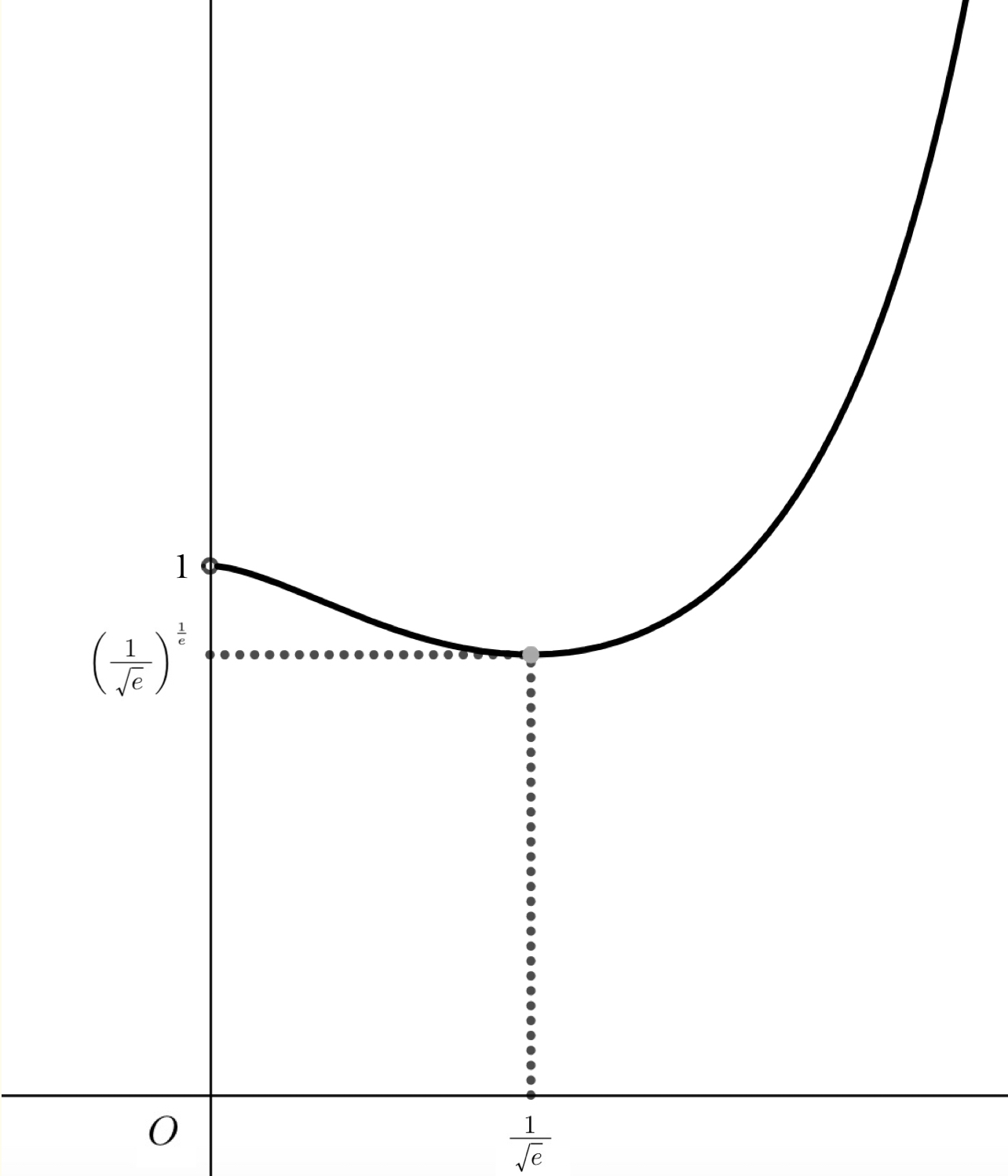
Part 3: count the intersections with y = k
The decreasing branch takes precisely the values , while the increasing branch takes every value above . At the two branches meet in one point. Therefore two distinct positive roots occur exactly when
At , only the increasing branch contributes, since the endpoint is excluded. At there is one root, and below none.
This final step is a parameter-separation and graphical root-counting problem. Logarithmic differentiation supplies the graph; domain and endpoint checks determine the answer.
Related articles
- Equating rational and irrational parts: proof and worked problems
- How to simplify nested square roots, with three worked examples
- Conditional probability: the formula, information protocols, and worked examples
- Integration by parts: formulas, proof, and four useful patterns
- Triple-angle identities: remember, derive, and apply them
About the author
Koki Saito
Physician and graduate of the University of Tokyo Faculty of Medicine. Drawing on his entrance-exam experience, he explains how to choose mathematical methods and construct complete solutions.
Full profile →Have a question or spotted an error? Contact us.