Finding a locus: eliminate parameters and prove every point occurs
A locus is a set of attainable points
A locus describes all positions satisfying a stated construction or condition. Many elementary examples are curves; some problems ask for a region instead. In either case, the essential task is to prove both directions: every constructed point lies in your proposed set, and every point in that set is actually obtainable.
Two useful approaches are eliminating parameters and using geometry. Neither method automatically guarantees that an equation has no extra points.
Elimination must preserve restrictions
Suppose
Since , substitution into both the equation and the interval yields
Every in that interval corresponds to an allowed , so this is the entire locus. Dropping the interval would incorrectly add the rest of the parabola. For more methods, see parametric curves.
Geometry can identify the curve, but check missing points
Drop a perpendicular from to the line , with ranging over all real numbers. Let the foot be .
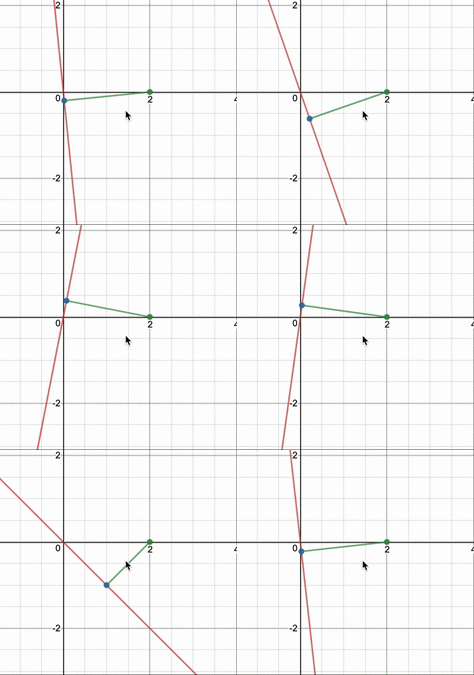
The right-angle condition places on the circle with diameter . However, the line never becomes vertical, so never reaches the origin. The position does occur when , even though the corresponding right triangle is degenerate.
Algebra confirms the exact set. By orthogonal projection,
Thus
Conversely, a point on this circle other than the origin has . Taking recovers its coordinates in the displayed projection formula. This proves that no other point is missing.
Example 1: transform a unit circle
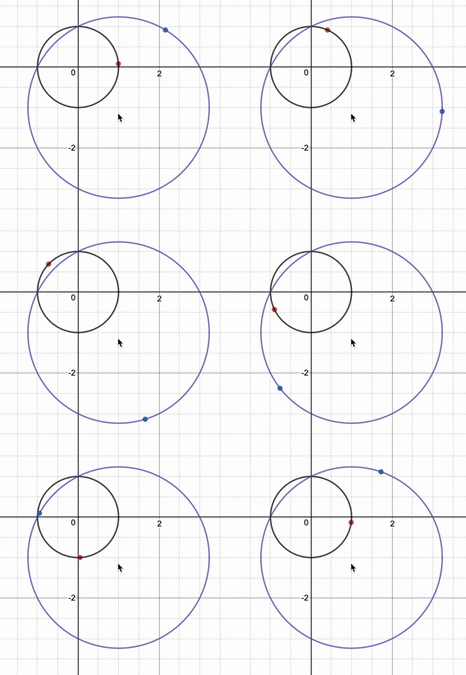
Let move on . Find the locus of
Write and solve for the original coordinates:
Substitution into the unit-circle equation gives
or
The coordinate transformation is invertible, and each point on this new circle maps back to a point of the unit circle. Therefore the whole circle is attained.
Example 2: reflect a fixed point in a varying line
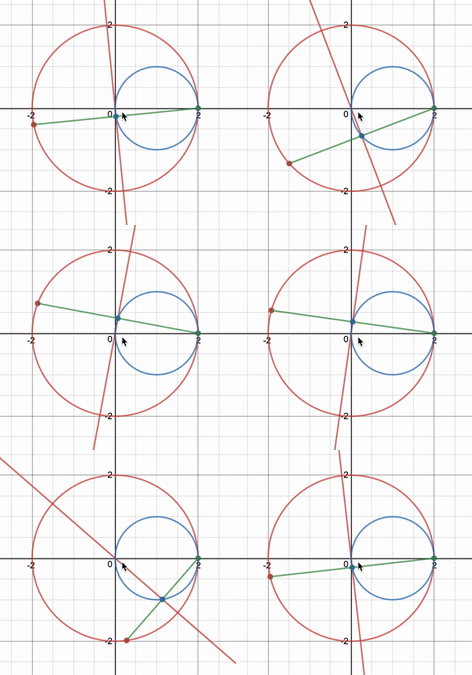
Let and let be its reflection in . Find the locus of as ranges over all real numbers. The source's prose omits the coordinates of , but its diagram and solution use this fixed point.
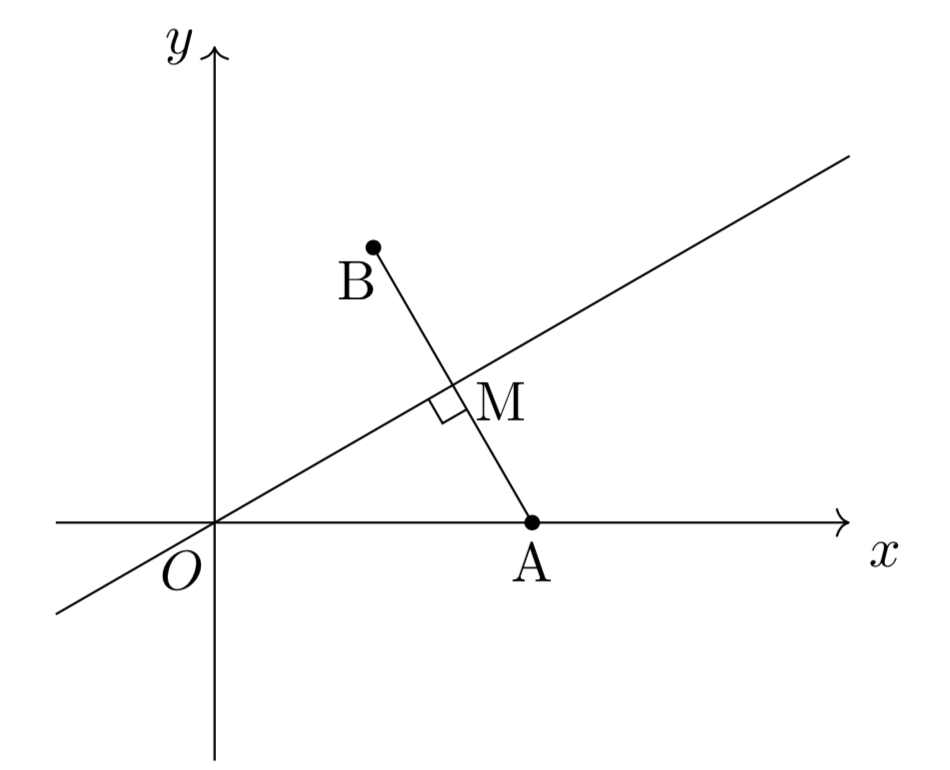
The midpoint of is the perpendicular foot just studied. Hence runs over the circle with diameter , excluding . If , then , giving
and the exclusion becomes . Thus
The affine correspondence is one-to-one, so every remaining point is attained. In particular occurs for the horizontal mirror line.
Example 3: midpoints of perpendicular radius vectors
Let be the origin and let lie on , with . Find the locus of the midpoint of .
Set
The nonzero restriction is necessary because an angle with a zero vector is undefined. Orthogonality gives
Since , we obtain . Put and . For ,
To show that every real occurs, the required must be real, nonzero, and distinct. They are the roots of
The discriminant is , and the product is . Thus these roots always meet all requirements and produce perpendicular nonzero vectors. Consequently the entire parabola
is the locus.
The recurring checks are the original parameter interval, real-root conditions after symmetric substitutions, excluded degenerate constructions, and a converse showing that no proposed point is unattainable.
Related articles
- Equating rational and irrational parts: proof and worked problems
- How to simplify nested square roots, with three worked examples
- Conditional probability: the formula, information protocols, and worked examples
- Integration by parts: formulas, proof, and four useful patterns
- Triple-angle identities: remember, derive, and apply them
About the author
Koki Saito
Physician and graduate of the University of Tokyo Faculty of Medicine. Drawing on his entrance-exam experience, he explains how to choose mathematical methods and construct complete solutions.
Full profile →Have a question or spotted an error? Contact us.