Common tangents: five useful problem patterns
Turn tangency into an equation
A common tangent touches two curves, possibly at different points. Five useful patterns are: a parabola paired with another graph, two higher-degree graphs, a line touching a quartic twice, two circles, and a parameter chosen to give a specified number of tangents. These are a practical collection of methods, not an exhaustive classification of all tangent problems.
For a differentiable graph , the tangent at is
Match both slope and intercept when two such expressions must describe the same line. For a parabola, substituting a proposed line gives a quadratic, and tangency is its repeated-root condition. For a circle, the distance from its center to the line must equal its radius.
A genuine cubic cannot have one line tangent at two distinct points: the difference between the cubic and line would need two distinct double roots, requiring degree at least four. This observation helps when counting tangents from their contact parameters.
1. A parabola and a cubic
How many lines are tangent to both and ?
At a cubic contact parameter , the tangent is
Intersection with the parabola gives
Its discriminant must vanish:
The distinct real parameters are
They give distinct cubic tangents by the degree argument above. Hence there are three common tangents. The repeated algebraic root still represents only one line.
If you need their equations, reduce higher powers of the quadratic roots before substituting. For example,
At a root of the quadratic, only the final linear remainder remains.
2. Two cubic graphs
Find the common tangents of and .
With contact parameters , their tangent equations are
Matching coefficients gives and . The case is impossible. With , we obtain , , and therefore
Matching slopes alone would not be sufficient: parallel tangents need not be the same line.
3. A quartic touched twice
Find a line tangent at two distinct points to
The tangent cannot be vertical, since this polynomial graph has a finite derivative everywhere. Write it as and let its distinct contact coordinates be . The difference polynomial is monic and has double roots at both points, so
Coefficient comparison gives
Hence , , and . The contact coordinates are the roots of , namely and , confirming they really are distinct and real. Thus
The factorization also checks the result directly: the difference is . The area between the curve and this line is
More generally,
For a quartic with leading coefficient , the ordinary enclosed area includes the factor .
4. Two circles
For a line , where , the distance from is
Equating this to each radius handles circle tangency and includes vertical lines. Two distinct circles can have up to four common tangents. External tangents place both centers on the same side; internal tangents place them on opposite sides. Coincident circles are an exception with infinitely many tangents.
Example and a correction to the source
The source statement uses and , but its solution uses center . These are different configurations.
For the stated pair with centers two units apart, the circles touch externally. The complete answer is
In particular, excluding vertical lines would lose a valid tangent. To check completeness, a nonvertical line must satisfy and . Thus ; contradicts the first equation, leaving , . A vertical common tangent must be .
For the pair actually solved in the source, with second center , there is no common vertical tangent. The conditions are instead
Subtracting gives . Either , , or , which gives . The four lines are
with the paired signs taken together.
5. Choose a parameter to obtain four tangents
Find all for which and have four common tangents.
The tangent to the cubic at is . Substituting it into the parabola gives
The discriminant condition is
Different real give different cubic tangents, so we need four distinct real solutions. Let . Then
Its successive critical values are
The derivative signs are on the four intervals, and at both ends.
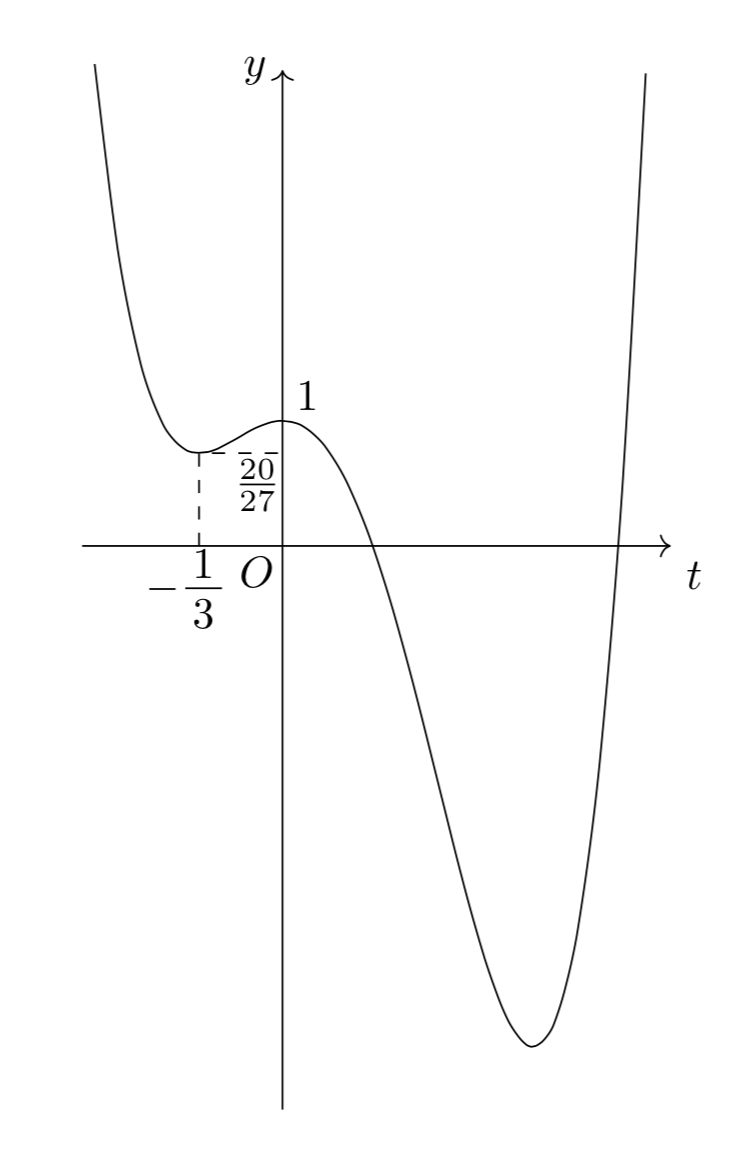
A horizontal line meets all four monotone branches exactly when . At either boundary, two intersections merge and there are fewer than four distinct tangents. Consequently,
This is an application of root placement and parameter separation. In general, always justify the relationship between contact parameters and distinct lines before using a root count as a tangent count.
Related articles
- Equating rational and irrational parts: proof and worked problems
- How to simplify nested square roots, with three worked examples
- Conditional probability: the formula, information protocols, and worked examples
- Integration by parts: formulas, proof, and four useful patterns
- Triple-angle identities: remember, derive, and apply them
About the author
Koki Saito
Physician and graduate of the University of Tokyo Faculty of Medicine. Drawing on his entrance-exam experience, he explains how to choose mathematical methods and construct complete solutions.
Full profile →Have a question or spotted an error? Contact us.