University of Tokyo science mathematics 2017: problems and solutions
These explanations are independently written by this site and are not official University of Tokyo solutions. The original author considered the 2017 science-track paper comparatively accessible. Difficulty and score suggestions below are personal assessments, not official admissions criteria. See the past-paper review for study suggestions.
Problem 1: a trigonometric quotient becomes a quadratic
For real , define
- Express and as polynomials in .
- Find and sketch the parameters for which has attained minimum zero on this interval.
The source screenshot places the minus one outside the denominator, which is inconsistent with the polynomial question and its solution. The denominator used here is .
Solution
Using and ,
The value is at , corresponding to . Therefore
Complete the square:
Because , an attained minimum requires the vertex to lie strictly inside the interval. Its height must be zero, giving
The parameter set is the indicated open arc of a parabola. The endpoints and are excluded.
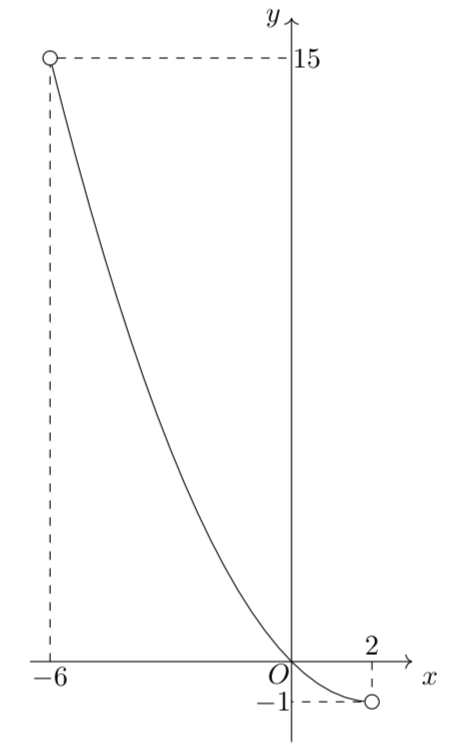
The author rated this as a straightforward use of triple angles and quadratic optimization. Remembering the open interval prevents confusing a minimum with an unattained infimum.
Problem 2: a six-step lattice walk
A point starts at the origin of the integer lattice. Each second it independently moves one unit right, up, left, or down, each with probability .
- Find the probability that after six seconds it lies on .
- Find the probability that it is back at the origin.
A short solution using diagonal coordinates
Let and . Each step changes each coordinate by either plus or minus one. The four pairs of changes occur equally often among the four possible moves. Thus the two step increments are independent fair signs. Across independent steps, the entire U-increment sequence is independent of the V-increment sequence.
The condition means . After six steps this requires three positive and three negative V-increments, so
The origin requires both and . Their independence, justified by the increment pairs above rather than by symmetry alone, gives
An endpoint-counting alternative
All paths are equally likely. The diagonal endpoints and numbers of paths to each are:
| Endpoint | Paths to each endpoint | | --- | --- | | | 400 | | and | 300 each | | and | 120 each | | and | 20 each |
For example, the origin count sums over nonnegative . More generally, at the right and up counts exceed their opposite counts by , and summing the corresponding multinomial counts gives the table. It yields on the diagonal and at the origin. The shorter diagonal-coordinate method saves time while the table provides a direct check.
Problem 3: the complex reciprocal of a line segment
For nonzero complex , put .
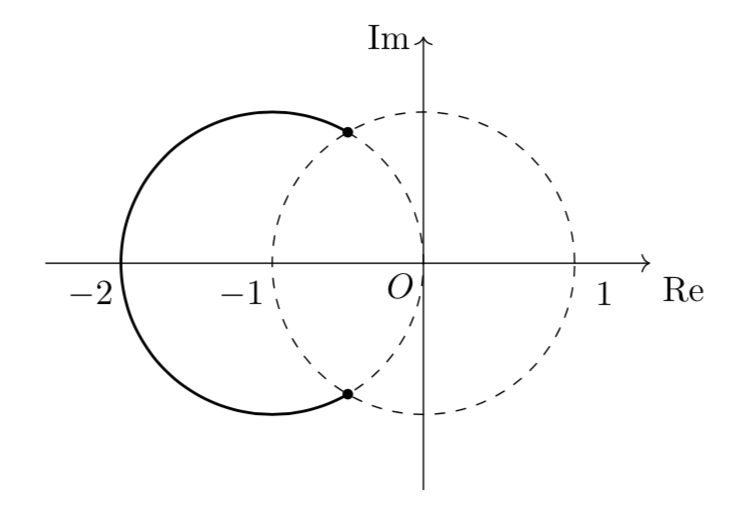
- Let and let be the perpendicular bisector of the segment from zero to . Show its image is a circle minus one point, and find the center and radius.
- Let be the cube root of one with positive imaginary part. Find the locus of as ranges over the closed segment joining to .
Part 1
On , . Substituting , with , gives
Thus the center is and radius , with excluded. Conversely, any nonzero point on this circle gives a point on the bisector, so no other point is missing.
The map combines inversion with reflection in the real axis. It is not exactly the geometric inversion ; see the inversion guide.
Part 2
We have and . Their segment is exactly
The line is the perpendicular bisector of zero and minus one. Part 1 therefore gives , while . The complete answer is
Every point satisfying these conditions has a nonzero reciprocal in the original segment. The two endpoints are included.
Problem 4: conjugate powers and a gcd
Let and, for , define
Find ; for , express using ; prove every is a positive integer; and find .
Initial values and recurrence
Since , the two bases have sum four and product minus one. Thus
For two bases ,
Here , so
The coefficient four multiplies , not . The two positive integer initial values and this recurrence prove positivity and integrality by two-step induction.
Alternatively, expanding and makes the odd radical terms cancel. Only even radical powers remain, giving an even integer. The conjugate expansion must reverse the signs of the odd radical terms.
Descend the gcd
Euclid's algorithm and the recurrence give
Hence
The conjugate-power guide explains this technique and its relation to integer and fractional parts.
Problem 5: common tangents to two reflected parabolas
For real , consider
- If is a common tangent with , express in terms of .
- Determine when a common tangent has slope two. Show that there are three common tangents and find their slopes and intercepts.
Part 1: impose two repeated-root conditions
A common tangent cannot be horizontal: substituting into C gives a single intersection with a nonhorizontal tangent. It cannot be vertical either, because D is a polynomial graph with finite derivative. Thus write a nonvertical line with .
For C, substitution gives
The discriminant condition is . For D, the corresponding equation is , giving . Substitute from the second equation into the first:
With , use and divide by . The resulting formulas are
Keeping the sign of the cubic correct is essential to this factorization.
Part 2: include the exceptional slope
At , the formula gives . For , solving gives or . Their intercepts are and .
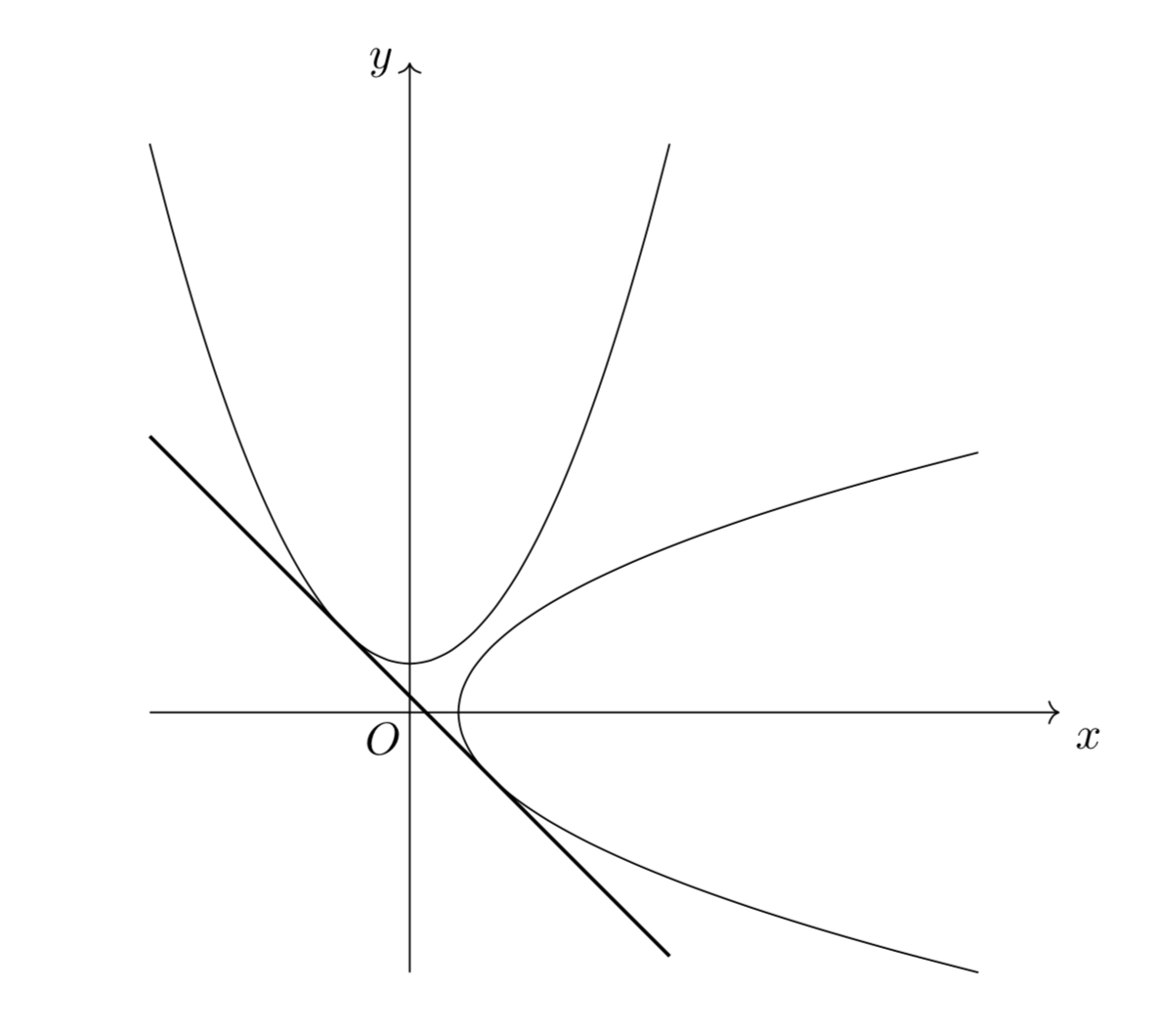
The excluded case must be examined separately. Substitution of into D gives , whose discriminant vanishes at . Substitution into C gives the same double-root condition. Thus the three pairs are
All possible slopes have been covered, and no vertical line is tangent to D, proving completeness. The main lesson is to return to a parameter value excluded during division. See the common-tangent guide.
Problem 6: rotate an equilateral triangle and sweep its edge
In three-dimensional space, O is the origin and is an equilateral triangle of side one. Put and .
- When , find the ranges of the x-coordinate of P and of .
- Let Q move in the plane . Find the volume of the region K swept out by the segment OP.
Part 1: the endpoint circle
The constraints imply and . Thus P runs over a circle of radius at height .
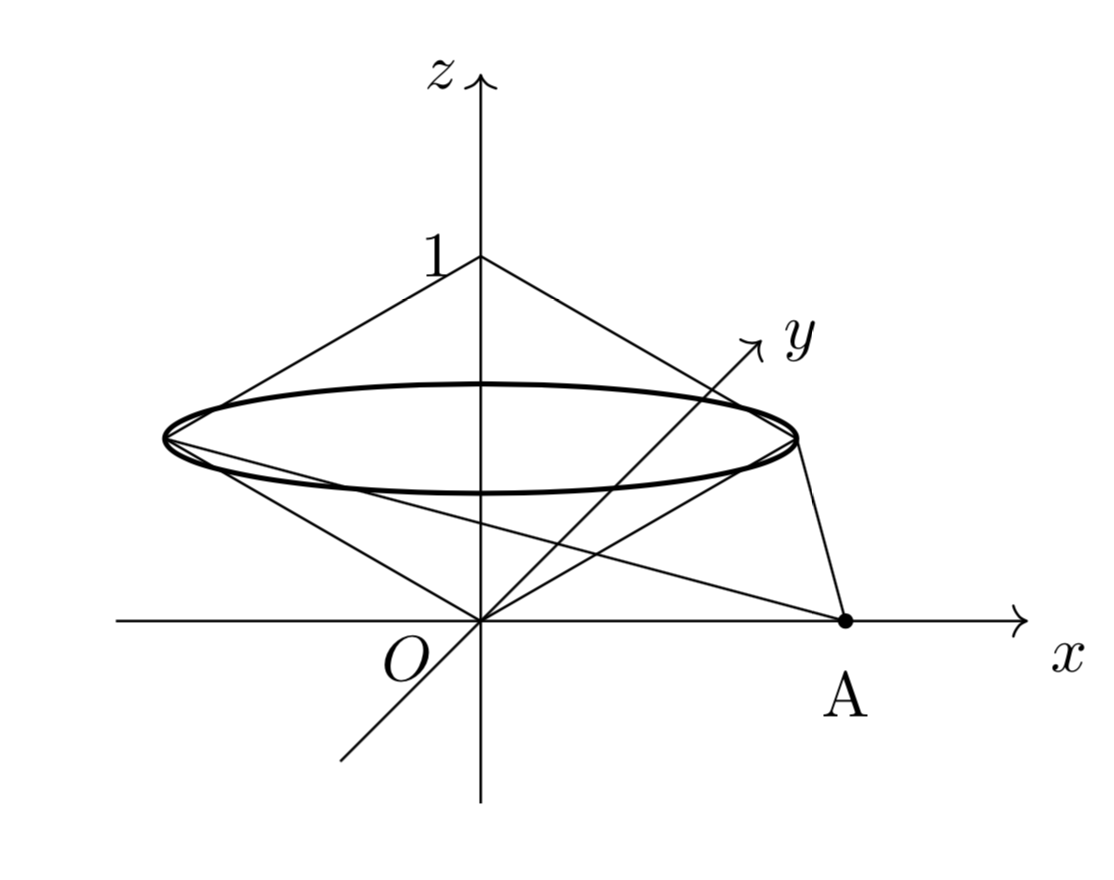
Since , . Therefore
Every intermediate value is attained by moving continuously around the circle.
Part 2: prove the full set of possible directions
Q must remain at unit distance from O, so it moves on the unit circle in the yz-plane. For a unit endpoint direction , the equilateral condition is .
As Q moves on that circle, takes all values from to . Thus such a Q exists exactly when
The segment OP then supplies every radius between zero and one along each admissible direction. Consequently K is the part of the closed unit ball outside the two open cones about the positive and negative x-axes with half-angle .
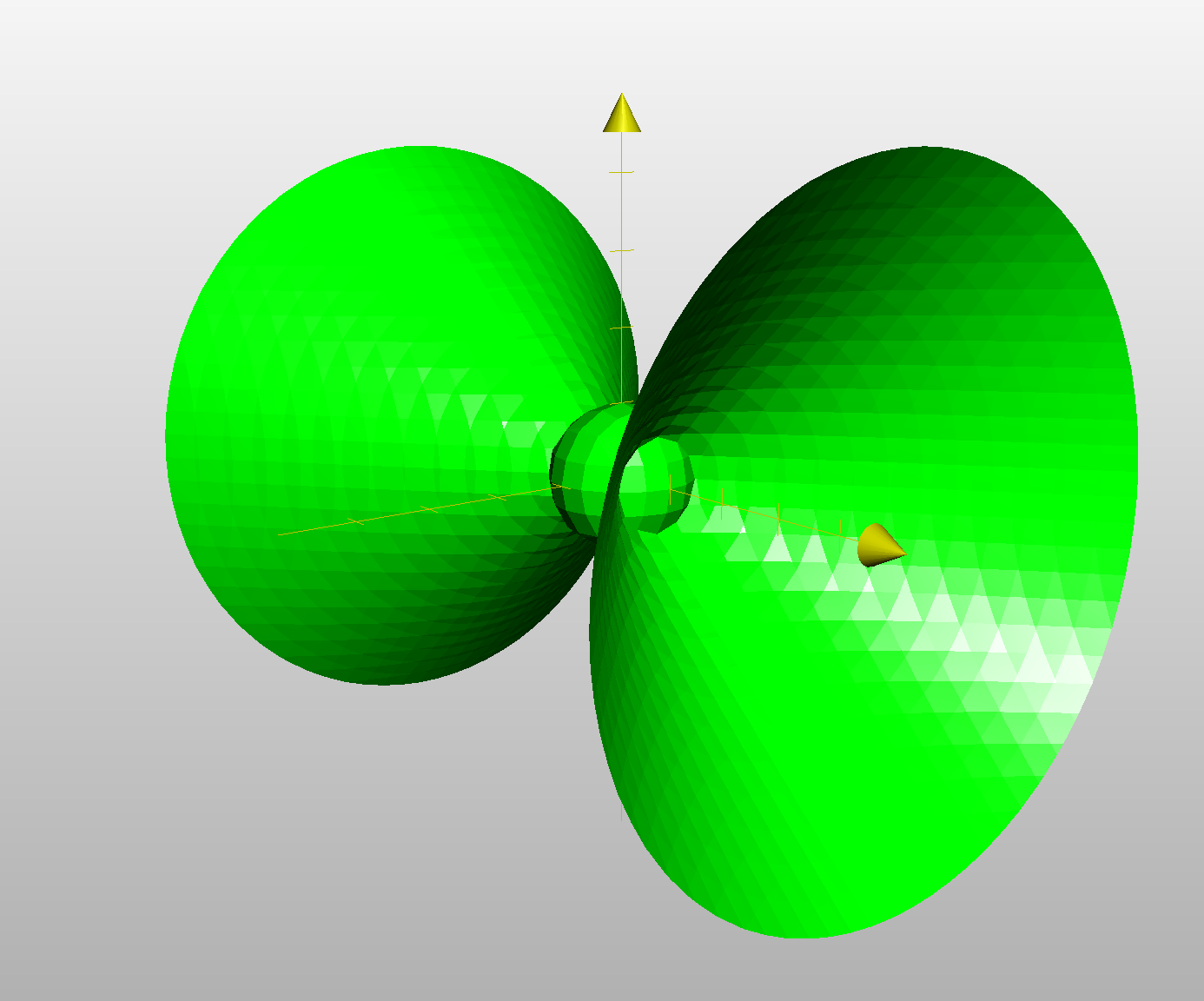
At a fixed , put . The ball requires , and the allowed direction condition requires . Hence the section is the full annulus
Its area is . Integrating,
Equivalently, subtract from the corresponding central slab of the ball two cones of radius and height . It is the moving segment, not only the endpoint P, that fills the volume.
Reviewing this paper
The original author recommended ambitious historical practice targets—110–120 for the strongest medical-track candidates and 80–90 for other science-track candidates—because the set was judged comparatively accessible. These are personal strategy opinions, not official cutoffs or a guarantee of admission.
The time-saving ideas are worth retaining: reduce trigonometry to a quadratic, use independent diagonal increments, track a reciprocal map's missing point, exploit conjugates, restore an excluded tangent slope, and prove every attainable direction before integrating a swept volume.
Related articles
- Equating rational and irrational parts: proof and worked problems
- How to simplify nested square roots, with three worked examples
- Conditional probability: the formula, information protocols, and worked examples
- Integration by parts: formulas, proof, and four useful patterns
- Triple-angle identities: remember, derive, and apply them
About the author
Koki Saito
Physician and graduate of the University of Tokyo Faculty of Medicine. Drawing on his entrance-exam experience, he explains how to choose mathematical methods and construct complete solutions.
Full profile →Have a question or spotted an error? Contact us.