Reciprocal polynomial equations: symmetry, substitution, and applications
What is a reciprocal polynomial?
A polynomial is reciprocal, or palindromic, when its coefficients read the same in ascending and descending order. For example,
has coefficient list . If has degree , the symmetry is expressed by for nonzero .
This structure can reduce the degree of an equation substantially. It does not guarantee a simple radical formula for equations of arbitrarily high degree, but it provides a systematic first reduction.
Even degree: divide by the middle power
Example. Solve
The constant term is one, so is not a solution. Divide by :
Set . Since , the equation becomes
giving or .
- gives , so .
- gives , so .
Thus the distinct solutions are
The root has multiplicity two; indeed the quartic factors as .
Why the substitution works in general
After a reciprocal polynomial of degree is divided by , terms occur in pairs , together with a possible constant term.
Write . Then
By induction every is a polynomial in . The original degree- equation therefore reduces to one of degree at most in . This is also an instance of expressing a symmetric polynomial in through their sum and product one.
Odd degree: first remove x + 1
Every odd-degree reciprocal polynomial has : symmetric terms cancel in pairs. Hence it has a factor .
For example,
The remaining quartic is the one already solved. Consequently the distinct roots are again , with now having multiplicity three.
The zero coefficients of and are part of the palindromic coefficient list. Including them makes the symmetry visible.
Why the quotient remains reciprocal
If has degree , reciprocity gives
Canceling for nonzero proves . Since this is a polynomial identity after clearing negative powers, it establishes the coefficient symmetry of the degree- quotient.
Application 1: the fifth roots of unity
Problem. Find all complex numbers satisfying .
Factor
For the quartic factor, . Divide by and put :
For either value of , solve . The five roots are
These agree with the more compact trigonometric description
The reciprocal substitution also derives the exact sine and cosine values rather than requiring them beforehand.
Application 2: prove a quartic is always positive
Problem. Show that for every real ,
At , the expression is two. For nonzero , division by the positive number preserves the inequality. With , it becomes
First find the allowed range of X
A real nonzero satisfying exists exactly when has a real root. Its discriminant gives
Conversely, for every such , the quadratic formula supplies real roots whose product is one, so they are nonzero. This proves the entire range, including attainability.
Now factor
For , both factors are negative. For , both are positive. Hence their product is strictly positive throughout the allowed range, proving the original inequality.
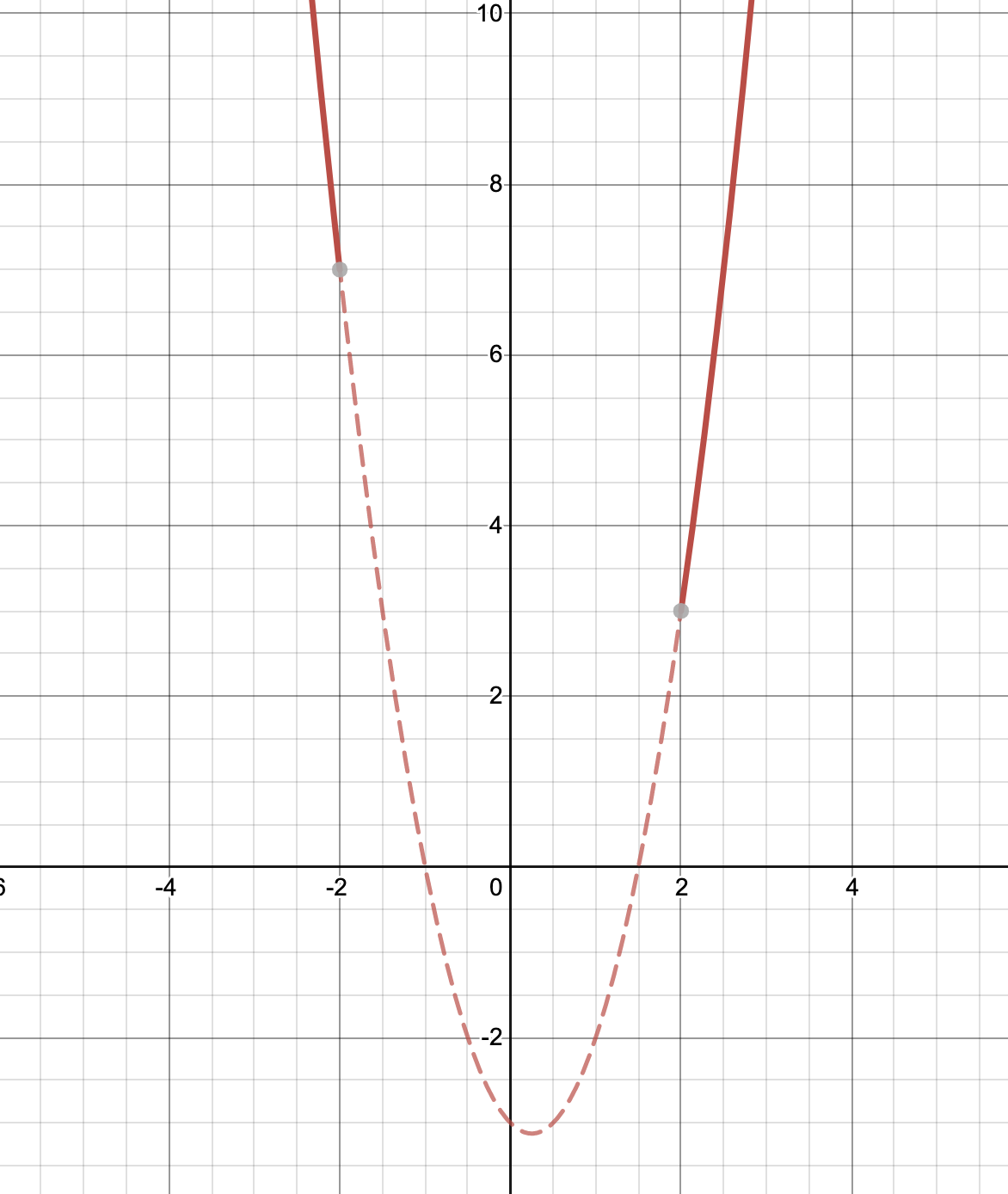
The important step was to keep the substitution's range. Showing positivity for every real would be false and is unnecessary. Bounds from an inequality can help locate a range, but a complete range statement should also explain why every claimed value is attained.
Related: root placement in intervals and conjugate radical powers.
Related articles
- Equating rational and irrational parts: proof and worked problems
- How to simplify nested square roots, with three worked examples
- Conditional probability: the formula, information protocols, and worked examples
- Integration by parts: formulas, proof, and four useful patterns
- Triple-angle identities: remember, derive, and apply them
About the author
Koki Saito
Physician and graduate of the University of Tokyo Faculty of Medicine. Drawing on his entrance-exam experience, he explains how to choose mathematical methods and construct complete solutions.
Full profile →Have a question or spotted an error? Contact us.