Perfect-score practice: three lessons from the former Center Test
The setting of this advice
The original article describes the author's preparation for the former Japanese Center Test, in which he received full marks in mathematics. Its references to Mathematics I/A question choices and Mathematics II/B topics describe that historical format. They should not be read as the rules of the current Common Test.
For current subjects, selection instructions, and official materials, consult the National Center for University Entrance Examinations' Common Test information. The transferable ideas below concern practice, checking, and calculation structure rather than a promise that any particular score is guaranteed.
Lesson 1: practice leaving time to review
The author's practice target was to finish with at least ten minutes available for checking. His account describes three stages:
- Use past papers to learn to finish efficiently, identifying unnecessary repeated work.
- Use the saved time to revisit doubtful questions and aim for a fully correct paper.
- Repeat the process with unfamiliar practice papers, so the speed is not merely recognition of remembered answers.
In his own Center Test attempt, he reports finishing Mathematics I/A with roughly twenty minutes left and Mathematics II/B with fifteen. Those are personal results, not timing requirements for another year's paper.
A review buffer is valuable only if it is used deliberately. Mark an uncertain answer, preserve enough intermediate work to check it, and revisit likely error points such as signs, counting factors, domains, and answer-box transcription.
Lesson 2: favor reliability when a format permits choices
In the former Mathematics I/A format discussed in the source, the author preferred the integer and geometry questions to probability questions. His reason was personal error detection: geometric values could be checked against a diagram, and integer answers often allowed direct substitution. A missed factor in a probability calculation was less visually conspicuous to him.
The general lesson is to evaluate your own accuracy and ability to check, not simply which topic seems fastest. It is not a universal recommendation to avoid probability, nor an instruction that the same optional-question structure still applies. Use the actual selection rules for the examination you are preparing for.
Lesson 3: know shortcuts together with their conditions
A short formula saves time only if its configuration and scale factor are identified correctly. The original article highlights three useful tools.
Shortcut 1: two area formulas for a parabola
Let with .
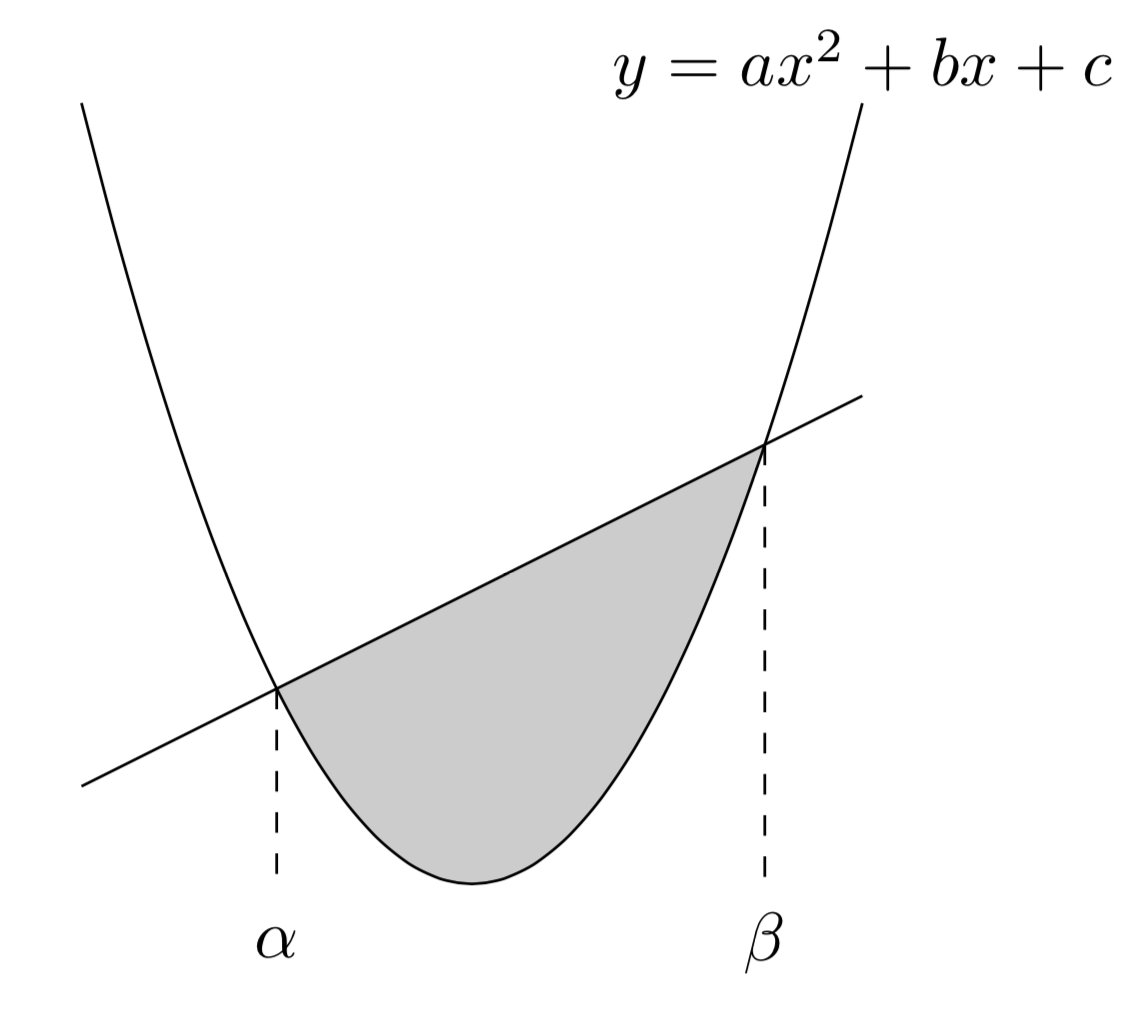
A parabola and a line: the one-sixth formula
If a line meets the parabola at abscissas , the enclosed area is
The difference between the two functions has roots and leading coefficient , so the area is
A parabola and two tangents: the one-twelfth formula
If tangents touch the parabola at abscissas , the area enclosed by the parabola and both tangents is
The tangents meet at the midpoint abscissa . The difference between a quadratic and its tangent at is , and similarly at . Integrating those differences over the two half-intervals gives the formula.
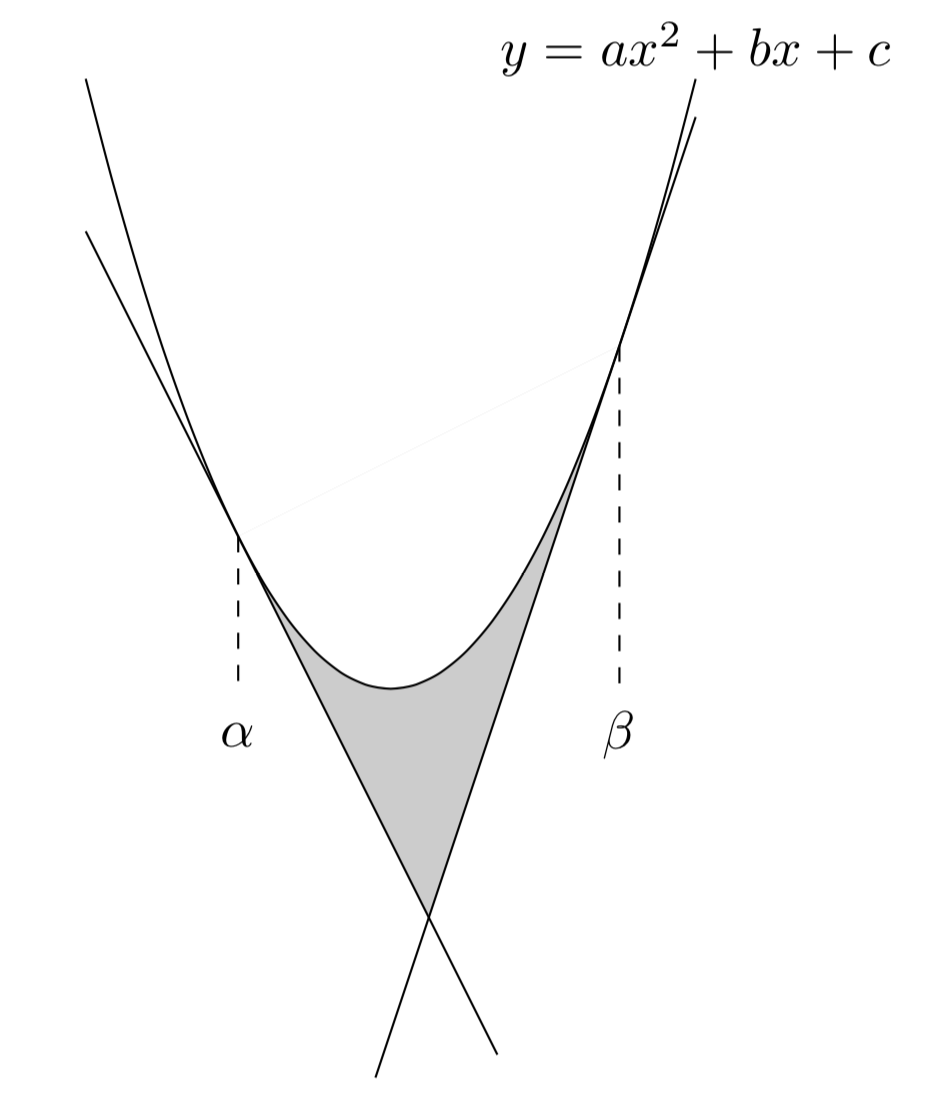
Both formulas require the factor . A version with no coefficient factor applies only to a quadratic with unit absolute leading coefficient. Also distinguish tangency abscissas from the intersections with a secant line: the configurations are different.
Shortcut 2: telescope an arithmetic-geometric sum
For a term such as , look for a discrete antiderivative satisfying equal to the summand. Here works, because
Hence
This can be shorter than multiplying an entire sum by its common ratio and aligning the shifted terms. It still needs a check of the difference and both endpoints; no method makes arithmetic errors impossible. See telescoping sums for the full procedure.
Shortcut 3: a determinant for a tetrahedron's volume
Suppose and , , . Then
Sarrus' rule evaluates the determinant:
The determinant is the signed volume of the parallelepiped spanned by the three vectors. The tetrahedron has one-sixth of its absolute volume. Sarrus' rule is the determinant calculation, not by itself the geometric volume theorem.
For a tetrahedron whose chosen base vertex is not the origin, first subtract that vertex from the other three position vectors. Omitting that translation can give a different volume. The cross product provides an equivalent scalar-triple-product calculation.
Use saved time to verify structure
Practice a formula by deriving it and checking a simple example, then use it where its assumptions are satisfied. Keep question-selection advice tied to the relevant examination format. Efficient preparation combines quick calculations with a reliable way to detect when a result is implausible.
Related articles
- Equating rational and irrational parts: proof and worked problems
- How to simplify nested square roots, with three worked examples
- Conditional probability: the formula, information protocols, and worked examples
- Integration by parts: formulas, proof, and four useful patterns
- Triple-angle identities: remember, derive, and apply them
About the author
Koki Saito
Physician and graduate of the University of Tokyo Faculty of Medicine. Drawing on his entrance-exam experience, he explains how to choose mathematical methods and construct complete solutions.
Full profile →Have a question or spotted an error? Contact us.