University of Tokyo science mathematics 2020: problems and solutions
These explanations are independently written by this site, not official University of Tokyo solutions. The original author judged the 2020 science-track paper harder than 2019, especially its combinatorics and ellipse-normal questions. Difficulty and score suggestions are historical opinions. See the past-paper review.
Problem 1: three inequalities describe a single ray
Let a,b,c,p be real. Suppose the simultaneous solution set of
is exactly .
- Prove .
- Prove at least one of a,b,c is zero.
- Prove .
Solution
If a coefficient were negative, the quadratic having it as leading coefficient would be negative for sufficiently large positive x. That contradicts the inclusion of every sufficiently large positive x in the ray. Thus all three coefficients are nonnegative.
If all three were positive, all three quadratics would be positive for sufficiently large negative x as well. That contradicts the lower bound p. Hence at least one coefficient is zero.
By cyclic relabeling, take . The inequalities become
The first two together force . Conversely, if and b,c are nonnegative and not both zero, all three hold. They cannot both be zero, because then the solution set would be empty, whereas is nonempty. The solution set is therefore exactly , proving
The contradiction arguments use the behavior at the two infinities, avoiding unnecessary casework about roots of three quadratics.
Problem 2: a region defined by three triangle areas
Let ABC have area one. Write for ordinary triangle area, taking collinear triples to have area zero. Find the area of all X satisfying
Use signed area coordinates
Write X in barycentric coordinates with sum one. Since the reference triangle has area one,
Inside the triangle all three coordinates are nonnegative, so their absolute sum is one and no point qualifies.
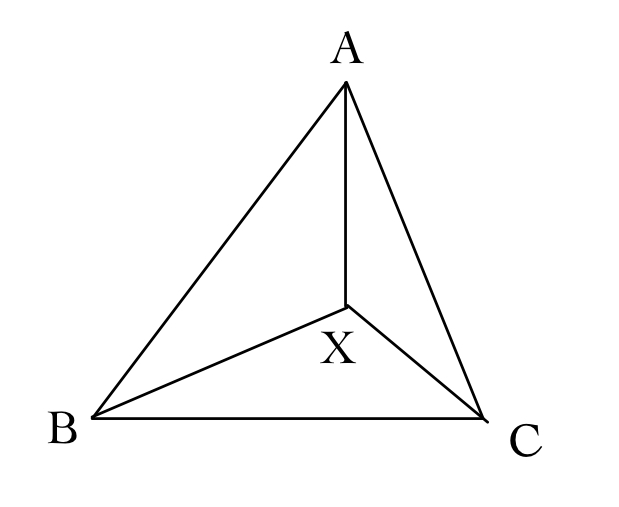
For outside points, there are two sign patterns. Boundary cases where a coordinate is zero have area zero and can be included without changing the answer.
One negative coordinate
Suppose , while the other two are nonnegative. Their sum is , so the absolute sum is . The condition becomes .
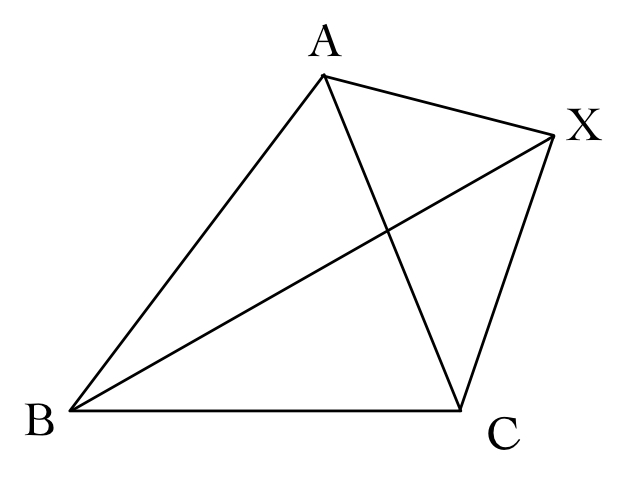
For a given s, ranges over . In the coordinate plane , the reference triangle has area , while its physical area is one. Thus the area scale is two, and this trapezoidal strip has physical area
There are three choices of the negative coordinate.
Two negative coordinates
Suppose , with , and . Now the absolute sum is , giving .
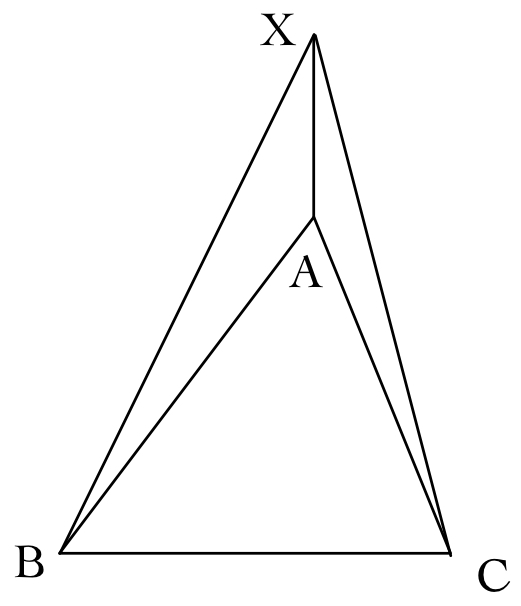
In the -plane this is the difference between two right triangles with leg lengths one and one half. Multiplying by the same area scale gives
Again there are three choices of the positive coordinate. The six regions have disjoint interiors, so the requested area is
This is the algebraic version of the source's decomposition into three side trapezoids and three vertex trapezoids. Because an invertible affine map preserves area ratios, no special shape of ABC is required.
Problem 3: rotate a parametric region through 90 degrees
For , define
Let .
- Prove strictly decreases on .
- Study the distance and find its maximum.
- Let C be P's curve and D the region enclosed by C and the x-axis. Find the area swept as D rotates clockwise through 90 degrees about the origin.
Part 1
For ,
and on its derivative is
Continuity at t=1, where the ratio is zero, includes that endpoint. The slope decreases from toward zero, so each ray in the first quadrant meets the curve at most once away from the origin.
Part 2
It is easier to optimize the squared distance:
The square is nonnegative, including its zero at t=-1. It increases until t=1/2 and decreases afterward. Its maximum is , so
At t=1 the squared distance is eight. A square-root argument does not require strictly positive radicand at the endpoint where it vanishes.
Part 3: justify the swept-area decomposition
The curve starts at the origin, stays in the first quadrant, and ends at . Since x(t) increases, the original area is
The odd term integrates to zero; the remaining integral is a unit semicircle's area.
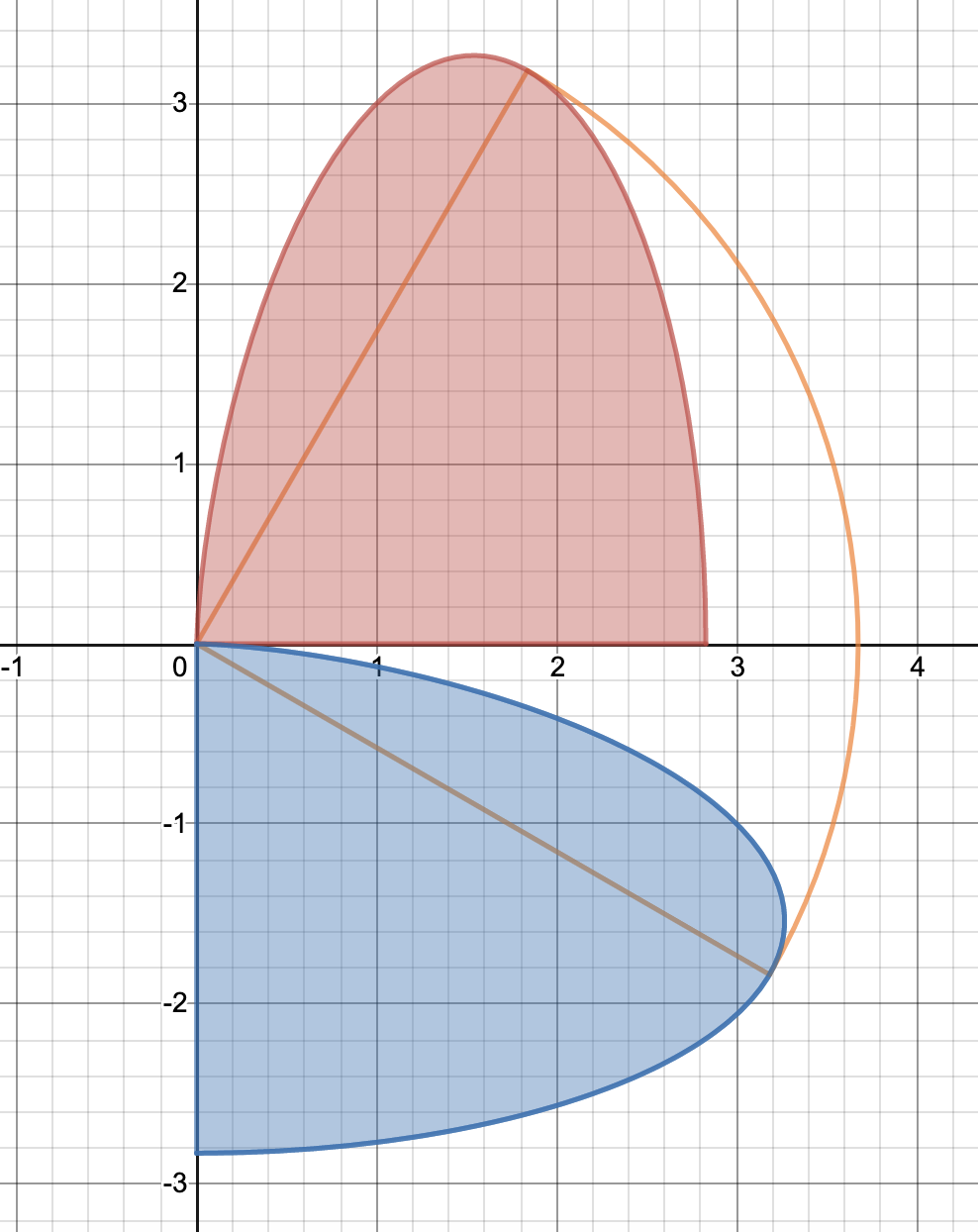
For a precise explanation of the union, let be the curve's radius on a first-quadrant ray. Part 1 makes the direction unique, and Part 2 shows R increases up to its single maximum as the direction moves toward the maximizing ray, then decreases afterward. The filled D supplies every radius from zero to that boundary.
During a quarter-turn, the maximizing ray sweeps a sector of angle and radius . On the two remaining angular tails of the union, the outer radius is supplied by the original boundary or its final rotated copy. Those tails together contribute exactly : they split the original radial area integral at its maximizing ray. There is no additional overlap area to count.
Thus
The direction of rotation changes the placement of the region, not this area calculation.
Problem 4: sums of products of powers of two
For integers , let be the sum of products obtained by choosing k distinct numbers from the n powers .
- Find for .
- Put . Find the polynomial quotients and .
- Find for .
Part 1
Squaring the sum of all powers counts each distinct pair twice, as well as the individual squares. Therefore
Part 2: two ways to expand the same product
By selecting either one or from each factor,
Separating the last factor or the first factor gives
Thus the quotient polynomials are and . These are exact divisibility identities; a quotient written as a rational function is evaluated only where its original denominator is nonzero.
In coefficient language, choosing whether or not to include gives
while choosing whether or not to include one, and scaling all remaining choices by two, gives
Part 3
For , eliminate from these two equations:
All the chosen-product sums in the denominator are positive. For k=n, directly compare the products of all n+1 and all n numbers; their ratio is , which agrees with the same formula. Hence
The product representation makes both recurrences visible and also proves the divisibility requested in Part 2.
Problem 5: segments from a point to a solid cone
Let S be the closed cone with base the unit disk centered at the origin in and apex . Put .
- Let T be the region swept by AP as P ranges over S's base. Sketch the sections of S and T by in the same plane.
- Find the volume swept by AP when P ranges over all of S.
Part 1
At height one, S has the disk centered at of radius . A point on AP at that height is its midpoint. For with , the midpoint is . Thus T has the disk centered at of radius .
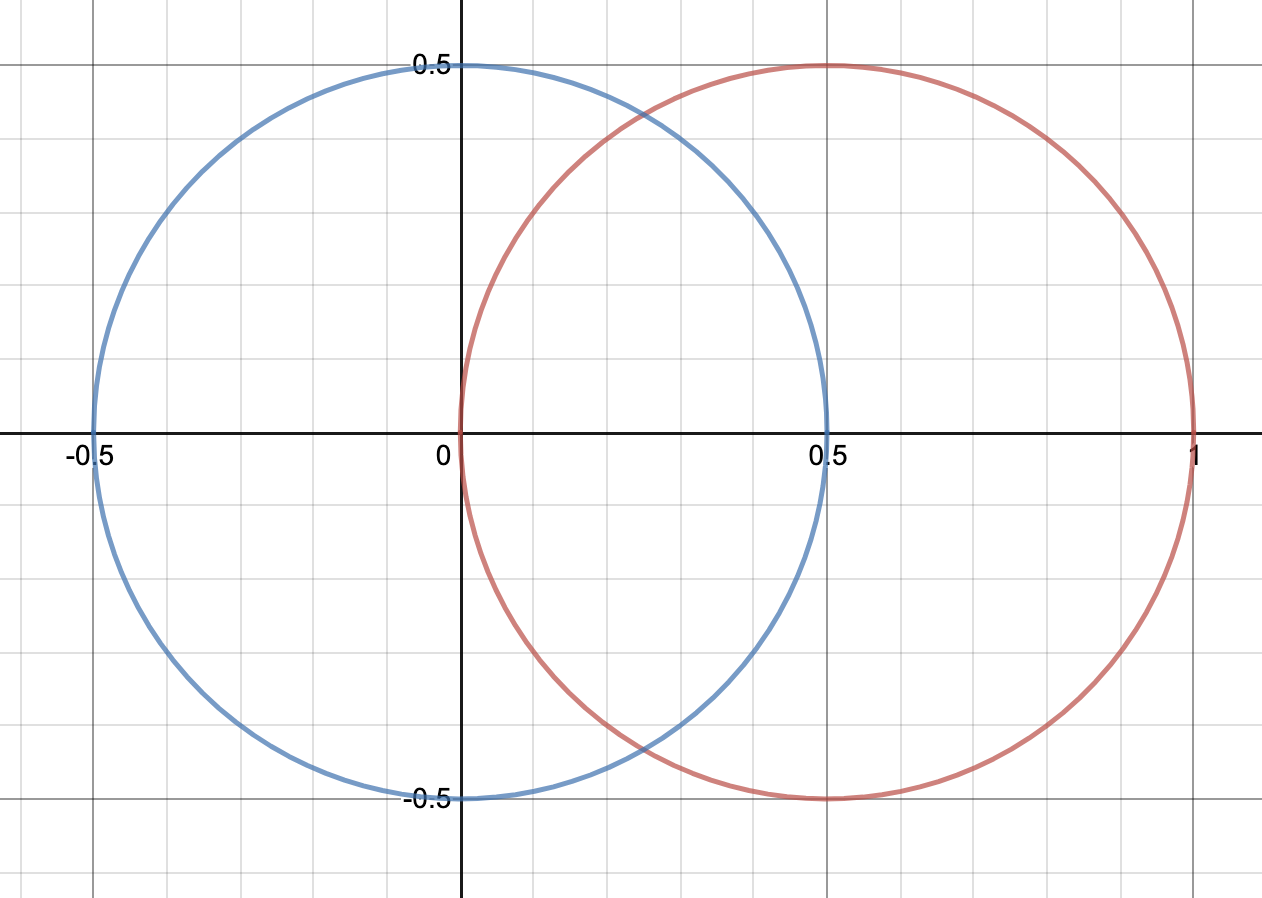
The sections include their interiors because P ranges over a base disk, not just its circumference.
Part 2
Fix a height , with . A point of S at height has form
The intersection of AP with is
For each k, these points fill a disk of radius , centered at x-coordinate . As k ranges from zero to t, c ranges continuously from t/2 down to zero.
The complete section is therefore a stadium: the union of radius-R disks with centers on a segment of length t/2. Its area is
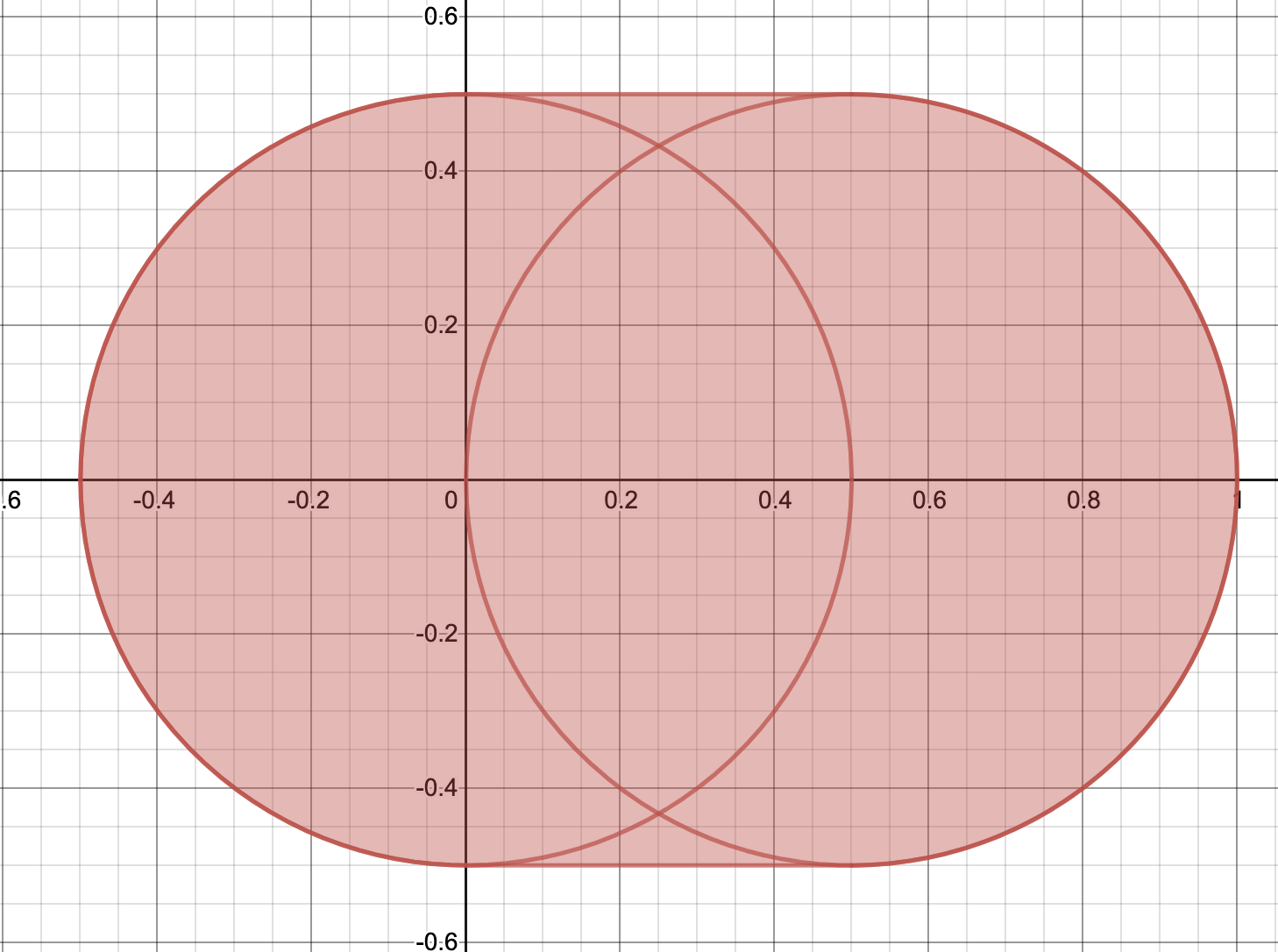
At t=2 the section is the segment BA, of area zero, consistent with the limiting formula. Integration gives
The center's range and the filled disks together prove that this is the exact section rather than a bound on it.
Problem 6: four normals to an ellipse
- For real A and , prove that if , the equation
has at least four distinct solutions in .
- Let . For , put . Show there exists r such that, for every P in D, there are at least four points Q on C for which the tangent at Q is perpendicular to the line PQ. Find the greatest such r.
Part 1: alternate signs around a period
Let . Since the second sine has absolute value at most one,
Continuity gives a root in each of the four open intervals between successive listed angles. The last interval wraps around modulo , and periodicity puts its root into . These four intervals are disjoint on the circle, proving four distinct roots.
Part 2: write the normal condition
Parametrize . A normal direction to the ellipse there is . The line through Q in that direction contains P=(x,y) exactly when
Let . If , choose with and . The condition becomes
For , Part 1 applies and gives at least four distinct Q. If , the condition is simply , which also has four distinct solutions in one period. These points P lie strictly inside the ellipse, so P and Q are distinct and line PQ is defined.
Hence every works, because D uses a strict inequality.
Show that a larger r fails
Take
Here and , so the normal equation becomes . The two sine-equality cases give
In one period the distinct solutions are only
The source's is a typo; the second solution is . Thus this P has only three qualifying Q. Any r greater than one half includes it in D and therefore fails. We conclude
This example shows why a sufficient small-radius bound must be paired with a counterexample to prove maximality, and why the origin should be treated separately before dividing by .
Reviewing this paper
The original author's historical practice targets were 80–90 points for the strongest medical-track candidates and 60–70 for other science-track candidates, prioritizing Problems 1, 2, and 5 before the harder counting and normal-line arguments. These are personal study suggestions, not official admissions thresholds.
Across the paper, the decisive steps are using behavior at infinity, separating signed-area cases, tracking a radial maximum during rotation, recognizing a generating product, proving an exact stadium section, and connecting a normal equation to an intermediate-value argument.
Related articles
- Equating rational and irrational parts: proof and worked problems
- How to simplify nested square roots, with three worked examples
- Conditional probability: the formula, information protocols, and worked examples
- Integration by parts: formulas, proof, and four useful patterns
- Triple-angle identities: remember, derive, and apply them
About the author
Koki Saito
Physician and graduate of the University of Tokyo Faculty of Medicine. Drawing on his entrance-exam experience, he explains how to choose mathematical methods and construct complete solutions.
Full profile →Have a question or spotted an error? Contact us.