AM–GM: proofs, equality conditions, and five worked problems
The inequality and its equality condition
For nonnegative real numbers ,
with equality exactly when . The arithmetic mean is the average of the numbers; the geometric mean is the square root of their product. A short proof is
The square vanishes exactly when .
A geometric picture
Take a circle of diameter , and divide that diameter into lengths and . The perpendicular half-chord at the division point has length by the intersecting-chords theorem. It cannot exceed the radius ; equality occurs when the division point is the center, or .
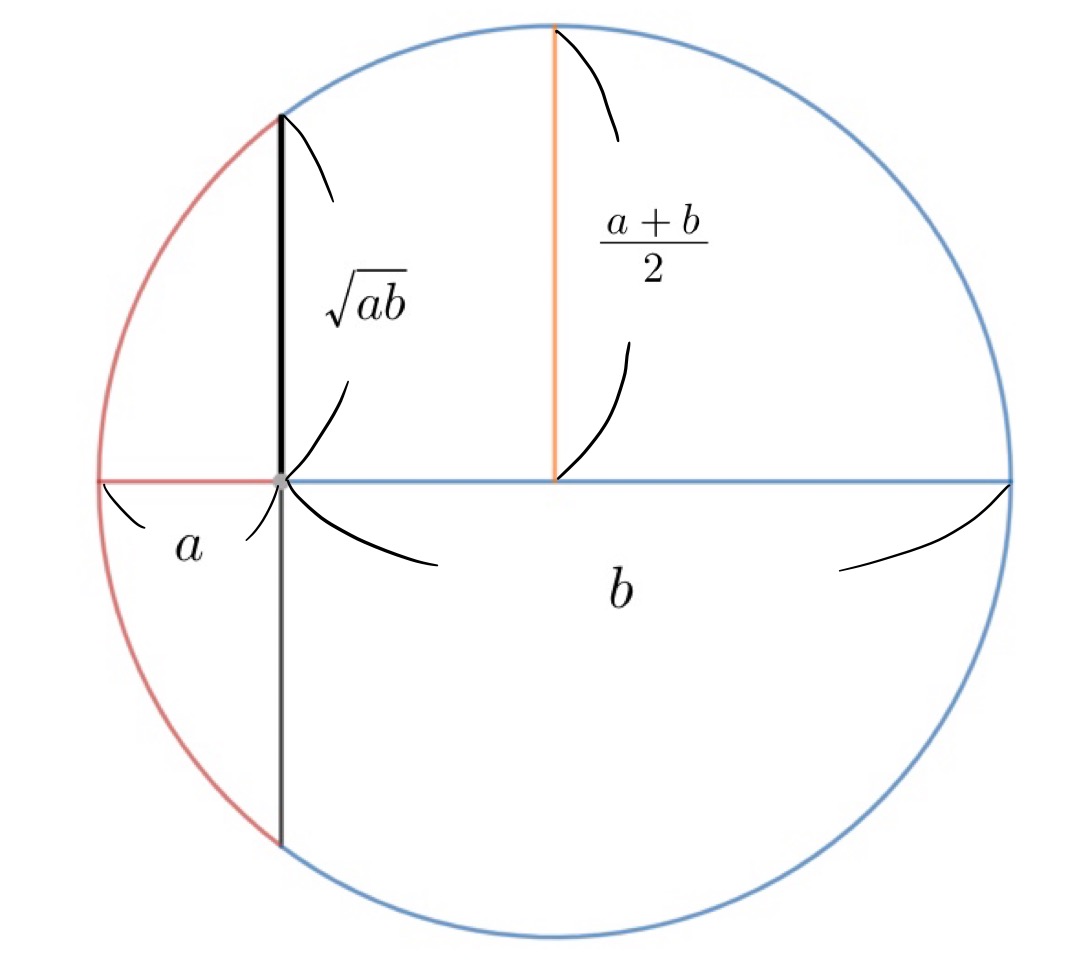
The degenerate cases or follow directly from the algebraic inequality.
The general form
For nonnegative numbers,
with equality exactly when all numbers are equal.
Here is a proof using , whose equality condition is . This auxiliary inequality follows because decreases before zero, increases afterward, and is zero at zero.
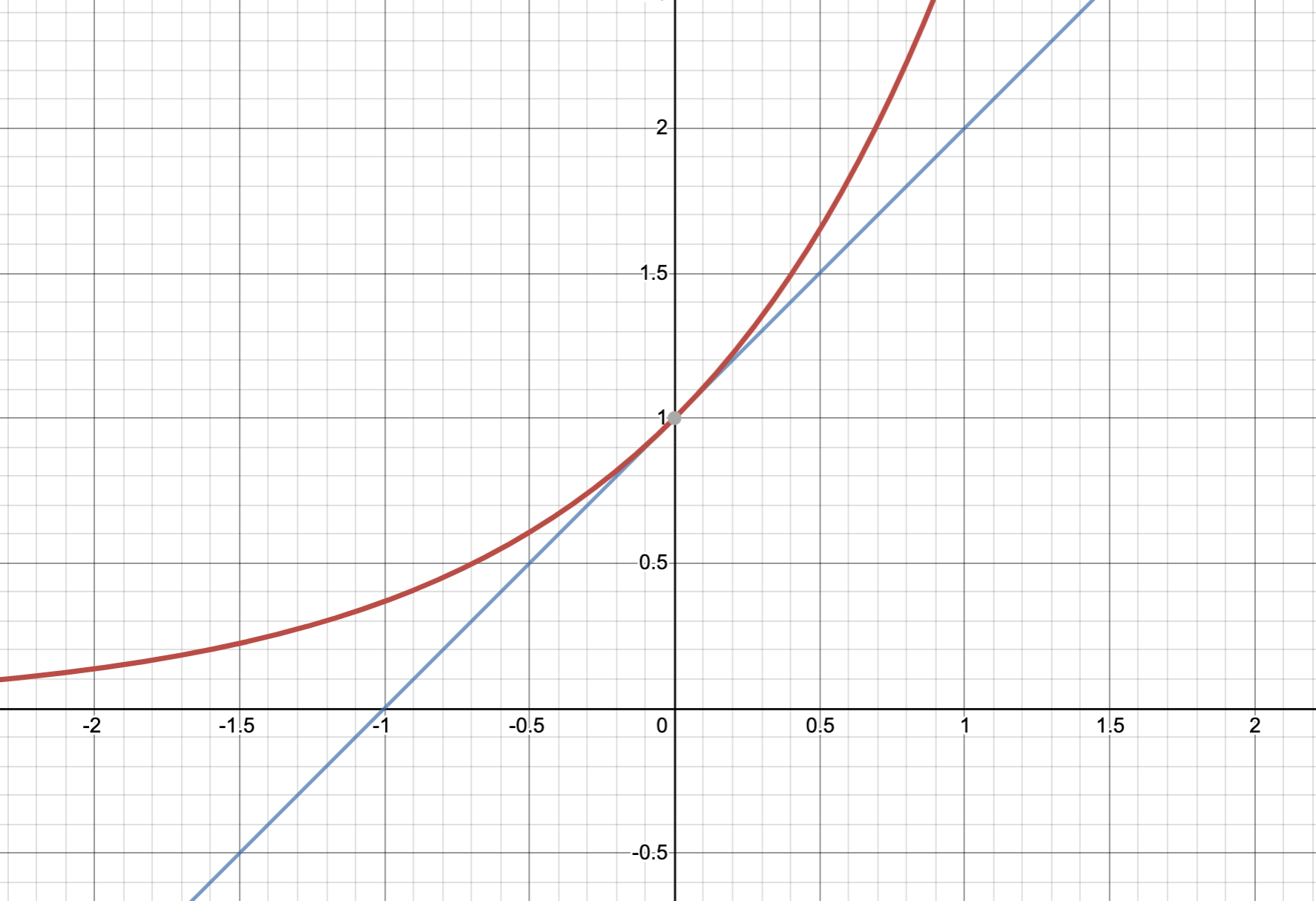
Let be the arithmetic mean. If , all the numbers are zero and the conclusion is immediate. If , apply the auxiliary inequality with and multiply the resulting nonnegative inequalities:
Thus . If any while , the AM–GM inequality is strict. Otherwise equality in the product requires equality in every exponential inequality, hence for all .
Three checks when using AM–GM for an extremum
Check that the terms are nonnegative, obtain a bound independent of the free variables, and verify that equality is attainable under all constraints.
For instance, when ,
with equality at , so the minimum is two. If the domain were , that equality point would be unavailable; the minimum would instead be at .
A moving lower bound is not a minimum
For , AM–GM correctly gives
with equality at . It does not prove that the minimum is two, because the right side changes with .
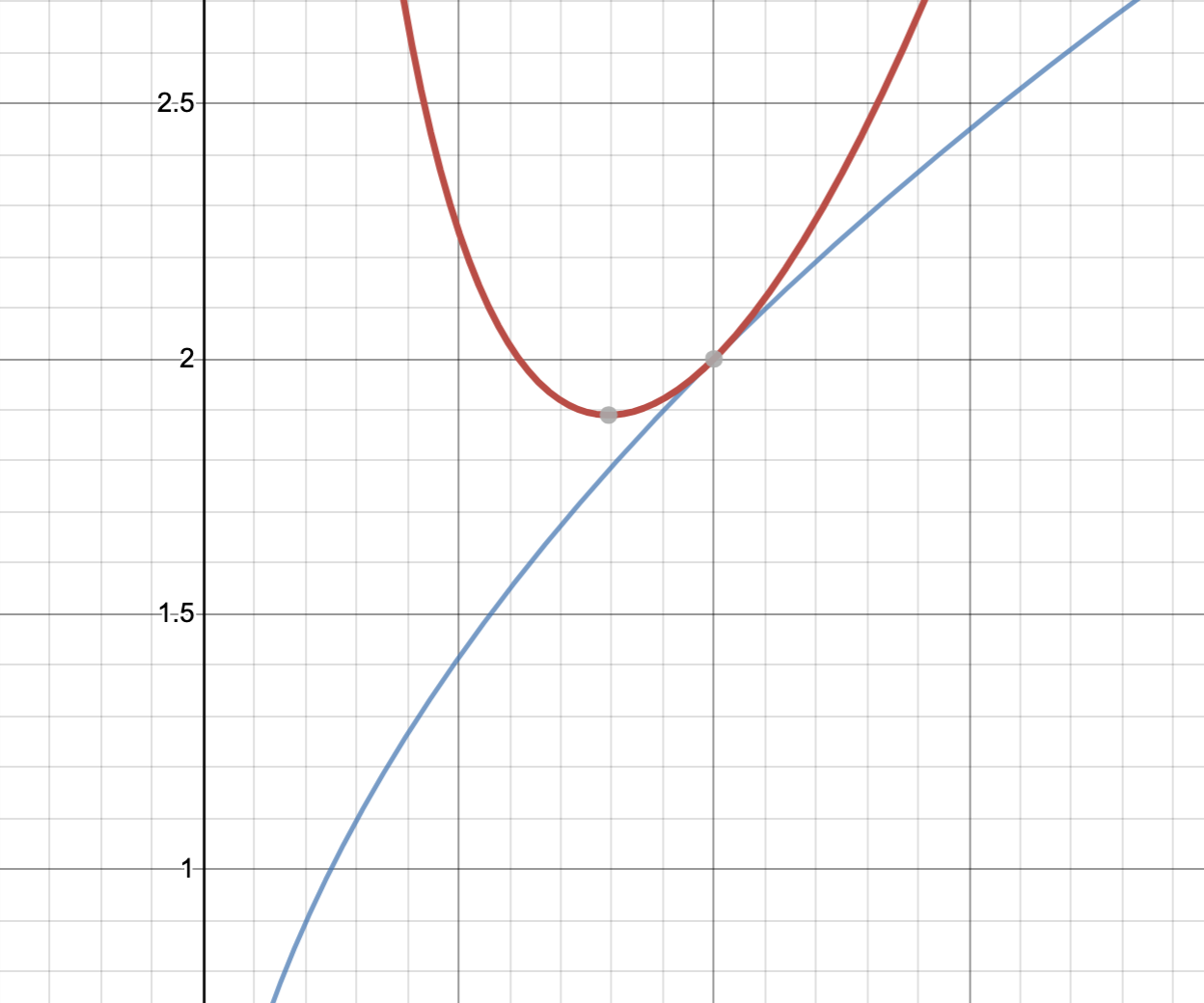
Instead, split the reciprocal:
Equality requires , giving . This proves the stated constant is the minimum.
Problem 1: divide first, then complete a useful pair
For , minimize .
Polynomial division gives
Both terms in the pair are positive, with product four. Therefore
Equality requires and , so . Hence the minimum is three, attained at one. Adding and subtracting one created a pair with a constant product.
Problem 2: maximize by bounding a reciprocal
For , maximize .
The denominator is , so the fraction is positive. Its reciprocal satisfies
Equality occurs at , or . Taking reciprocals reverses the inequality between these positive numbers, giving
The constant in the completed square is ; the source's different constant is a typographical error.
Problem 3: exploit homogeneity
For , maximize
Divide numerator and denominator by , and set . Every positive is attainable. Then
The denominator is positive. Equality holds exactly when , or . Thus the maximum is three, attained for every positive equal pair. Homogeneity reduced two free variables to their ratio.
Problem 4: a triangle with a moving point
Let , , , and , where . Choose on segment so that . Find the maximum area of triangle .
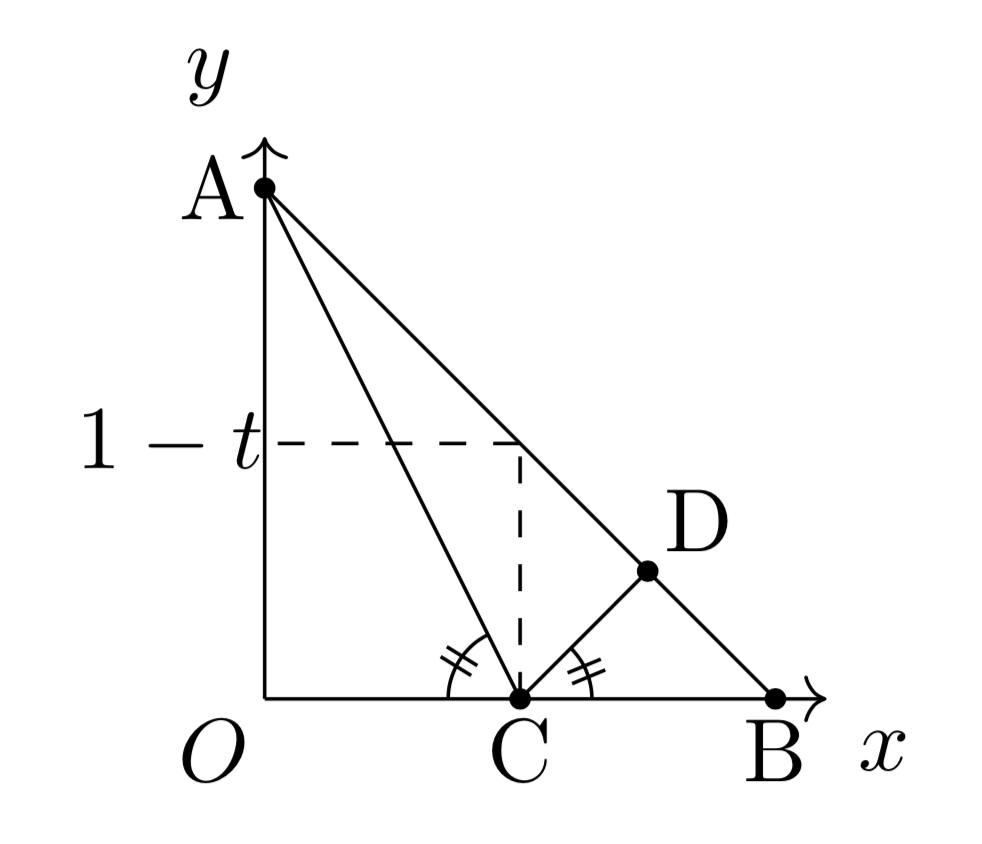
The slope of is , so the equal-angle condition gives slope for . Intersect
to obtain
These coordinates do lie on for . The determinant area formula gives
Equality requires , so , which lies in the allowed interval. Therefore
Problem 5: minimize a tetrahedron volume
Let be a regular tetrahedron of side one, and let satisfy
Points lie in the interiors of , respectively, with
Suppose lies in triangle . Prove , find the perpendicular foot from to plane , and minimize the volume of .
The plane condition
The vectors along the three edges at are linearly independent. Expressing using gives
Membership in the affine plane means these coefficients sum to one. Thus
The coefficients are positive, so when the equation holds, is indeed inside the triangle, not merely on its extended plane.
The perpendicular foot
Write in vector notation. Each edge vector has length one, and their pairwise inner products are . The conditions become
Hence , and
Notice the minus signs on the terms; they are required because . Computing the squared length yields .
The volume bound
The base has area , and the height is . Therefore
AM–GM applied to the positive reciprocals gives
Equality is attained at , which satisfies the segment constraints and the triangle condition. Thus
In each problem, the bound alone is only part of the solution. Its equality condition is what turns an inequality into an attained minimum or maximum.
Related articles
- Equating rational and irrational parts: proof and worked problems
- How to simplify nested square roots, with three worked examples
- Conditional probability: the formula, information protocols, and worked examples
- Integration by parts: formulas, proof, and four useful patterns
- Triple-angle identities: remember, derive, and apply them
About the author
Koki Saito
Physician and graduate of the University of Tokyo Faculty of Medicine. Drawing on his entrance-exam experience, he explains how to choose mathematical methods and construct complete solutions.
Full profile →Have a question or spotted an error? Contact us.