How extra calculus and complex numbers can help humanities mathematics
Why learn a little beyond your required course?
The original 2019 article encouraged humanities-track applicants to learn selected ideas from the advanced mathematics course then called Mathematics III. Curriculum boundaries and permitted examination methods depend on the examination, so check your own requirements. The mathematical question is simpler: Which additional tools would help you understand and check the problems you already study?
There are four possible benefits:
- Checking an answer. A limiting value can expose a probability formula that behaves implausibly.
- Continuing with an awkward variable choice. A less convenient expression may still be manageable by differentiation.
- Replacing a hard-to-spot trick with a systematic method. Calculus can sometimes find an extremum that would otherwise require a clever inequality.
- Writing a shorter argument. Complex multiplication provides a compact description of a rotation.
These benefits do not mean that every student should study an entire additional course, or that calculus solves every optimization problem. Choose tools that complement your preparation and understand why they work.
1. Limits: a useful way to check behavior
A limit describes how a quantity behaves as its argument approaches a value. For example,
The first expression approaches zero from the positive side; it does not substitute into . Differentiation itself is defined by a limit:
when that finite limit exists.
Example: rolling a tetrahedron
A regular tetrahedron rests on a plane. At each step, choose one of the three edges of its bottom face with equal probability and roll onto the adjacent face. Let be the probability that the initial bottom face is down after rolls.
From that face the next roll always leaves it; from any other face, one of three rolls reaches it. Therefore
and
Its limit is , consistent with the four symmetric faces. The values , , and are additional checks.
The source screenshot instead says to track a face not initially down, while its displayed answer is for the initial bottom face. For a specified initially nonbottom face, the correct formula is
Both formulas tend to . This illustrates a limitation of checking only a limit: it cannot establish that the entire answer is correct. Initial conditions and the recurrence must also match the actual question. The full probability-recurrence guide explains the method in more detail.
2. Differentiation: more functions, more possible approaches
Beyond polynomial derivatives, the following five rules are especially useful:
The trigonometric formulas use radians. Each rule applies where the component functions have the required derivatives and the expression is defined. See the chain-rule explanation for the third rule.
Example: a cone tangent to a unit sphere
A right circular cone has its vertex on the positive -axis and its base centered at the origin in the -plane. Its lateral surface is tangent to the unit sphere centered at the origin. The source problem asks for minimum surface area and volume; the teaching example below first focuses on volume.
Cut through the axis of symmetry. The upper semicircle of radius one is tangent to the two sides of an isosceles triangle.
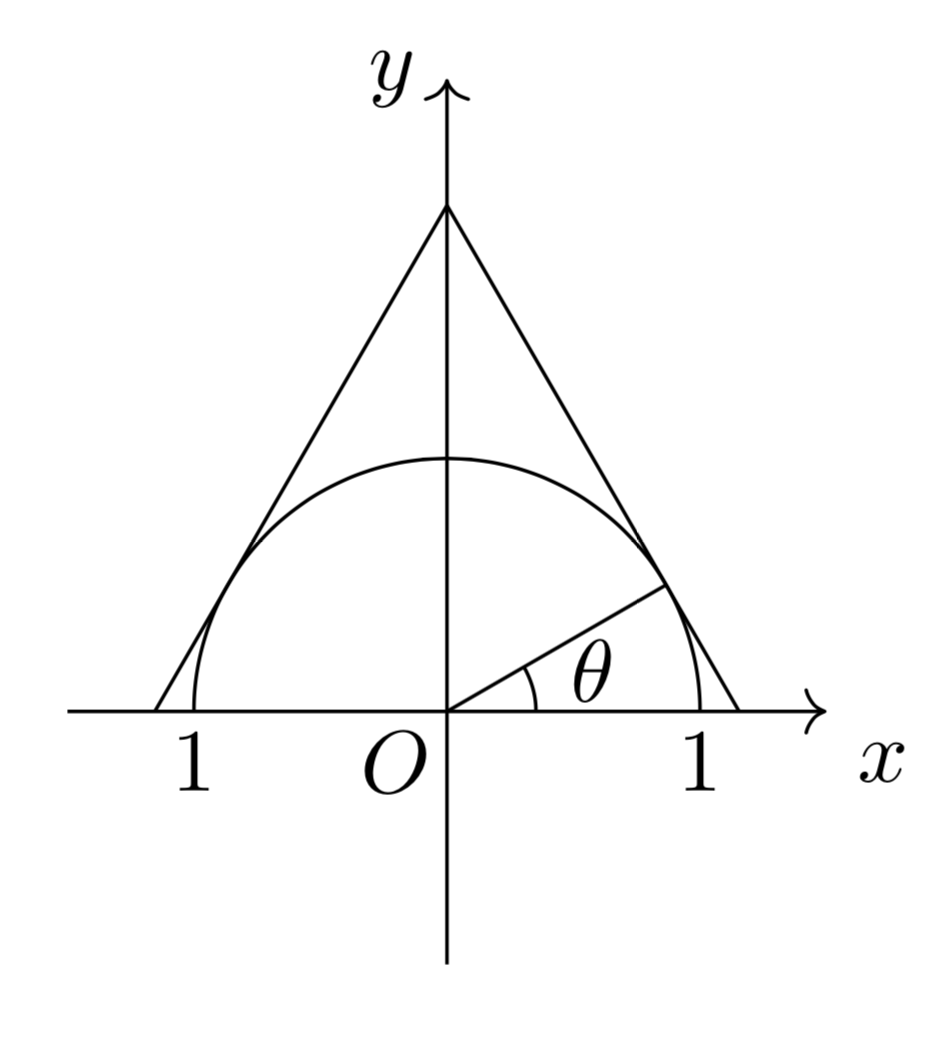
An angle parameter can simplify the geometry. Suppose instead that we choose the base radius . If the height is , the sloping line in this section has distance one from the origin. Equivalently,
The resulting volume is
The quotient and chain rules let us continue with this parameter:
For this is negative, and for it is positive. Thus
The same function can also be studied by algebraic substitutions and inequalities; choosing did not make calculus logically necessary. The point is that the extra tool gives a direct route even when the chosen expression is not convenient for basic polynomial differentiation.
For completeness, distinguish lateral area from total surface area. The slant height is , so lateral area equals and has minimum . Total area includes the base and is
Writing gives . Its derivative vanishes at the unique positive root of ; the derivative is negative before this root and positive afterward. Therefore the minimum total area is , not three times the minimum volume.
Example: an inequality or a derivative
Find the minimum of for .
A useful AM–GM argument splits the reciprocal term into two equal parts:
Equality holds when , namely .
If that split does not occur to you, differentiation gives another route. Put . Then
The derivative changes from negative to positive at , so
This example shows a systematic alternative to a clever transformation. For other functions, solving the derivative equation may itself be difficult, and endpoints or nondifferentiable points can still matter.
Example: finding a range
For , find the range of .
An algebraic approach sets and asks when has a real root. The condition is , and its roots are nonzero because their product is one. Thus every or occurs.
Calculus gives the same result from
On the positive branch, decreases to and then increases, tending to at both ends. By continuity its range there is . On the negative branch, the maximum is , and the endpoint limits are . Hence the full range is
3. Complex multiplication: a compact rotation rule
Identify the point with the complex number . The horizontal real axis is labeled Re and the vertical imaginary axis Im.
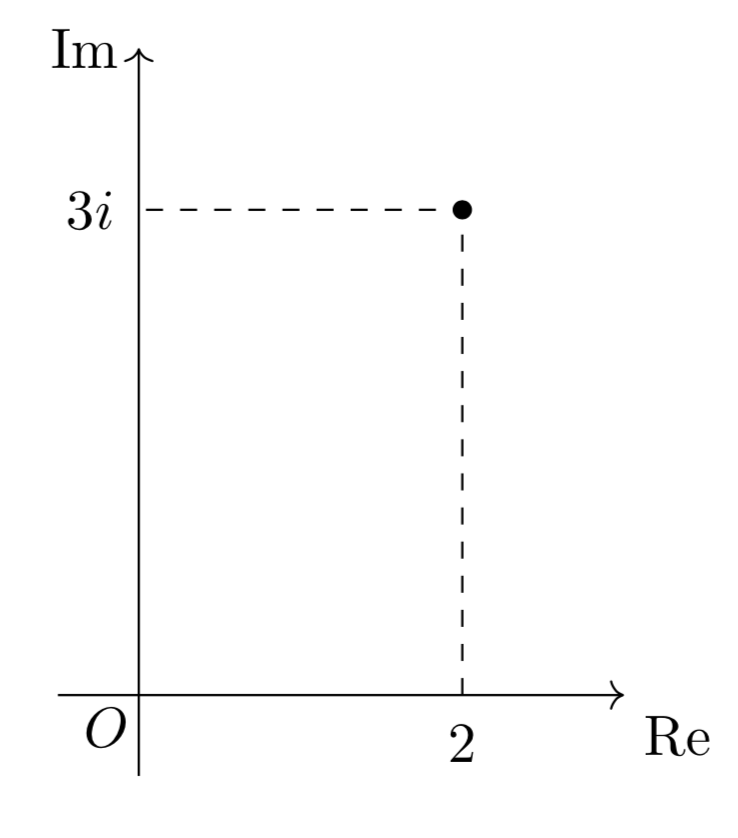
Multiplying by rotates a point counterclockwise through about the origin, without changing its distance from the origin. For example,
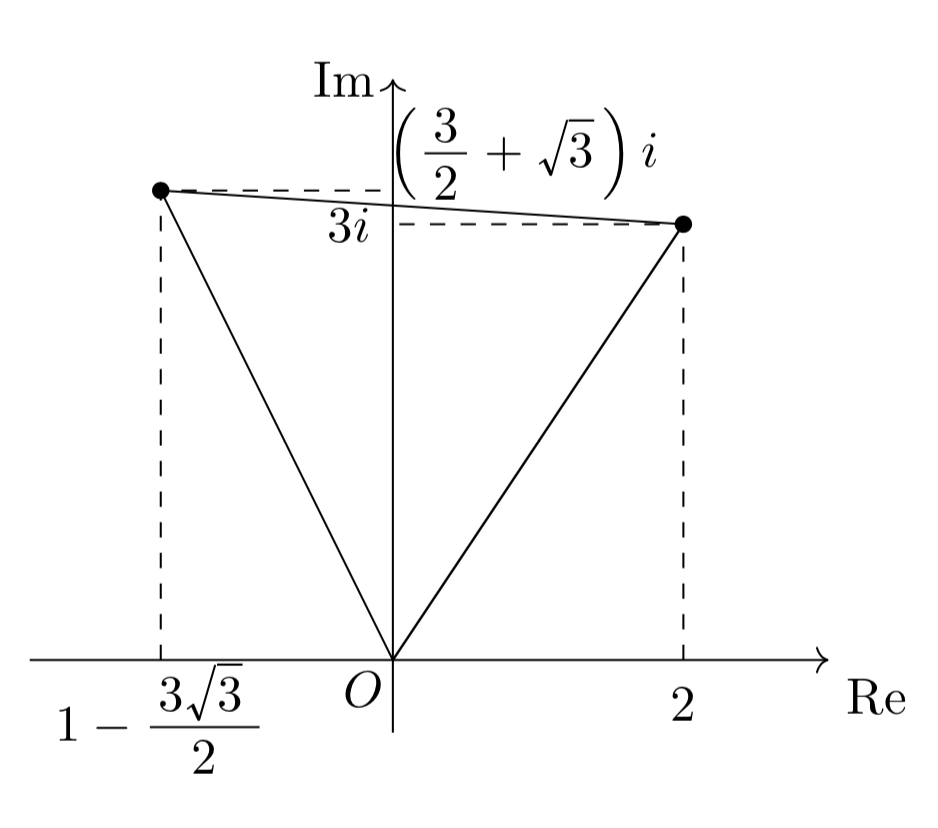
In general,
The rotated coordinates are therefore
Why multiplication rotates
The number has modulus . Choose with and . Then
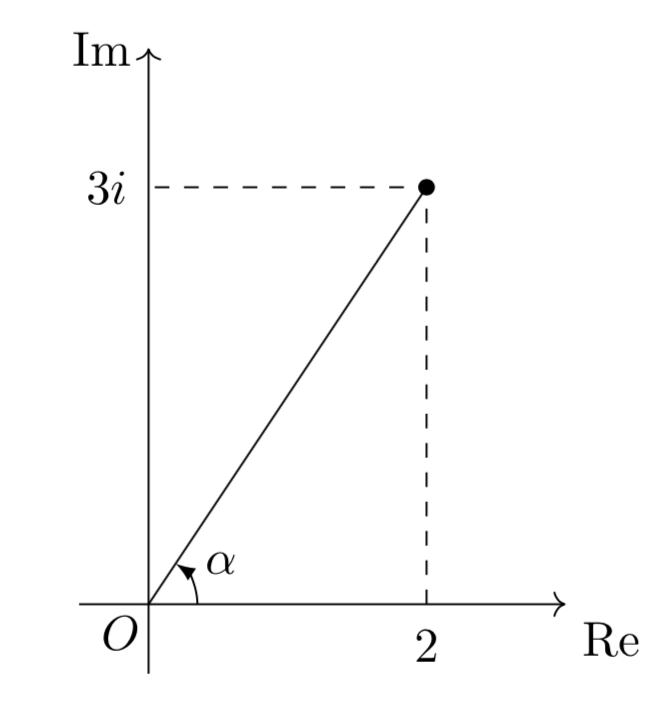
By the angle-addition formulas,
The modulus stays and the angle increases by , which is exactly the required rotation.
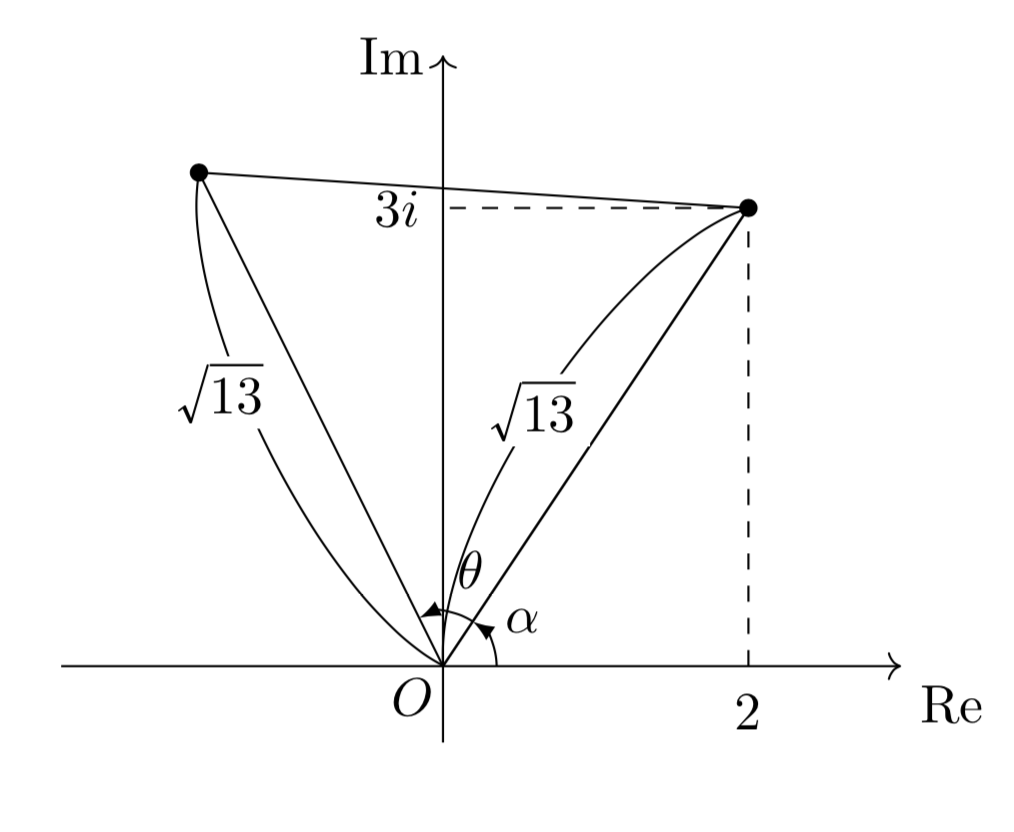
These three tools—limits, more general derivatives, and complex rotations—can make familiar problems easier to check, solve, or explain. Learn their conditions as well as their formulas, then compare them with the methods already in your required course.
Related articles
- Equating rational and irrational parts: proof and worked problems
- How to simplify nested square roots, with three worked examples
- Conditional probability: the formula, information protocols, and worked examples
- Integration by parts: formulas, proof, and four useful patterns
- Triple-angle identities: remember, derive, and apply them
About the author
Koki Saito
Physician and graduate of the University of Tokyo Faculty of Medicine. Drawing on his entrance-exam experience, he explains how to choose mathematical methods and construct complete solutions.
Full profile →Have a question or spotted an error? Contact us.