University of Tokyo science mathematics 2019: problems and solutions
The following are this site's independent solutions to the 2019 science-track paper, not official University of Tokyo answers. The original article also includes a related mock-exam problem; it is translated and solved below. Difficulty and timing judgments are the author's retrospective opinions. See the past-paper review.
Problem 1: a definite integral
Evaluate
Solution by expansion
Expanding gives four manageable integrals:
The first three are
For the last, substitute :
Adding,
An integration-by-parts alternative
Put . Since , the original integrand is . Hence
Expanding gives the same answer. The source accidentally squares this expanded sum again in one intermediate line; it should appear only to the first power. The author regarded the problem as accessible with direct integration; a clever rearrangement is optional.
Problem 2: two equal triangle areas inside a square
Let ABCD be a unit square. Points P, Q, R lie on AB, AD, CD, respectively, and both triangles APQ and PQR have area . Find the maximum and minimum of .
Solution
Set , . The first area condition gives . The side constraints therefore require
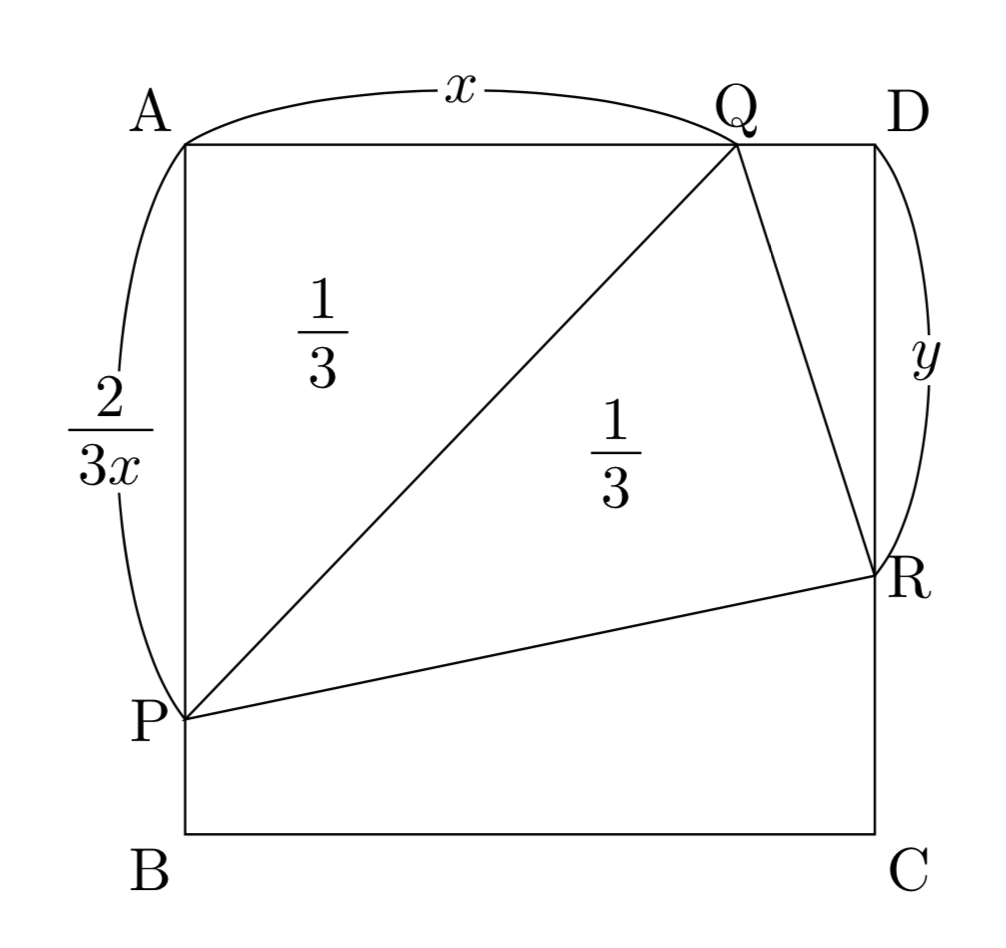
Choose coordinates , , , . Then , , and . The determinant for PQR gives
Thus
For every , the resulting is in , so no additional side restriction removes part of this interval.
Since , the function increases up to and decreases afterward. Its relevant values are
Therefore
The equality constraints reduce the geometry to one variable; checking that every parameter value gives actual points on the sides makes the extrema attainable.
Problem 3: an octagonal section of an octahedron
In space, put
and , where . Let M and N be the midpoints of AB and AD. Let be the plane through M,N parallel to AE.
- Describe the sections of octahedron PABCDE and plane by , drawing them in the same plane.
- Find the values of p for which the section by is an octagon.
- Under that condition, take the part of the section with . Find the area of its orthogonal projection onto the yz-plane.
Part 1: work in an axial plane
The octahedron's section by is quadrilateral PCEA in the xz-plane, with vertices
The plane is : it contains and , and its direction along AE has equal changes in x and z. Its trace on is therefore the line through and .
These coordinates specify the three sketches in the source. If , P lies above that line; at , P lies on it; if , P lies below it. In every sketch, the line cuts the lower edge CE at . Its other intersection lies on PA in the first case, at P in the second, and on PC in the third.
Part 2: count crossed edges
Below or at , the plane cuts the five edges AB, AD, BE, CE, and DE. Above that plane, it cuts PB, PC, and PD precisely when P lies below , namely . This supplies eight distinct section vertices exactly when
At the transition , intersections merge at P, so it is not an octagon. One can verify the count by evaluating at the six vertices and checking which edges connect opposite signs.
Part 3: only three upper-quadrant vertices are needed
Let and . In the region , the section's relevant vertices are M,F,G, and its intersection with projects to the origin.
On PB, write -weight from B. Then . The plane condition gives , so
On PC, write . The plane condition gives , hence
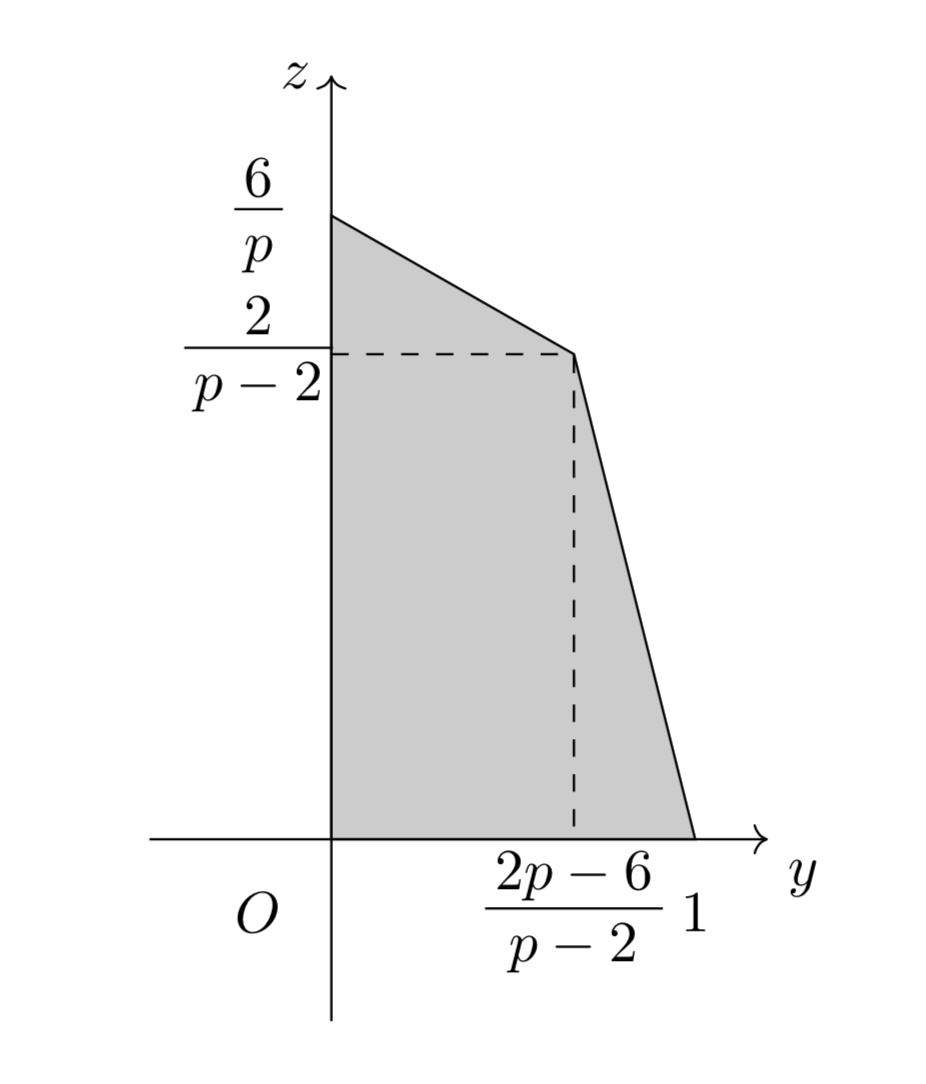
Split the quadrilateral into two triangles based at the origin. Its area is
Identifying the requested projection avoids calculating every vertex of the octagon.
Problem 4: a product that is never a square
For integers ,
- find ;
- prove that is never an integer square.
Part 1
Since ,
An even n has , while an odd n has .
Part 2
After division by the gcd, the two factors are coprime. If their product were a square, each reduced factor would be a square, since every prime exponent in their product is even and no prime is shared.
For even n, , so would be a square. But
which is impossible.
For odd n, we would have
for coprime positive integers u,v. Every odd square is one modulo eight, so the second equation would give . Squares modulo eight are , and twice a square is therefore or , never six. Again this is impossible.
Alternatively, the first equation forces u odd; the second would force v odd as well. Adding and dividing by two yields , whose sides are zero and two modulo four, respectively. Either contradiction proves the result. See integer-problem strategies.
Problem 5: unique roots and three related limits
For , consider
- Prove there is exactly one real solution .
- Prove .
- Find
Parts 1 and 2: locate the root before differentiating
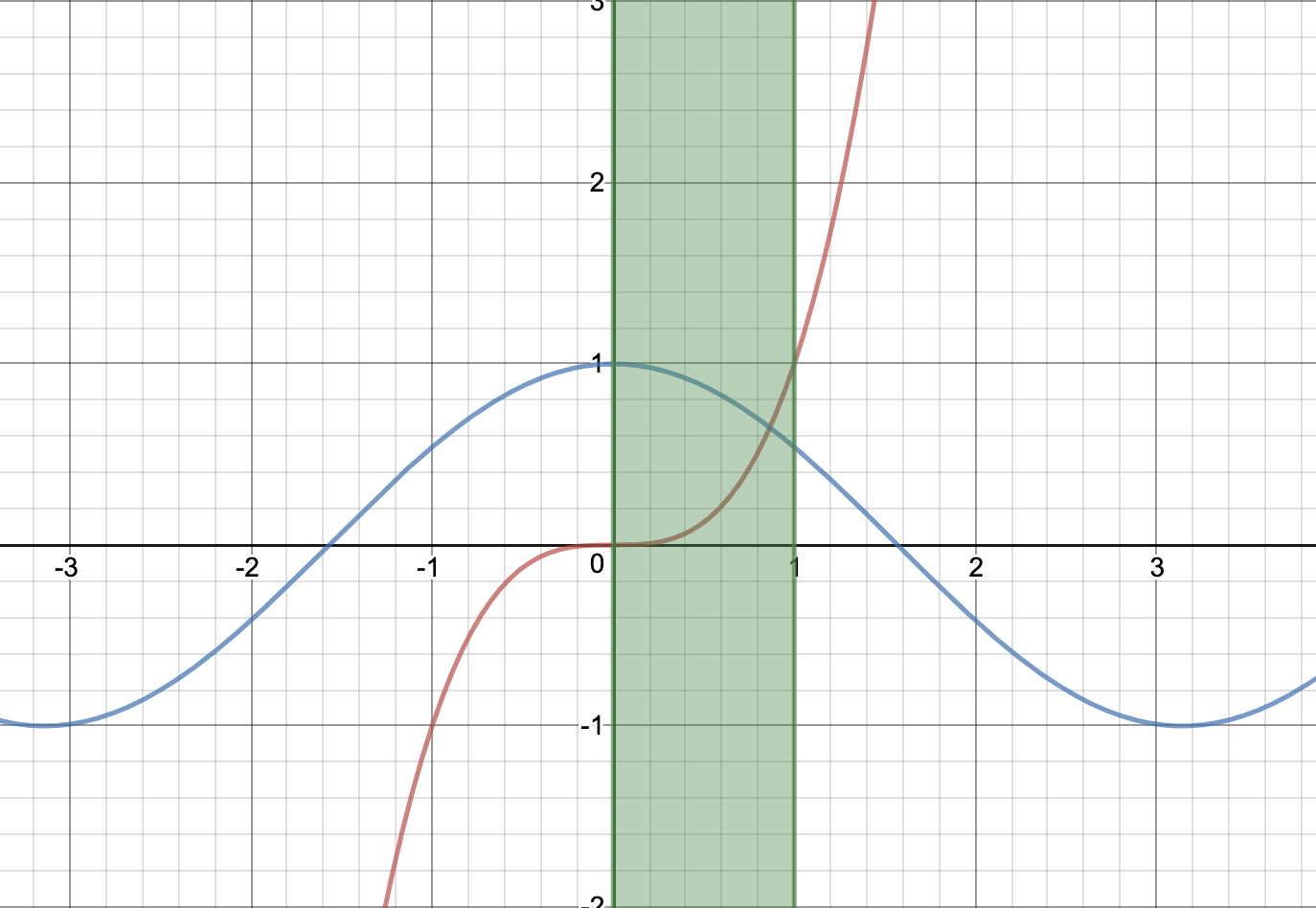
For , , so there is no root. For , the odd power is negative and cosine is positive, again excluding roots.
On , has and . It strictly increases: its derivative is positive for . Therefore it has exactly one root, with
Since cosine strictly decreases there, .
Part 3: use the equation defining the root
From ,
The lower bound tends to one, so . Also
giving .
For the last limit, the exact identity
follows from the defining equation and positivity. Put in a neighborhood of one. Then the requested quotient is a derivative along :
Equivalently, split the derivative into that of and that of . Merely raising a loose bound to a growing power would not justify this limit.
Related mock-exam example included in the source
For , let , and let its tangent at be . Show there is exactly one other common point, of x-coordinate , with . If is the enclosed area, find .
The tangent is . Intersections satisfy
Its derivative is : positive outside and negative inside. We have and . Thus minus one is the tangential root, and there is exactly one other root .
For , the first three terms of the binomial expansion give
Hence , and .
The curve lies below the tangent on , so
Do not replace a power of a quantity tending to one by one. In particular, diverges; after division by it still diverges, so it does not give the lower squeeze bound claimed by a tempting incorrect argument.
Instead use the exact root equation
Substituting into , the first term tends to zero because its numerator is and denominator ; the second tends to zero because ; the last tends to four. Therefore
The coefficient must remain in the root equation; omitting its one would change the exact substitution.
Problem 6: a quartic with a purely imaginary paired sum
Distinct complex numbers are the four roots of
where a,b are real. Suppose has real part zero and nonzero imaginary part.
- Show that exactly two roots are real and the other two form a nonreal conjugate pair.
- Express b in terms of a and determine the allowed a-values.
- Find the locus of .
Part 1: use conjugate roots
Conjugating a polynomial equation with real coefficients shows that a nonreal root brings its conjugate. Thus the possibilities are four real roots, two real roots plus a conjugate pair, or two nonreal conjugate pairs.
Four real roots would make every paired product sum real. For two conjugate pairs , all three possible pairings give real sums:
These also violate the nonzero-imaginary-part condition. Therefore only the middle possibility remains.
Part 2: compare coefficients in two cases
Write the real roots as s,t and the nonreal pair as , , with . The pairing is real, so the required pairing is a cross pairing, say . Its real part is and its imaginary part is because the roots are distinct. Hence
If , factor the quartic as
Coefficient comparison yields , , , and . A genuine nonreal pair requires . The four roots are and , which are distinct and satisfy the condition under a cross pairing.
If , factor instead as
Comparison gives , , , and . Now , with real roots and nonreal roots . They are distinct and also admit the required cross pairing.
Therefore necessity and sufficiency give
A direct factorization checks both cases:
Part 3: retain the excluded points
The permitted pairing makes a sum of one real and one nonreal root. For , its possible values are
with independent signs. For , substituting gives precisely the same family with a replaced by q.
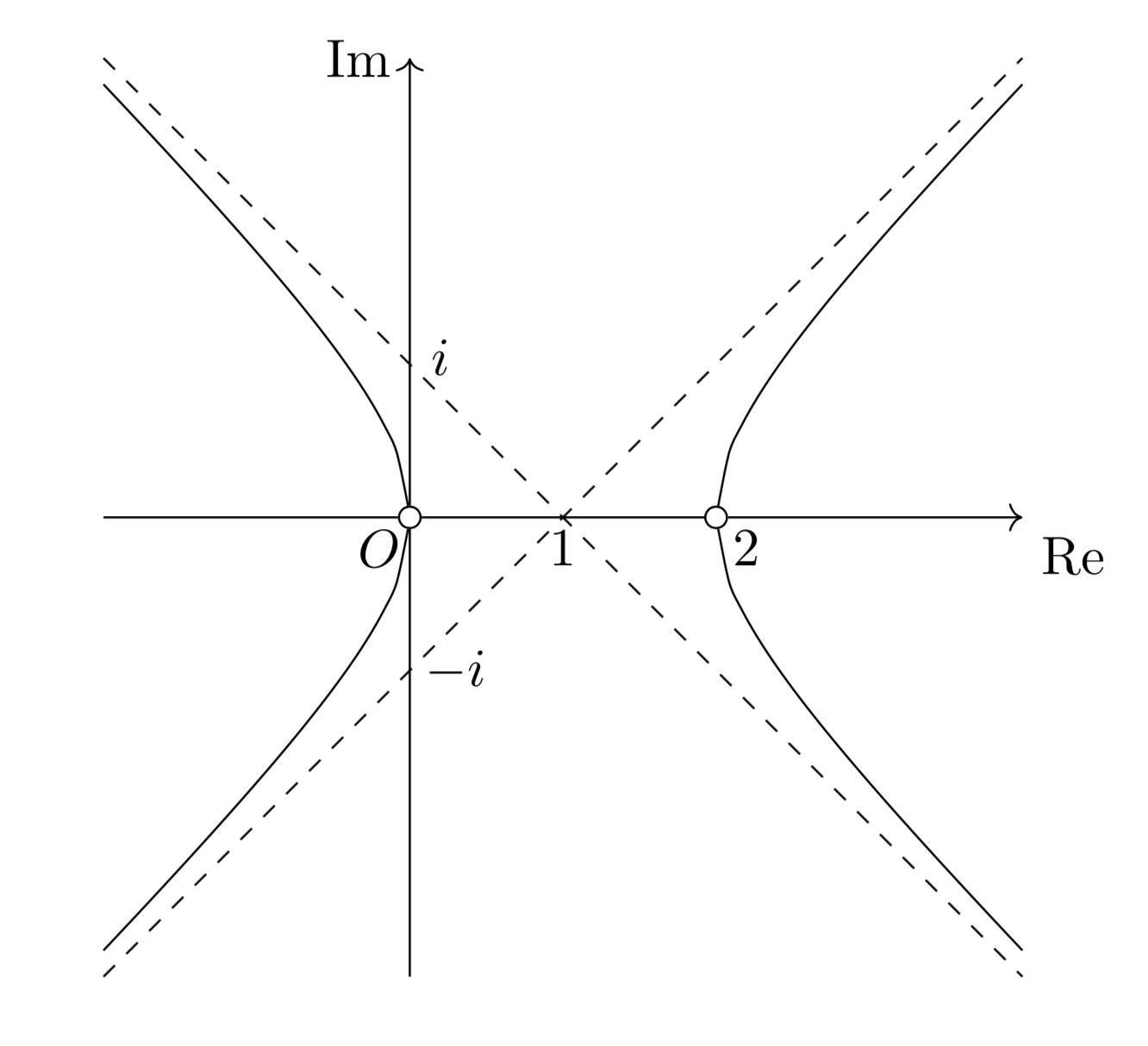
Writing , we obtain
Conversely, every point of this hyperbola with is realized by choosing and the appropriate roots and pairing. The points and are excluded.
Reviewing this paper
The original author's historical practice targets were about 90 points for the strongest medical-track candidates and about 70 for other science-track candidates. They are strategy suggestions rather than official admissions thresholds. The latter questions reward careful use of a defining equation and explicit case analysis; partial progress can be valuable when a full complex-root classification would take too long.
Related articles
- Equating rational and irrational parts: proof and worked problems
- How to simplify nested square roots, with three worked examples
- Conditional probability: the formula, information protocols, and worked examples
- Integration by parts: formulas, proof, and four useful patterns
- Triple-angle identities: remember, derive, and apply them
About the author
Koki Saito
Physician and graduate of the University of Tokyo Faculty of Medicine. Drawing on his entrance-exam experience, he explains how to choose mathematical methods and construct complete solutions.
Full profile →Have a question or spotted an error? Contact us.