Three connected topics for University of Tokyo mathematics practice
What this guide covers
The original article was written in January 2019, looking back at entrance papers and mock examinations available then. Its forecasts concerned the 2019 examination; they are not current predictions. The three topics remain useful examples of how a problem can combine several mathematical skills:
- Probability, especially probability recurrences.
- Complex-plane geometry.
- Areas and volumes of solids obtained from cross-sections.
The worked examples below come from the mock-exam problems discussed in that article. Use them to practice setting up a model, rather than assuming that a future paper must contain these topics.
1. Probability recurrences
A probability problem that involves repeated steps often also tests your understanding of sequences. Instead of enumerating every successful history, identify what information about the latest step determines which transitions remain possible. See the probability-recurrence guide for the basic method.
Problem: adjacent products divisible by three
Roll a fair six-sided die times, where , obtaining . Find the probability that is divisible by for every .
A product is divisible by exactly when at least one factor is. Thus the forbidden event is a pair of consecutive outcomes neither of which is a multiple of .
Let be the probability of a valid sequence ending in a multiple of , and the probability of a valid sequence ending in a nonmultiple. A multiple occurs with probability .
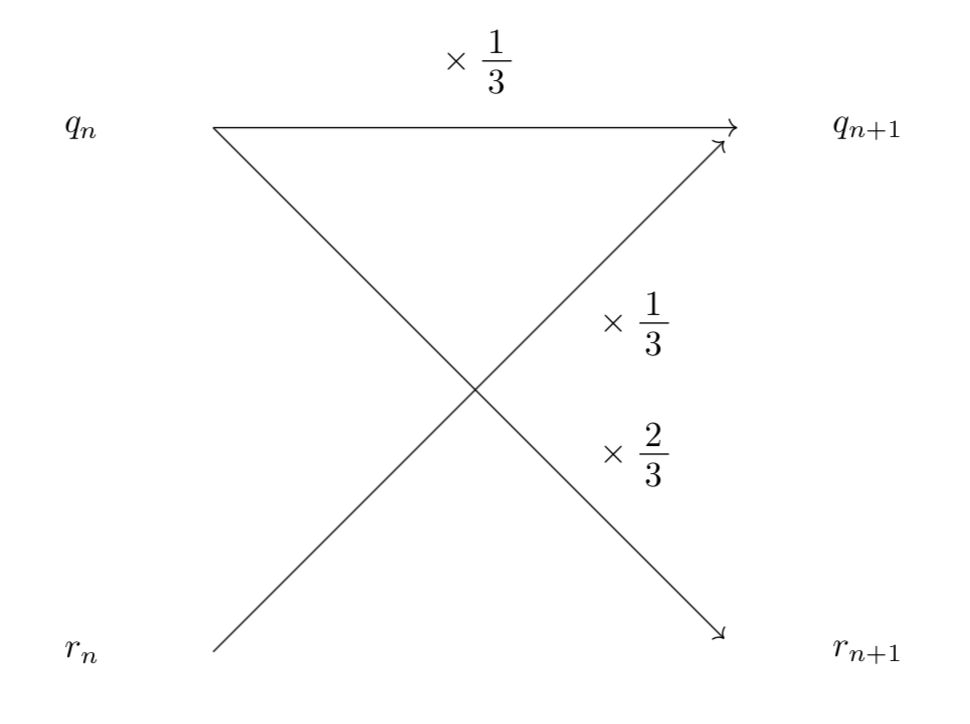
Appending one outcome gives
We can solve the system by looking for linear combinations that form geometric sequences:
The initial values therefore give
Solving,
Consequently,
For instance, : the only failure is that both outcomes are nonmultiples, with probability . This provides a quick check on the formula.
2. Complex numbers and geometric transformations
The historical guide highlighted the way complex numbers connect rotations, similarity, and loci. The following problem does not explicitly tell you to introduce a complex plane. Recognizing that option is the main strategic step.
Problem: similar isosceles triangles
Triangles and are similar, noncongruent isosceles triangles with and . Their corresponding vertices are and , respectively, and each triple is ordered counterclockwise.
Choose so that is a right isosceles triangle with , and are ordered counterclockwise. Let be the midpoint of . If are collinear, find .
Normalize the configuration
A translation, rotation, and positive scaling preserve the required angle. Put , , and write , , where
Similarity then gives and . Because , the denominator cannot vanish.
The right-angle and orientation conditions at give
Collinearity means that is real. A complex number is real exactly when it equals its conjugate, so
Substitute the expression for and clear denominators:
Using , expansion and cancellation reduce this to
The triangles are not congruent, so . Hence ; multiplying by gives . Of the two roots, only one lies above the real axis:
Its argument is , so
The useful translations were: rotation becomes multiplication, a midpoint becomes an average, and collinearity becomes a real ratio. Fewer equations than unknown coordinates need not be a problem when the requested angle is invariant across a family of configurations.
3. Solid volumes from cross-sections
For a complicated solid, fixing one coordinate can turn a spatial problem into a plane region. Determine its area as a function of the fixed coordinate, then integrate. The main work is often identifying the values at which the shape of the section changes.
Problem: shortest axis-parallel paths in a cube
Let , let be its surface, and let be the closed square pyramid with apex and base the face of .
For points , let be the shortest length of a polygonal path joining them using segments parallel to coordinate axes. For , define
Let consist of the points satisfying .
- Express in coordinates for .
- For , find the area of the section of by , taking an empty section to have area zero.
- Find the volume of .
Part 1: translate the distance definition
Any axis-parallel path must cover at least the absolute change in each coordinate, and moving along the three axes in succession attains that bound. Therefore
To reach a specified face of the cube, the other two coordinates can remain unchanged. Thus, throughout ,
Inside we have , , and , giving
Part 2: intersect a square and a diamond
At height , the condition defining becomes
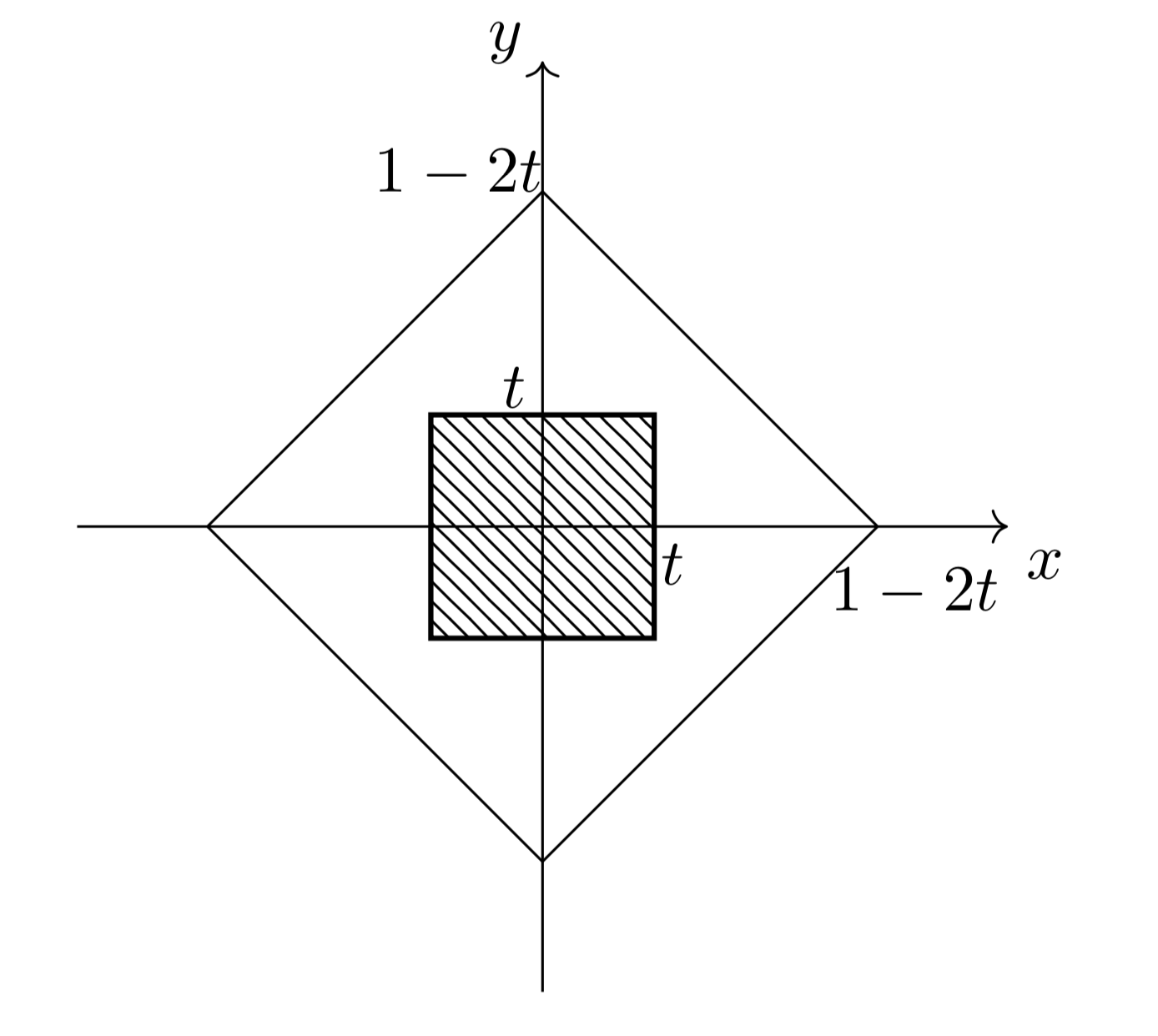
Together with the pyramid constraints, the section is
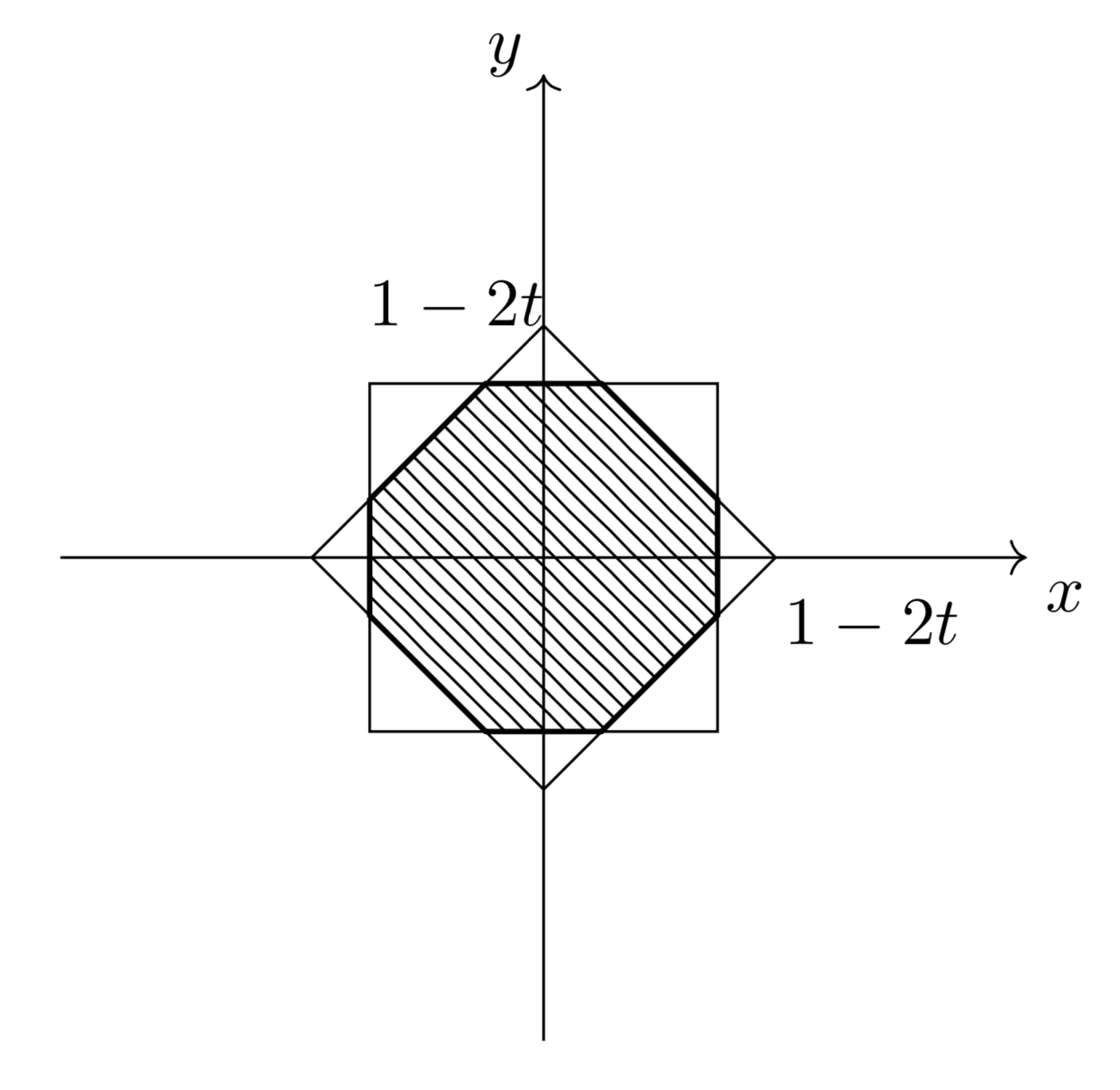
The square expands as increases, while the diamond shrinks.
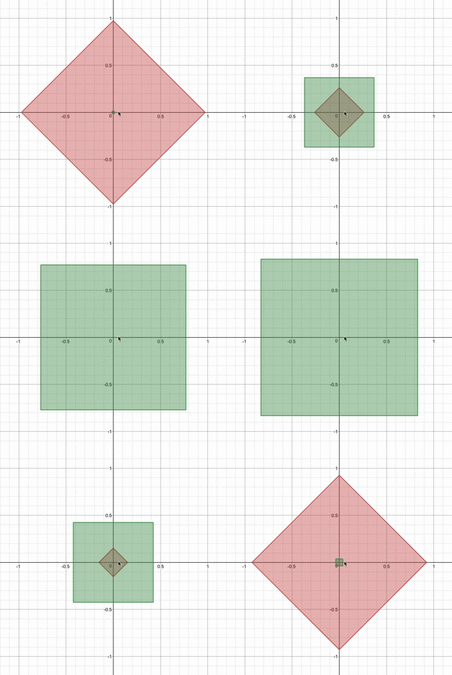
For , the square lies inside the diamond, since its corners satisfy .
For , four corner triangles are cut from the square. Each triangle has perpendicular side length .
For , the diamond lies inside the square, since .
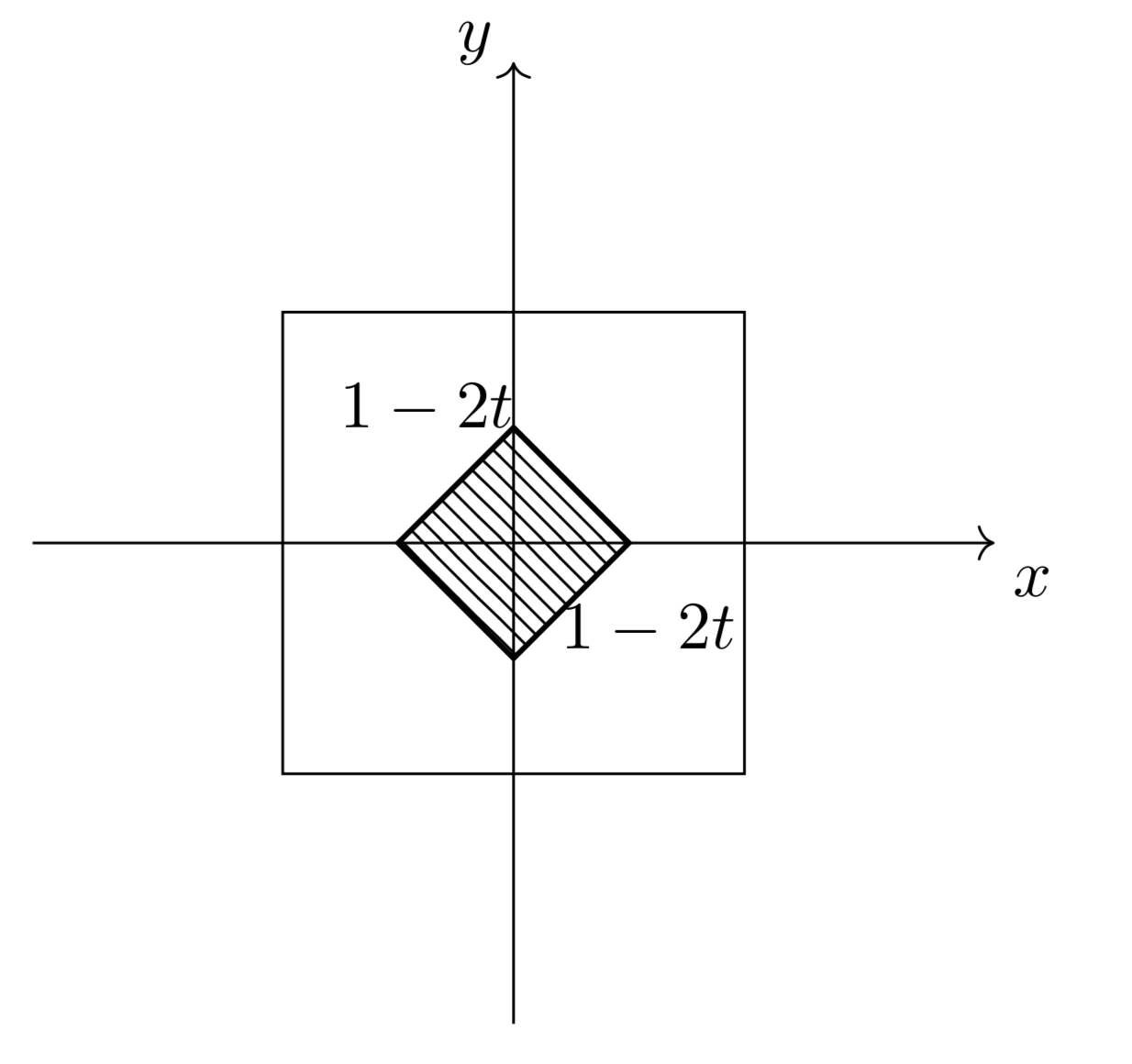
For there is no section. At it is a single point and still has area zero. Therefore
The formulas agree at every shared endpoint.
Part 3: integrate and restore symmetry
The volume inside this one pyramid is
The cube decomposes into six congruent pyramids with apex , one for each face. Their common boundaries have volume zero, and is symmetric under the corresponding coordinate permutations and sign changes. Hence
The factor six matters: integrating finds only the portion within .
What to carry into your practice
For repeated probability experiments, choose states that retain the information needed for the next step. For geometric similarity and rotation, try complex coordinates. For solids, work with cross-sections and locate every change of shape before integrating. These are ways of connecting familiar ideas, rather than a prediction of a particular future paper.
Related articles
- Equating rational and irrational parts: proof and worked problems
- How to simplify nested square roots, with three worked examples
- Conditional probability: the formula, information protocols, and worked examples
- Integration by parts: formulas, proof, and four useful patterns
- Triple-angle identities: remember, derive, and apply them
About the author
Koki Saito
Physician and graduate of the University of Tokyo Faculty of Medicine. Drawing on his entrance-exam experience, he explains how to choose mathematical methods and construct complete solutions.
Full profile →Have a question or spotted an error? Contact us.