Rock-paper-scissors probabilities: draws and the round of a final winner
Specify the random model first
Assume every player independently chooses rock, paper, or scissors with probability , independently on each round. Then labeled players have equally likely hand patterns.
For two players, six of the nine patterns give a winner and three are draws. Thus the probability of a decisive round is and the draw probability is .
For more than two players, we use the standard group rule: a round is decisive when exactly two hand types appear. Everyone showing the winning type wins that round. If all players show the same type, or all three types appear, the round is a draw.
This distinction matters: a decisive round can leave more than one winning player.
Problem 1: the draw probability for n players
Problem. Find the probability that a single round with players is a draw.
Count the complement. Choose the two types appearing in the round in ways. For a chosen pair, there are patterns, but the two patterns with every player showing the same type must be excluded. Hence the number of decisive patterns is .
These cases do not overlap because each contains exactly its chosen pair of types. Therefore
At and , this gives . For larger groups, draws become more common; counting all-three-type draws directly would be less convenient than using the complement.
Problem 2: one final winner after exactly n rounds
Three players repeatedly play under the following elimination rule. In a decisive round, all losing players leave and the winners continue. A draw leaves the player set unchanged. The process ends when exactly one player remains. Count every round, including draws.
Problem. Find the probability that the final winner is determined on round .
For three players, a round has these probabilities:
- Exactly one winner, reducing the group from three to one: .
- Exactly two winners, reducing the group from three to two: .
- A draw, leaving three players: .
For example, a unique winner is specified by choosing the player in three ways and that player's hand in three ways; the other two must both show the losing hand. Thus there are nine of the hand patterns.
With two players, a draw has probability , and a unique winner has probability .
First solution: split the possible elimination paths
Three players directly to one
There must be draws followed by a unique winner:
Three players to two, then to one
Suppose the reduction to two occurs on round , where . There are initial draws, the reduction with probability , then two-player draws and a final decisive round with probability .
For each , the probability is
There are choices of . Adding both paths gives
For , the second path is impossible and its term is zero, so the same final formula still works.
Second solution: track the unfinished states
Let be the probability that three players remain after rounds and the probability that two remain. Initially . The transition probabilities give
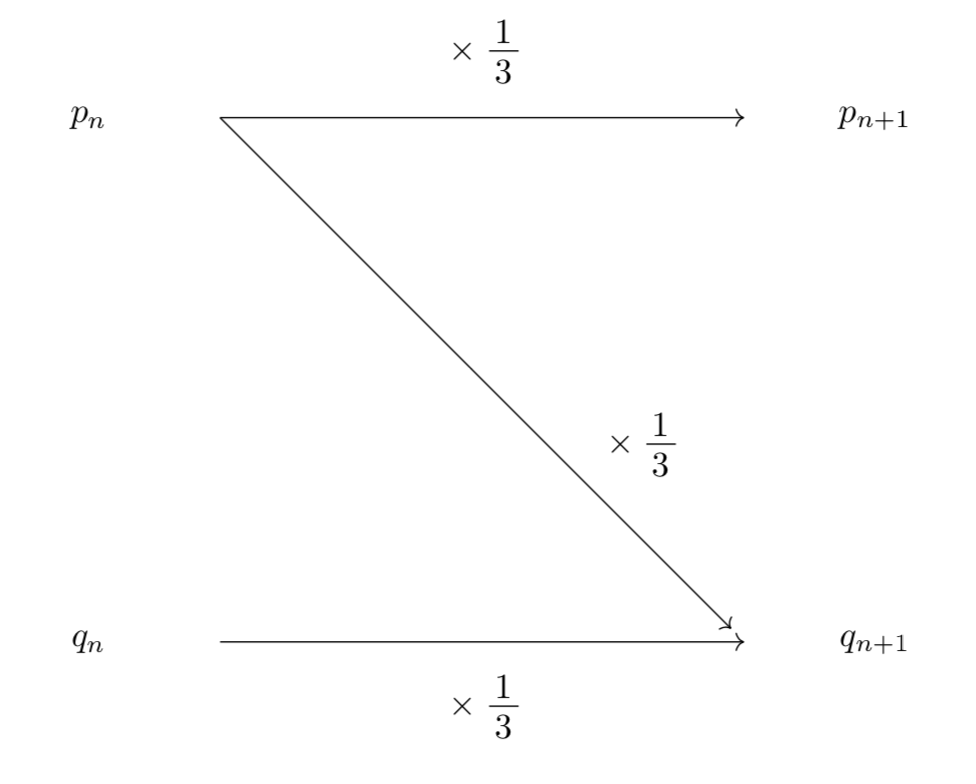
The diagram displays only the unfinished states. The omitted probability corresponds to a finished game, not to a missing possible outcome.
The first recurrence gives . Multiply the second by :
Since , this yields . A game ending on round must have been unfinished after round , so
Using time zero makes the argument work uniformly at without a separate path case.
What to watch for
Distinguish a decisive round from a unique final winner. Include all possible group-size paths and all possible times of an intermediate reduction. When draw probabilities differ between group sizes, the path sum may become a genuine geometric sum rather than a constant term repeated times.
Related: probability recurrence relations and telescoping and geometric-factor sums.
Related articles
- Equating rational and irrational parts: proof and worked problems
- How to simplify nested square roots, with three worked examples
- Conditional probability: the formula, information protocols, and worked examples
- Integration by parts: formulas, proof, and four useful patterns
- Triple-angle identities: remember, derive, and apply them
About the author
Koki Saito
Physician and graduate of the University of Tokyo Faculty of Medicine. Drawing on his entrance-exam experience, he explains how to choose mathematical methods and construct complete solutions.
Full profile →Have a question or spotted an error? Contact us.